No products in the cart.
U.S. FILLED & FINISHED | ≥99% COA-VERIFIED PURITY
LC-MS VERIFIED IDENTITY | INDEPENDENTLY TESTED
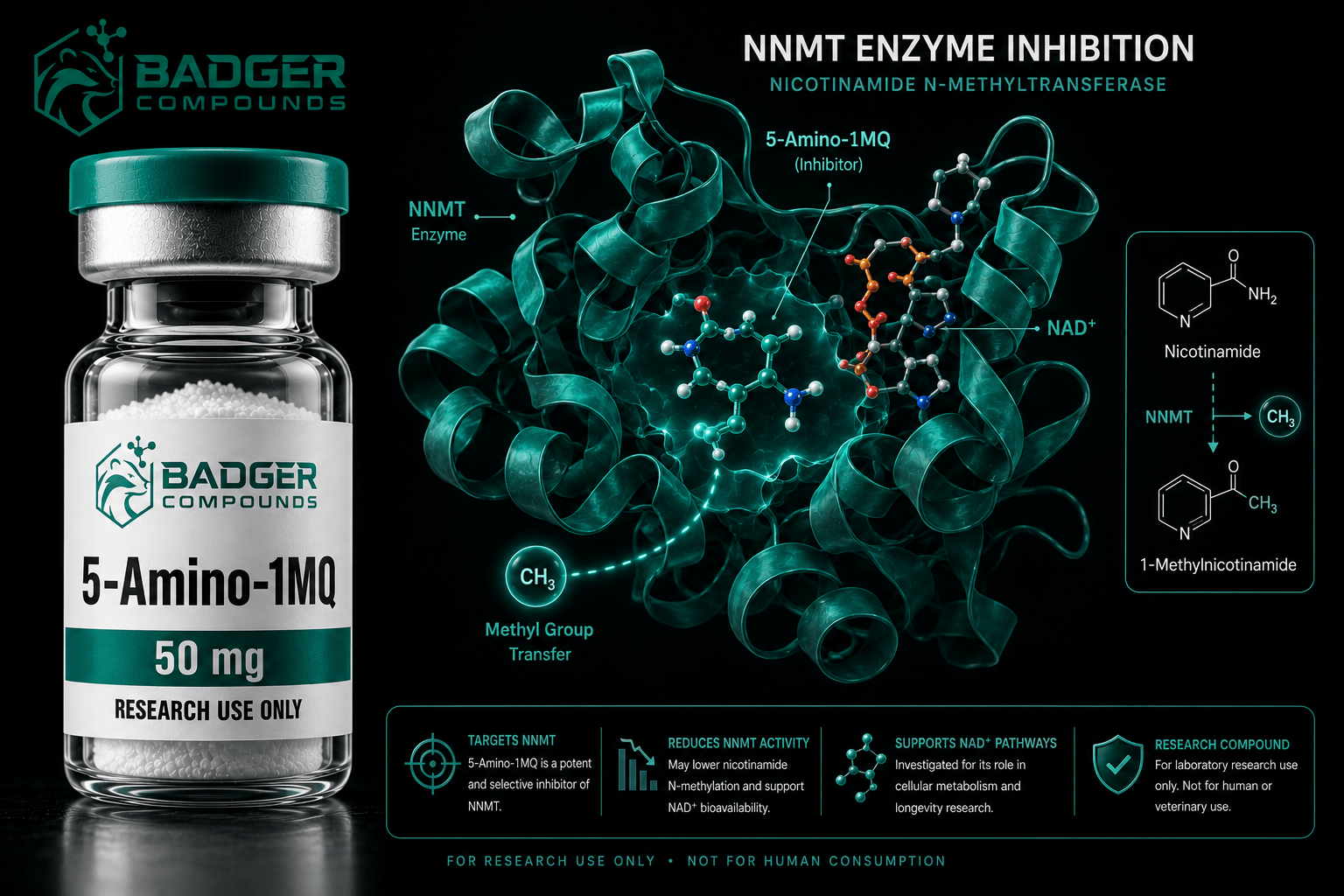
5-Amino-1MQ NNMT research centers on a small-molecule inhibitor of nicotinamide N-methyltransferase, where preclinical investigations have examined how blocking this enzyme raises intracellular NAD+ and S-adenosylmethionine levels and reshapes energy metabolism in adipose and muscle research models.
5-Amino-1MQ NNMT Research: Targeting a Metabolic Enzyme
5-Amino-1MQ (5-amino-1-methylquinolinium) is a small-molecule inhibitor of nicotinamide N-methyltransferase (NNMT), an enzyme increasingly studied as a regulator of cellular energy metabolism. Preclinical investigations have characterized how NNMT inhibition raises intracellular NAD+ and reshapes metabolism in adipose and muscle research models.
What Is 5-Amino-1MQ?
5-Amino-1MQ is a small-molecule research compound, not a peptide. It belongs to a class of methylquinolinium scaffolds developed as selective, membrane-permeable inhibitors of nicotinamide N-methyltransferase. Structurally, it is a quinolinium ring bearing an amino substitution at the 5-position and a methyl group at the ring nitrogen, a configuration that research identified as combining high cell permeability with selectivity for its target enzyme.
The compound emerged from a structure-activity program aimed at validating NNMT as a metabolic drug target. Because it does not inhibit structurally related SAM-dependent methyltransferases or enzymes in the NAD+ salvage pathway, 5-Amino-1MQ has served as a relatively clean pharmacological tool for isolating the specific consequences of blocking NNMT activity in cell and animal models.
The NNMT Enzyme and Why It Matters
Nicotinamide N-methyltransferase catalyzes the transfer of a methyl group from S-adenosylmethionine (SAM) to nicotinamide, a form of vitamin B3, producing 1-methylnicotinamide (1-MNA) and S-adenosylhomocysteine. This single reaction sits at an important metabolic crossroads because both of its substrates are central currencies of cellular metabolism. Nicotinamide is a precursor of NAD+, the cofactor that links cellular redox state to energy production, and SAM is the principal methyl donor for reactions including histone methylation.
The foundational insight came from Kraus and colleagues (2014), publishing in Nature, who identified NNMT as the most strongly reciprocally regulated gene in adipose tissue models of altered insulin sensitivity. Their research reported that NNMT expression is elevated in the white adipose tissue and liver of obese and diabetic mice, and that knocking down NNMT protected against diet-induced obesity by increasing cellular energy expenditure. This work established NNMT as a candidate metabolic target and set the stage for small-molecule inhibitor development.
NAD+ Availability
By reducing methylation of nicotinamide, NNMT inhibition is associated with increased intracellular NAD+, a central cofactor in energy metabolism, in research models.
SAM and Methylation
NNMT inhibition raises SAM levels, affecting histone methylation and polyamine flux, mechanisms tied to energy expenditure in adipose research models.
Enzyme Selectivity
5-Amino-1MQ was reported not to inhibit related methyltransferases or NAD+ salvage enzymes, supporting its use as a selective research tool.
Research framing: All findings referenced in this post derive from preclinical cell-based and animal research models. Human clinical data on 5-Amino-1MQ has not been reported. 5-Amino-1MQ is supplied by Badger Compounds for laboratory research use only and is not intended for human or veterinary use. No therapeutic conclusions should be drawn from the preclinical data discussed here.
Adipocyte and Obesity Research
The defining study of 5-Amino-1MQ specifically was reported by Neelakantan and colleagues (2018) in Biochemical Pharmacology. This research characterized the permeability, selectivity, and physiological effects of the methylquinolinium inhibitor series and tested a potent member of the series in diet-induced obese mice. In cultured adipocytes, the inhibitor reduced intracellular 1-MNA, increased intracellular NAD+ and SAM, and suppressed lipogenesis. In diet-induced obese mice, systemic administration significantly reduced body weight and white adipose mass, decreased adipocyte size, and lowered plasma total cholesterol.
A notable detail from that study is that the inhibitor produced these changes without reducing total food intake and without observable adverse effects in the model, which the authors interpreted as evidence that the metabolic effect operated through altered energy handling rather than appetite suppression. A later study by Dimet-Wiley and colleagues (2022) in Scientific Reports, which explicitly used 5-amino-1-methylquinolinium, examined the compound combined with a low-fat diet and reported that this combination normalized adiposity in obese mice while establishing a distinct gut microbiome profile.
Aged Muscle and Sarcopenia Research
A distinct and more recent line of research has examined NNMT inhibition in the context of aging skeletal muscle. Dimet-Wiley and colleagues (2024), publishing in Scientific Reports, treated aged mice with an NNMT inhibitor, intensive exercise, or both, and measured a range of muscle function endpoints. The research reported that NNMT-inhibitor-treated aged sedentary mice showed roughly 40 percent greater grip strength than sedentary controls, and that the effects of the inhibitor and exercise were additive, with the combination producing about a 60 percent increase in grip strength relative to controls.
This muscle research reflects the same underlying rationale as the metabolic work: skeletal muscle NAD+ declines with age, and NNMT inhibition is proposed to help preserve NAD+ availability in muscle tissue. It is worth noting for transparency that the muscle studies were conducted by a research group affiliated with a company developing NNMT inhibitors, a relevant consideration when weighing preclinical findings. As with the metabolic literature, these results are from animal models and have not been established in humans.
| Research Model | System | Reported Observation |
|---|---|---|
| NNMT target validation | Adipose knockdown, DIO mice (Kraus 2014) | NNMT knockdown increased energy expenditure and protected against obesity |
| Cultured adipocytes | 3T3-L1 cells (Neelakantan 2018) | Reduced 1-MNA, increased NAD+ and SAM, suppressed lipogenesis |
| Diet-induced obesity | High-fat-diet mice (Neelakantan 2018) | Reduced body weight, adipose mass, adipocyte size, plasma cholesterol |
| Diet combination | DIO mice plus low-fat diet (Dimet-Wiley 2022) | Normalized adiposity; distinct gut microbiome profile |
| Aged skeletal muscle | 24-month-old mice (Dimet-Wiley 2024) | Increased grip strength; additive with exercise |
5-Amino-1MQ is a research-use-only compound with no reported human clinical data. Badger Compounds supplies 5-Amino-1MQ exclusively for qualified research applications in controlled laboratory settings. The preclinical data summarized here does not establish safety or efficacy in any human population.
Mechanism Summary: The NAD+ and SAM Connection
The unifying thread across the adipose and muscle research is that NNMT sits upstream of two metabolic currencies whose availability declines in obesity and aging. By consuming nicotinamide and SAM, NNMT activity can lower the pools available for NAD+ synthesis and for methylation reactions. Inhibiting the enzyme is proposed to preserve these pools, and the preclinical literature associates this with increased energy expenditure in adipose tissue and improved functional measures in aged muscle.
A comprehensive review by Liu and colleagues (2021) in BioMed Research International surveyed the NNMT literature in obesity and type 2 diabetes and emphasized an important caveat that applies to this entire field: the exact mechanisms are not yet fully understood, and no clinical trials targeting NNMT have been reported. 5-Amino-1MQ should therefore be understood as a research tool for probing an intriguing but still-emerging target, not as a validated intervention.
Small Molecule, Not a Peptide
5-Amino-1MQ is a synthetic small-molecule enzyme inhibitor. Its mechanism and handling differ fundamentally from the peptides often grouped alongside it in research catalogs.
Preclinical Stage Only
All current evidence derives from cell and animal models. No human clinical trials targeting NNMT have been reported, and efficacy in humans remains unestablished.
Research Pathways Associated with 5-Amino-1MQ
Preclinical literature has examined 5-Amino-1MQ and NNMT inhibition across several interconnected research contexts:
NNMT enzyme inhibition NAD+ metabolism S-adenosylmethionine (SAM) flux Adipocyte lipogenesis Energy expenditure Histone methylation and polyamine flux Skeletal muscle and sarcopenia Insulin sensitivity in research models5-Amino-1MQ – Research Grade, ≥99% (HPLC)
Badger Compounds supplies 5-Amino-1MQ as a research compound, six-round independently tested per batch with publicly viewable COAs. For qualified laboratory research use only.
View 5-Amino-1MQ- Kraus D, Yang Q, Kong D, et al. Nicotinamide N-methyltransferase knockdown protects against diet-induced obesity. Nature. 2014;508(7495):258-262. PMID 24717514
- Neelakantan H, Vance V, Wetzel MD, et al. Selective and membrane-permeable small molecule inhibitors of nicotinamide N-methyltransferase reverse high fat diet-induced obesity in mice. Biochem Pharmacol. 2018;147:141-152. PMID 29155147
- Dimet-Wiley A, Wu Q, Wiley JT, et al. Reduced calorie diet combined with NNMT inhibition establishes a distinct microbiome in DIO mice. Sci Rep. 2022;12(1):484. PMID 35013352
- Dimet-Wiley AL, Latham CM, Brightwell CR, et al. Nicotinamide N-methyltransferase inhibition mimics and boosts exercise-mediated improvements in muscle function in aged mice. Sci Rep. 2024;14(1):15554. PMID 38969654
- Liu JR, Deng ZH, Zhu XJ, et al. Roles of nicotinamide N-methyltransferase in obesity and type 2 diabetes. Biomed Res Int. 2021;2021:9924314. PMID 34368359
Disclaimer: 5-Amino-1MQ is supplied by Badger Compounds for laboratory and in vitro research use only. It is not intended for human or veterinary use, and no product sold by Badger Compounds is approved for therapeutic, diagnostic, or clinical application. All research findings referenced in this post are derived from preclinical cell-based and animal model studies. No clinical efficacy or safety conclusions should be drawn from the data summarized here.