No products in the cart.
U.S. FILLED & FINISHED | ≥99% COA-VERIFIED PURITY
LC-MS VERIFIED IDENTITY | INDEPENDENTLY TESTED
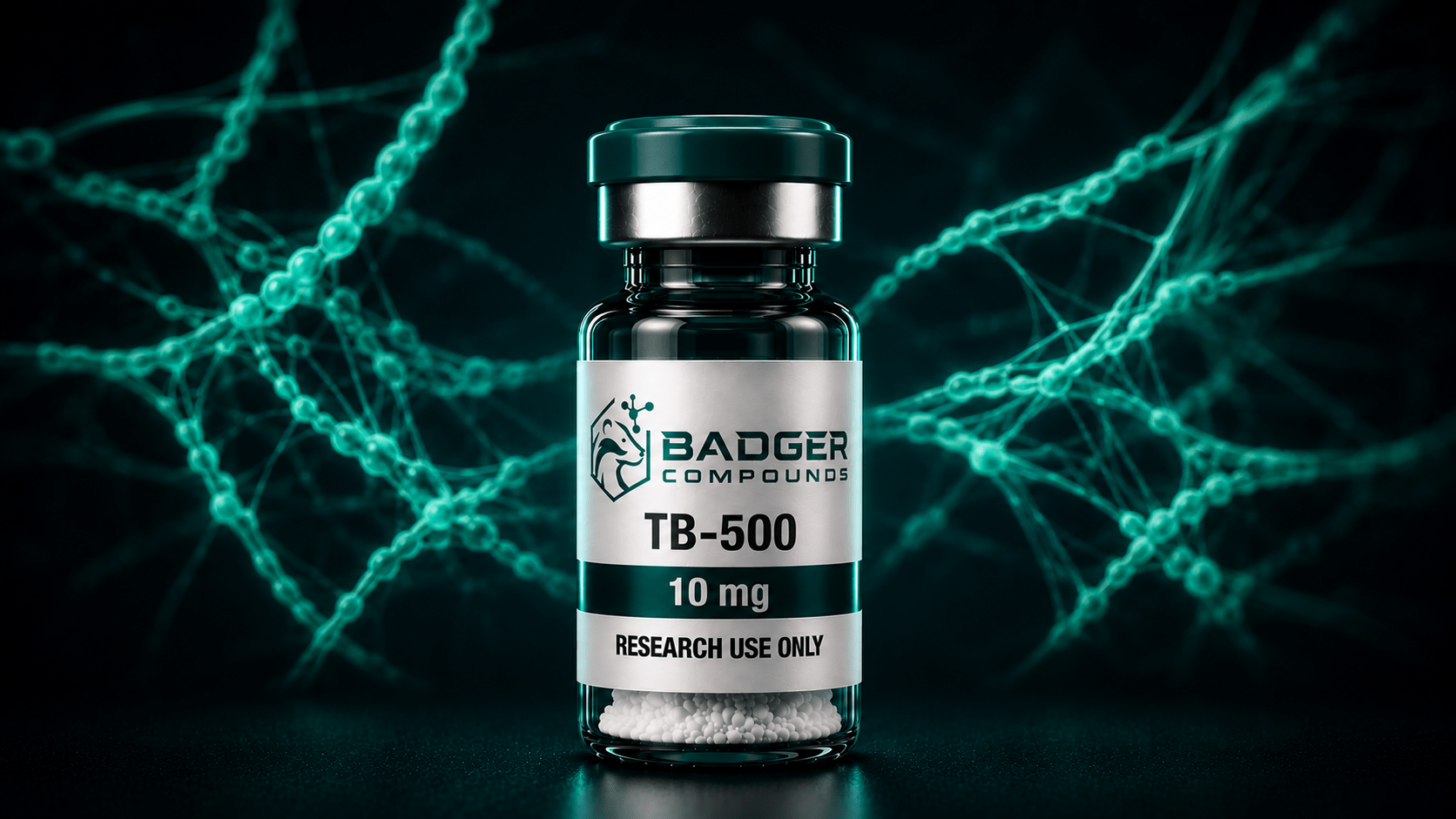
TB-500 is one of the most frequently paired research peptides in tissue-repair investigation, usually discussed alongside BPC-157. This guide gives TB-500 its own dedicated treatment: what it actually is, its relationship to the naturally occurring protein thymosin beta-4, its proposed mechanisms, and an honest look at the evidence, including one of the few genuine human randomized trials in this compound class.
TB-500 Research: Thymosin Beta-4 Mechanisms and Evidence
TB-500 almost always appears in the same sentence as BPC-157, but it is a genuinely distinct compound with its own origin, mechanism, and evidence base. Here is TB-500 on its own terms: what it is, how it relates to a naturally occurring protein your own body already makes, and what the research actually shows.
What Is TB-500?
TB-500 is a synthetic peptide corresponding to the active region of thymosin beta-4 (Tβ4), a naturally occurring 43-amino-acid protein present in nearly every cell type in the body except red blood cells. Thymosin beta-4 is best known as the major actin-sequestering protein in mammalian cells, meaning it binds and regulates the pool of free G-actin monomers that cells use to build and remodel their internal skeleton [1]. TB-500 was developed as a shorter, synthetic tool for studying this same biology without requiring the full-length protein.
Research framing: This article is intended for educational and research-context discussion only. TB-500 is a research compound sold for laboratory investigation only. This content does not provide medical advice, dosing guidance, or treatment recommendations of any kind.
How TB-500 Relates to Thymosin Beta-4
Research has shown that thymosin beta-4’s biological activities can be reproduced using short synthetic fragments corresponding to specific active sites within the full protein, rather than requiring the entire 43-amino-acid sequence. Work characterizing these active sites identified the region responsible for cell migration and wound-repair activity, which is the basis for TB-500 as a research tool: a defined, synthesizable fragment that captures a specific functional domain of the parent protein [2].
Proposed Mechanisms of Action
Actin Sequestration
The core, defining biochemical activity of thymosin beta-4: binding free G-actin monomers and regulating the dynamics of the cytoskeleton [1].
Cell Migration
By regulating actin dynamics, thymosin beta-4-related peptides have been studied for their role in promoting the movement of cells, including endothelial cells and fibroblasts, into injury sites.
ILK-Akt Survival Signaling
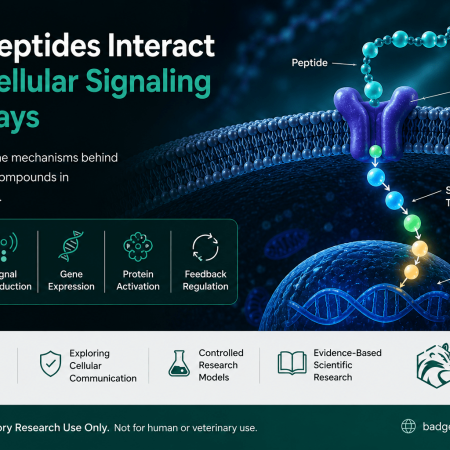
Foundational cardiac research identified a functional complex between thymosin beta-4, PINCH, and integrin-linked kinase (ILK), activating the survival kinase Akt in cardiac cells [3].
Angiogenesis
Thymosin beta-4-related research has been associated with new blood vessel formation, studied particularly in cardiac and vascular injury models.
Where TB-500 and Thymosin Beta-4 Have Been Studied
Thymosin beta-4 biology has been examined across several tissue systems, with cardiac and dermal wound research forming the deepest body of literature. Foundational work established that thymosin beta-4 promotes cardiomyocyte migration and survival after coronary artery ligation in mouse models, upregulating ILK and Akt activity and improving cardiac function following experimental myocardial injury [3]. This cardiac research line has continued for two decades and is one of the more extensively developed areas of the broader Tβ4 literature.
Thymosin beta-4’s cardiac research program includes something genuinely rare in this compound class: a real human randomized controlled trial. That does not make the compound proven or approved, but it does mean the evidence picture here looks different from many other research peptides.
A Genuine Human Trial
A 2025 study evaluated recombinant human thymosin beta-4 in both a mouse ischemia-reperfusion model and in a randomized, placebo-controlled, double-blind clinical trial involving 96 patients with acute ST-segment elevation myocardial infarction (STEMI) following percutaneous coronary intervention. Patients receiving thymosin beta-4 within 8 hours of their procedure showed a significant reduction in infarcted heart area at 90-day follow-up compared to placebo, and mouse studies in the same paper linked the effect to activation of the ErbB2 signaling pathway [4]. This is a meaningfully more advanced evidence stage than most compounds discussed in this research library reach, though it remains a single trial, is specific to recombinant thymosin beta-4 rather than the synthetic TB-500 fragment used in most laboratory research, and does not constitute regulatory approval for any use.
TB-500 vs the Full Thymosin Beta-4 Protein
| Property | Thymosin Beta-4 (full protein) | TB-500 (synthetic fragment) |
|---|---|---|
| Length | 43 amino acids | Shorter fragment corresponding to an active region |
| Origin | Naturally occurring, produced throughout the body | Synthetic research tool |
| Research purpose | Basic biology of actin regulation and tissue repair | Studying the same activity with a simpler, synthesizable molecule |
Research Concepts Related to TB-500
Actin sequestration Cytoskeletal dynamics Cell migration ILK-Akt signaling Cardiac repair models AngiogenesisRelated Reading
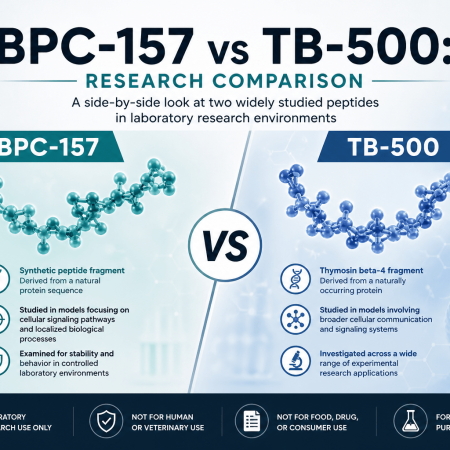
For how TB-500 compares directly to BPC-157, and why the two are so often studied together, see our guides on BPC-157 vs TB-500 and BPC-157 and TB-500 research.
TB-500 – Research Grade, ≥99% (HPLC)
Badger Compounds supplies TB-500 as a lyophilized research peptide, six-round independently tested per batch with publicly viewable COAs. For qualified laboratory research use only.
View TB-500- Goldstein AL, Hannappel E, Kleinman HK. Thymosin beta4: actin-sequestering protein moonlights to repair injured tissues. Trends Mol Med. 2005;11(9):421-429. PMID 16099219
- Sosne G, Qiu P, Goldstein AL, Wheater M. Biological activities of thymosin beta4 defined by active sites in short peptide sequences. FASEB J. 2010;24(7):2144-2151. PMID 20181939
- Bock-Marquette I, Saxena A, White MD, Dimaio JM, Srivastava D. Thymosin beta4 activates integrin-linked kinase and promotes cardiac cell migration, survival and cardiac repair. Nature. 2004;432(7016):466-472. PMID 15565145
- Zhang Y, Dong Q, Bian X, Qiao Z, Cui C, et al. Recombinant human thymosin beta 4 improves ischemic cardiac dysfunction in mice and patients with acute ST-segment elevation myocardial infarction after reperfusion. Cardiovasc Res. 2025;121(17):2747-2758. PMID 41229390
Disclaimer: This article is for informational and educational purposes only. Products and compounds discussed are intended for research use only and are not for human consumption, veterinary use, clinical use, diagnostic use, food use, supplement use, pharmaceutical use, cosmetic use, or any consumer application. Statements have not been evaluated by the FDA. This content does not provide medical advice, treatment guidance, dosing information, or recommendations for personal use.