No products in the cart.
U.S. FILLED & FINISHED | ≥99% COA-VERIFIED PURITY
LC-MS VERIFIED IDENTITY | INDEPENDENTLY TESTED


MOTS-c mitochondrial research has emerged as one of the most compelling areas of investigation in modern peptide biology. Unlike most peptides, which are encoded in the nuclear genome, MOTS-c is a mitochondria-derived peptide encoded within the mitochondrial genome itself – a distinction that has made it a uniquely interesting subject for researchers studying cellular energy regulation, metabolic signaling, and longevity-related biology.
This article explores what MOTS-c is, how it interacts with mitochondrial and metabolic signaling pathways, and what current areas of preclinical investigation are revealing about its biological role.
Research focus: This article is intended for educational and research-context discussion only. MOTS-c is a research compound sold for laboratory investigation only. This content does not provide medical advice, dosing guidance, or treatment recommendations of any kind.
What Is MOTS-c?
MOTS-c (Mitochondrial Open Reading Frame of the Twelve S rRNA type-c) is a 16-amino acid peptide encoded within the 12S ribosomal RNA gene of the mitochondrial genome. It was first identified and characterized by researchers at the University of Southern California in 2015, and has since become a significant subject of investigation in mitochondrial biology, metabolic research, and aging science.
What makes MOTS-c particularly notable in research is its origin. The vast majority of biologically active peptides studied in research settings are encoded by nuclear DNA. MOTS-c is one of a small class of mitochondria-derived peptides (MDPs) – compounds that are transcribed and translated directly within the mitochondria. This unique origin is directly relevant to its proposed biological functions, which appear to be closely tied to mitochondrial activity and cellular energy homeostasis.
MOTS-c at a Glance
MOTS-c is a 16-amino acid mitochondria-derived peptide encoded within the mitochondrial genome. It is one of the few known peptides of mitochondrial origin and is primarily investigated in relation to cellular energy regulation, metabolic signaling, and age-related biological research.
The Mitochondrial Connection
To understand why MOTS-c mitochondrial research has attracted significant scientific attention, it helps to understand the role mitochondria play in cellular biology. Mitochondria are the primary site of ATP production in eukaryotic cells – they generate the energy currency that powers virtually every cellular process. Beyond energy production, mitochondria are involved in calcium signaling, apoptosis regulation, reactive oxygen species (ROS) management, and cellular stress response.
The fact that MOTS-c is encoded within the mitochondrial genome and appears to respond to mitochondrial stress signals has led researchers to investigate it as a potential mediator of mitochondria-to-nucleus communication – a signaling axis sometimes referred to as retrograde signaling. This positions MOTS-c as a research compound at the intersection of mitochondrial biology, metabolic regulation, and cellular aging research.
Pathway 1
Energy Regulation
MOTS-c research has focused heavily on its role in cellular energy homeostasis. Preclinical investigations have examined how MOTS-c interacts with AMPK signaling – a central regulator of cellular energy balance that responds to changes in the AMP to ATP ratio.
Pathway 2
Metabolic Signaling
Studies have investigated MOTS-c in relation to glucose metabolism and insulin signaling in research models. Preclinical data suggests involvement in pathways related to glucose uptake and metabolic flexibility in skeletal muscle tissue models.
Pathway 3
Cellular Stress Response
MOTS-c appears to be upregulated in response to mitochondrial stress signals. Research has examined its role in activating adaptive cellular stress response pathways, including those involved in oxidative stress management and mitohormesis.
Pathway 4
Nuclear Translocation
One of the more distinctive findings in MOTS-c research is its capacity to translocate from the mitochondria to the nucleus in response to stress. This nuclear translocation behavior has led to investigations of its role in gene expression regulation.
Pathway 5
Aging and Longevity
MOTS-c levels have been observed to decline with age in research models. This age-dependent pattern has made it a subject of significant interest in longevity research, particularly in studies examining the relationship between mitochondrial function and biological aging.
Pathway 6
Exercise and Muscle Research
Research has identified MOTS-c as a exercise-responsive peptide. Studies have examined how physical activity influences MOTS-c levels and how it may interact with skeletal muscle metabolism and physical performance in preclinical models.
MOTS-c and AMPK Pathway Research
One of the most investigated aspects of MOTS-c biology is its interaction with the AMPK (AMP-activated protein kinase) signaling pathway. AMPK is often described as a master regulator of cellular energy homeostasis – it is activated when cellular energy levels fall and triggers a cascade of metabolic adaptations designed to restore energy balance.
Preclinical research has suggested that MOTS-c may activate AMPK signaling, which would position it as a potential upstream regulator of metabolic adaptation. AMPK activation is associated with increased glucose uptake, enhanced fatty acid oxidation, inhibition of energy-consuming anabolic processes, and mitochondrial biogenesis – all areas that are actively studied in metabolic and longevity research.
AMPK Pathway Research Areas
- Glucose uptake and insulin sensitivity models
- Fatty acid oxidation and lipid metabolism
- Mitochondrial biogenesis signaling
- Cellular energy homeostasis regulation
- Metabolic flexibility in skeletal muscle
- mTOR pathway interaction research
Why AMPK Is Relevant to Aging Research
- AMPK activity declines with age in research models
- Associated with longevity pathways in multiple organisms
- Regulates autophagy and cellular cleanup processes
- Interacts with sirtuins and NAD+ metabolism
- Studied in caloric restriction mimetic research
- Central to mitohormesis pathway investigations
MOTS-c vs Other Mitochondria-Derived Peptides
MOTS-c belongs to a broader class of compounds known as mitochondria-derived peptides (MDPs). Understanding how MOTS-c compares to other MDPs helps researchers contextualize its unique research profile and identify the most appropriate investigational framework for their study design.
| Peptide | Origin | Primary Research Focus | Key Pathway |
|---|---|---|---|
| MOTS-c | 12S rRNA gene, mitochondrial genome | Metabolic regulation, energy homeostasis, aging | AMPK, glucose metabolism, nuclear translocation |
| Humanin | 16S rRNA gene, mitochondrial genome | Neuroprotection, cell survival, insulin signaling | STAT3, IGF-1, apoptosis inhibition |
| SS-31 (Elamipretide) | Synthetic – targets mitochondrial membrane | Mitochondrial membrane integrity, oxidative stress | Cardiolipin interaction, ROS reduction |
| SHLP2 | 16S rRNA gene, mitochondrial genome | Metabolic regulation, cytoprotection | Insulin signaling, mitochondrial biogenesis |
Current Areas of MOTS-c Investigation
MOTS-c mitochondrial research continues to expand as investigators study its behavior across a range of controlled experimental frameworks. The following represent the most active areas currently documented in peer-reviewed literature.
Metabolic Research Models
A significant body of MOTS-c research has examined its effects in metabolic research models, including investigations related to glucose homeostasis, insulin sensitivity, and diet-induced metabolic disruption in preclinical animal studies.
Aging and Longevity Research
The age-dependent decline in circulating MOTS-c levels observed in research models has made it a subject of growing interest in longevity biology. Studies have examined whether exogenous MOTS-c supplementation in research models can influence age-related biological markers.
Exercise Biology Research
Research has identified that MOTS-c is released from skeletal muscle in response to exercise stimuli. Investigators have examined how exercise-induced MOTS-c expression relates to metabolic adaptation, physical performance, and mitochondrial biogenesis signaling.
Stress Response Research
The nuclear translocation behavior of MOTS-c under cellular stress conditions has prompted research into its role as a regulator of stress-responsive gene expression. Studies have examined how MOTS-c interacts with nuclear transcription factor pathways under various stress conditions.
Inflammation Research
Preclinical investigations have examined MOTS-c in relation to inflammatory signaling pathways. Research has explored its potential interactions with cytokine regulation and immune cell function in tissue and systemic inflammation models.
Bone and Muscle Research
Recent research has begun examining MOTS-c in the context of musculoskeletal biology. Studies have investigated its role in osteoblast function, muscle metabolism, and age-related changes in skeletal tissue in preclinical research models.
Why Mitochondrial Research Has Become a Major Scientific Focus
The growing scientific interest in MOTS-c is part of a broader shift in research focus toward mitochondrial biology as a central theme in aging, metabolic disease, and cellular health research. For decades, mitochondria were studied primarily in the context of energy production. More recent research has revealed that mitochondria function as dynamic signaling organelles that communicate with the rest of the cell and respond to a wide range of environmental and metabolic signals.
The discovery of mitochondria-derived peptides like MOTS-c has added a new dimension to this picture – one in which the mitochondria not only respond to cellular signals but actively produce bioactive molecules that regulate metabolism, stress responses, and potentially aging biology. This has made MDPs one of the more exciting frontiers in current peptide research.
Key Research Takeaway
MOTS-c represents a new class of biologically active compounds – mitochondria-derived peptides encoded within the mitochondrial genome itself. Its investigation spans metabolic regulation, cellular stress response, aging biology, and exercise physiology, making it one of the most multidimensional research peptides currently under investigation.
What Researchers Should Know When Sourcing MOTS-c
Because MOTS-c is a relatively short peptide (16 amino acids), its synthesis and purification require careful analytical verification to confirm both sequence identity and purity. As with all research peptides, the quality of the compound used directly affects the reliability of experimental outcomes.
Key Quality Considerations
- Minimum 99% HPLC purity confirmation
- Mass spectrometry identity verification
- Correct molecular weight: approximately 2174 Da
- Lyophilized format for long-term stability
- Lot-specific Certificate of Analysis
- Independent third-party laboratory verification
Storage and Handling in Research Settings
- Store lyophilized powder at -20 degrees Celsius
- Protect from light and moisture exposure
- Reconstitute in sterile water or appropriate buffer
- Avoid repeated freeze-thaw cycles after reconstitution
- Use within recommended timeframe after reconstitution
- Document lot number in all experimental records
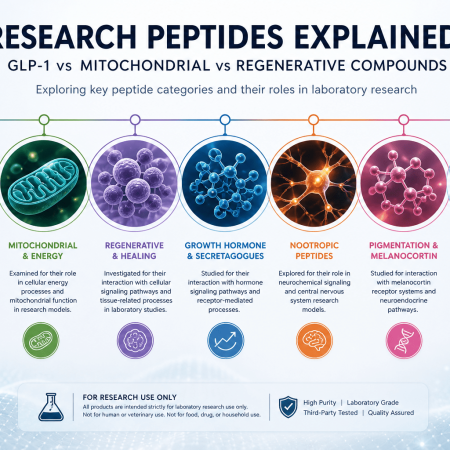
Related reading: For a broader overview of how mitochondrial peptides compare to other research peptide categories, see our article on Research Peptides Explained: GLP-1 vs Mitochondrial vs Regenerative Compounds.
Final Thoughts
MOTS-c mitochondrial research represents one of the most scientifically novel areas of current peptide investigation. As a mitochondria-derived peptide with demonstrated involvement in AMPK signaling, metabolic regulation, cellular stress response, and age-related biology, MOTS-c occupies a unique position in the research landscape – one that bridges mitochondrial biology, metabolic science, and longevity research in a single investigational compound.
As preclinical research in this area continues to mature, MOTS-c is likely to remain a central subject of investigation for researchers studying the mitochondrial basis of aging, metabolic regulation, and cellular resilience. Researchers sourcing MOTS-c for investigational use should prioritize analytical transparency, sequence verification, and independent CoA documentation to ensure experimental integrity.
Related reading: To understand how third-party testing and CoA verification apply to mitochondrial research compounds like MOTS-c, see our article on Why Third-Party Testing Matters in Research Compounds.
Explore Mitochondrial Research Compounds
MOTS-c and other mitochondria-derived peptides are available in our research compound catalog, each supported by independent third-party CoA documentation and our 6x testing standard.
View Longevity and Cellular Research CompoundsReferences
[1] Lee C, et al. The mitochondrial-derived peptide MOTS-c promotes metabolic homeostasis and reduces obesity and insulin resistance. Cell Metab. 2015;21(3):443-454. View via PubMed
[2] Reynolds JC, et al. MOTS-c is an exercise-induced mitochondrial-encoded regulator of age-dependent physical decline and muscle homeostasis. Nat Commun. 2021;12(1):470. View via PubMed
[3] Kim SJ, et al. Mitochondria-derived peptides in aging and healthspan. J Clin Invest. 2022;132(9):e158450. View via PubMed
[4] Bhullar KS, et al. MOTS-c: A mitochondrial-encoded peptide with pleiotropic effects on metabolism and longevity. Ageing Res Rev. 2023;91:102059. View via PubMed
[5] Miller B, et al. Mitochondrial-derived peptides in aging and disease. Ageing Res Rev. 2023;84:101821. View via PubMed
[6] Zempo H, et al. A promoter variant of the MOTS-c gene associated with myocardial infarction risk. J Hum Genet. 2021;66(3):281-286. View via PubMed
Disclaimer: This article is for informational and educational purposes only. Products and compounds discussed are intended for research use only and are not for human consumption, veterinary use, clinical use, diagnostic use, food use, supplement use, pharmaceutical use, cosmetic use, or any consumer application. Statements have not been evaluated by the FDA. This content does not provide medical advice, treatment guidance, dosing information, or recommendations for personal use.