No products in the cart.
U.S. FILLED & FINISHED | ≥99% COA-VERIFIED PURITY
LC-MS VERIFIED IDENTITY | INDEPENDENTLY TESTED
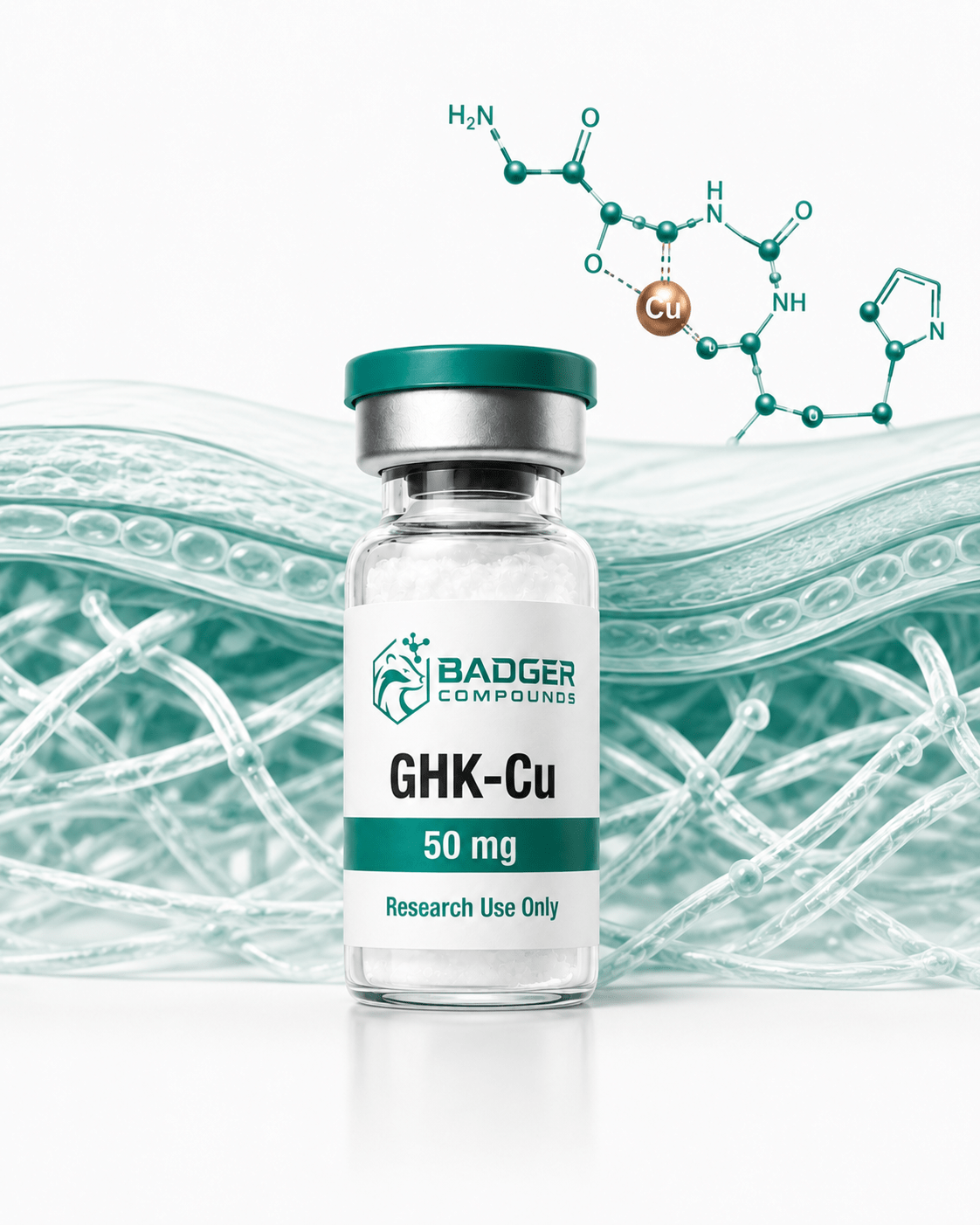
GHK-Cu is a naturally occurring copper tripeptide studied widely in skin biology research, and the subject of the overview below.
GHK-Cu is one of the most extensively studied copper peptides in skin biology. We look at how decades of research describe its interaction with collagen, the extracellular matrix, and the fibroblasts that build and maintain skin structure.
GHK-Cu is the copper complex of GHK, a tripeptide with the sequence glycyl-L-histidyl-L-lysine. GHK occurs naturally in human plasma, saliva, and urine, and it binds copper(II) with high affinity to form the GHK-Cu complex. It was first isolated by Pickart in 1973. Research notes that plasma GHK levels are reported around 200 ng/mL at roughly age 20 and decline to about 80 ng/mL by roughly age 60, a change that has drawn research interest in the context of tissue regenerative capacity.
The Copper Connection
A central theme in GHK-Cu research is copper biology. Copper is a required cofactor for lysyl oxidase, the enzyme that cross-links collagen and elastin fibers into a stable matrix. Research describes GHK as facilitating copper uptake into cells, positioning the complex as both a signaling molecule and a copper carrier within models of tissue repair.
Skin Biology Pathways Studied
Structural Proteins
Collagen Synthesis
Research reports that GHK-Cu stimulates collagen synthesis in fibroblast cultures at low nanomolar concentrations.
Matrix
Glycosaminoglycans
Studies describe stimulation of glycosaminoglycans and proteoglycans, including decorin, dermatan sulfate, and chondroitin sulfate.
Remodeling
Metalloproteinases
GHK-Cu has been reported to modulate matrix metalloproteinases and their inhibitors, influencing extracellular matrix turnover.
Cellular
Fibroblast Vitality
Research describes restoration of replicative vitality and growth factor secretion in fibroblasts following radiation in culture.
Extracellular Matrix Remodeling
Beyond simply increasing synthesis, GHK-Cu is studied for its role in balanced matrix remodeling. Research reports that the complex stimulates both the building and the controlled breakdown of collagen and glycosaminoglycans, and that it influences the activity of matrix metalloproteinases, including MMP-2 expression in fibroblast cultures. This dual action is part of why it is described in the literature as a modulator rather than a simple stimulant.
Gene-Level Research
More recent work has examined GHK at the level of gene expression. Analyses using large gene-profiling datasets have reported that GHK influences the expression of a broad set of genes, including groups associated with antioxidant defense, DNA repair, and anti-inflammatory signaling. We summarize commonly reported research observations below.
| Pathway Studied | Reported Research Observation |
|---|---|
| Collagen | Stimulated synthesis in fibroblast cultures at low nanomolar levels |
| Proteoglycans | Increased decorin and sulfated glycosaminoglycans |
| Matrix turnover | Modulation of metalloproteinases and their inhibitors |
| Fibroblasts | Restored vitality and growth factor output after radiation in vitro |
| Gene expression | Broad modulation, including antioxidant and DNA repair gene groups |
For skin biology research, GHK-Cu sits at the intersection of copper chemistry, extracellular matrix science, and gene regulation, which is why it remains one of the most referenced copper peptides in the literature. We present this overview strictly for its scientific and laboratory interest.
Explore our research-grade peptide catalog and batch-level certificates of analysis.
View the CatalogReferences
- Pickart L, Vasquez-Soltero JM, Margolina A. GHK Peptide as a Natural Modulator of Multiple Cellular Pathways in Skin Regeneration. Biomed Res Int. 2015. PubMed: 26236730
- Pickart L, Margolina A. Regenerative and Protective Actions of the GHK-Cu Peptide in the Light of the New Gene Data. Int J Mol Sci. 2018. PubMed: 29986520
- Simeon A, Emonard H, Hornebeck W, Maquart FX. The tripeptide-copper complex glycyl-L-histidyl-L-lysine-Cu2+ stimulates matrix metalloproteinase-2 expression by fibroblast cultures. Life Sci. 2000. PubMed: 11045606
All products and materials referenced are intended exclusively for in-vitro laboratory and research use only. They are not intended for human or animal consumption, diagnosis, treatment, or the prevention of any disease. Nothing in this article constitutes medical advice or a claim of therapeutic benefit. Statements describe published research findings only.