No products in the cart.
U.S. FILLED & FINISHED | ≥99% COA-VERIFIED PURITY
LC-MS VERIFIED IDENTITY | INDEPENDENTLY TESTED
ARA-290 innate repair receptor research centers on an 11-amino-acid peptide engineered from the helix B surface of erythropoietin, where preclinical and early clinical investigations have examined its selective activation of a tissue-protective receptor complex without triggering the red blood cell production associated with intact erythropoietin.
ARA-290 Innate Repair Receptor Research
ARA-290 (cibinetide) is an 11-amino-acid peptide engineered from the aqueous-exposed face of helix B of erythropoietin. Preclinical and early clinical investigations have characterized its selective activation of the innate repair receptor, a tissue-protective signaling complex distinct from the receptor responsible for red blood cell production.
What Is ARA-290?
ARA-290 is a synthetic linear peptide corresponding to a short stretch of amino acids that form the aqueous-facing surface of helix B in erythropoietin (EPO), a region of the molecule not involved in binding the classical EPO receptor homodimer that drives erythrocyte production. It is also known by its International Nonproprietary Name, cibinetide, and is sometimes referred to in the literature as Helix B Surface Peptide (HBSP). The peptide was developed by Michael Brines, Anthony Cerami, and colleagues, building on earlier work characterizing EPO derivatives that retain tissue-protective activity without stimulating erythropoiesis.
The research premise is one of pharmacological separation: intact EPO has long been known to protect tissue from ischemic, traumatic, and inflammatory injury in addition to its blood-forming role, but clinical use of EPO for tissue protection is limited by the cardiovascular risks of elevated hematocrit. ARA-290 was engineered specifically to isolate the protective signaling from the erythropoietic signaling.
The Innate Repair Receptor
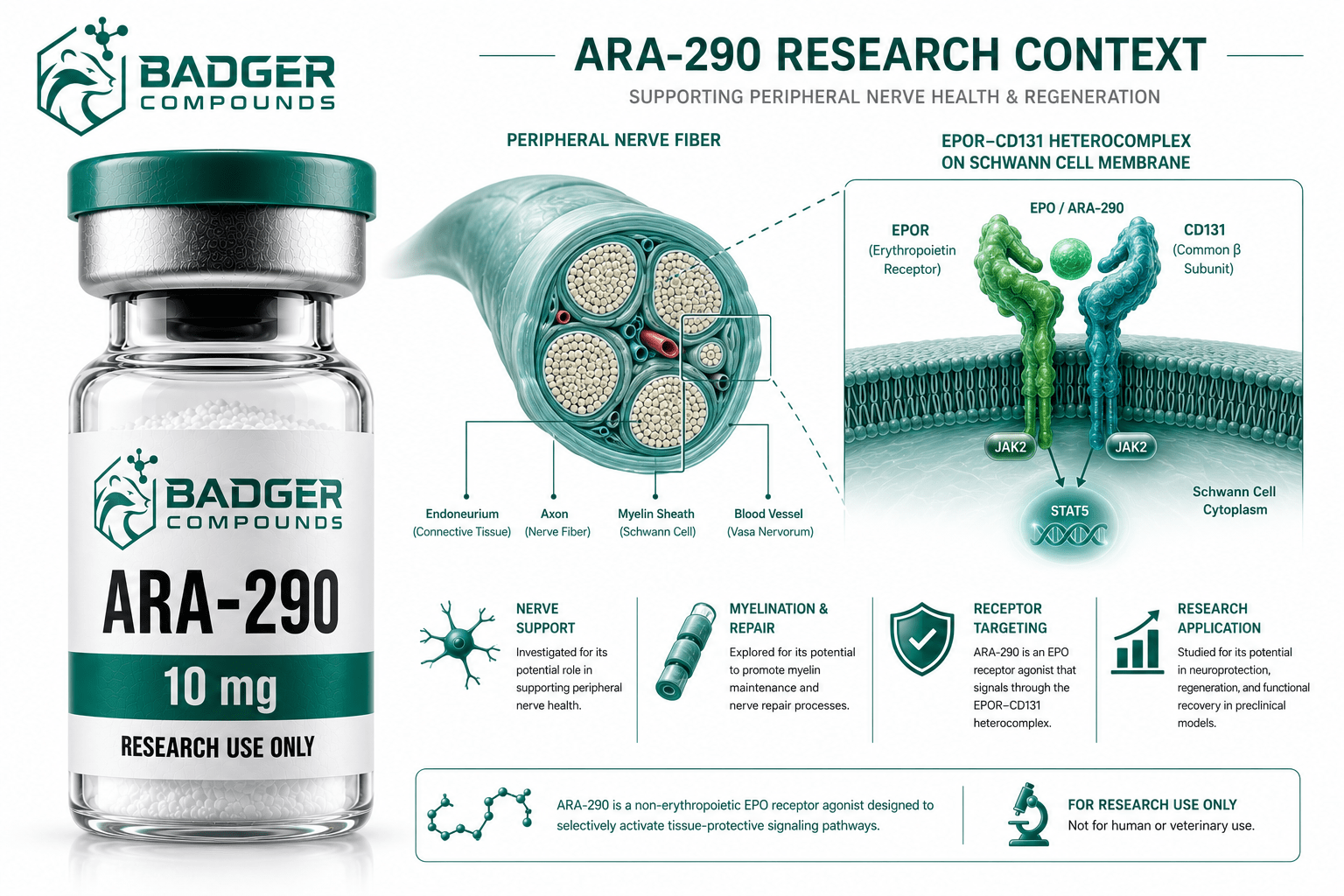
The foundational discovery underlying ARA-290 came from Brines and colleagues (2004), publishing in PNAS, who identified that EPO’s tissue-protective effects are mediated by a distinct receptor complex rather than the classical EPO receptor homodimer. The research demonstrated that the EPO receptor (EPOR) physically associates with the common beta receptor (betacR, also called CD131), the signal-transducing subunit shared by several cytokine receptors, to form a heterocomplex. Because betacR knockout mice show normal erythrocyte maturation, this heterocomplex, now referred to as the innate repair receptor (IRR), was established as unnecessary for erythropoiesis but required for EPO’s tissue-protective actions in the models tested.
Building directly on this discovery, Brines and colleagues (2008), also in PNAS, mapped the tissue-protective activity to the helix B region of EPO and then to the 11-amino-acid peptide that became ARA-290. The research reported that this short peptide was tissue-protective in models of ischemic stroke and renal ischemia-reperfusion injury, accelerated wound healing, and augmented cognitive function in rodents, while confirming it was not erythropoietic in either in vitro or in vivo testing.
EPOR + CD131 Heterocomplex
The innate repair receptor is a heterocomplex of the EPO receptor and the common beta receptor (CD131), distinct from the homodimer that drives erythropoiesis.
Helix B Origin
ARA-290 corresponds to the aqueous-exposed face of EPO’s helix B region, a sequence identified as sufficient for tissue-protective activity in isolation.
No Erythropoietic Activity
Preclinical testing found ARA-290 was not erythropoietic in vitro or in vivo, distinguishing its research profile from intact EPO.
Research framing: All findings referenced in this post derive from preclinical and early-phase clinical research. ARA-290 is supplied by Badger Compounds for laboratory research use only and is not intended for human or veterinary use. No therapeutic conclusions should be drawn from the research discussed here.
Sarcoidosis-Associated Small Fiber Neuropathy Research
The most developed clinical research program for ARA-290 concerns small fiber neuropathy (SFN) associated with sarcoidosis, an inflammatory disease that damages small and autonomic nerve fibers. The strongest evidence comes from Culver and colleagues (2017), publishing in Investigative Ophthalmology and Visual Science, who conducted a phase 2b, 28-day, randomized, placebo-controlled trial in 64 subjects. The trial used corneal confocal microscopy to measure corneal nerve fiber area (CNFA) as a surrogate marker of nerve repair.
The research reported a statistically significant placebo-corrected increase in CNFA of 697 μm2 in the 4 mg per day dosing group (P = 0.012), along with increased regenerating intraepidermal nerve fibers in that group. Changes in corneal nerve fiber area correlated with both nerve fiber regeneration markers and improved six-minute walk test distance. Pain improved across all dosing groups, with subjects reporting moderate to severe pain showing the largest reduction in the 4 mg group.
| Research Model | System | Reported Observation |
|---|---|---|
| Tissue protection mechanism | betacR knockout mice, cardiomyocyte/spinal models (Brines 2004) | Identified EPOR-betacR heterocomplex as the tissue-protective receptor |
| Peptide mapping | Stroke, retinal edema, nerve trauma models (Brines 2008) | 11-aa helix B peptide tissue-protective without erythropoietic activity |
| Sarcoidosis SFN | Phase 2b RCT, 64 subjects (Culver 2017) | Significant increase in corneal nerve fiber area at 4 mg dose |
| Sarcoidosis and diabetic SFN | Corneal confocal microscopy comparison (Brines 2018) | Corneal nerve fiber size added diagnostic and treatment-response utility |
| Type 2 diabetes with neuropathy | Phase 2 trial, 28-day dosing (Brines 2015) | Improved HbA1c, lipid profile, and PainDetect neuropathy scores |
ARA-290 is a research-use-only peptide. Badger Compounds supplies ARA-290 exclusively for qualified research applications in controlled laboratory settings. The research summarized here does not establish safety or efficacy in any human population.
Metabolic and Corneal Nerve Fiber Research
Beyond sarcoidosis, ARA-290 has been examined in type 2 diabetes with painful neuropathy. Brines and colleagues (2015), publishing in Molecular Medicine, conducted a phase 2 study in which subjects self-administered 4 mg of ARA-290 or placebo subcutaneously for 28 days. The research reported improvement in hemoglobin A1c and lipid profiles over the 56-day observation period, along with significant improvement in neuropathic symptoms measured by the PainDetect questionnaire. Subjects with reduced corneal nerve fiber density at baseline showed a significant increase in fiber density following treatment.
A related 2018 study by Brines and colleagues in Scientific Reports examined corneal nerve fiber size specifically, comparing patients with diabetic and sarcoidosis-associated small fiber neuropathy, including those who had received cibinetide. The research proposed that corneal nerve fiber area, in addition to standard corneal confocal microscopy variables like density and branch density, adds diagnostic sensitivity and is useful for quantifying treatment-related change in nerve morphology. Together, this body of work positions corneal confocal microscopy as a recurring, non-invasive outcome measure across the ARA-290 clinical research program.
Scope and Limitations of the Evidence
ARA-290 has a more developed human clinical research record than many peptides discussed on this site, including a randomized, placebo-controlled phase 2b trial. That said, several limitations are worth stating plainly. The published literature is concentrated among a relatively small, overlapping group of investigators and institutions, principally Araim Pharmaceuticals and Warren Pharmaceuticals along with academic collaborators in Leiden, Manchester, and Cleveland. The 2008 PNAS paper mapping the peptide’s structure discloses that several authors were employees of Warren Pharmaceuticals, the company developing EPO analogs and tissue-protective compounds commercially at the time, a disclosed financial interest worth factoring into how the foundational findings are weighed.
All published trials to date are early-phase (phase 2 or 2b) with relatively small subject numbers, and no phase 3 trial data has been reported. Corneal nerve fiber measures function as surrogate endpoints, meaning they indicate biological activity but are not themselves direct measures of disease outcome. ARA-290 should be understood as a research peptide with a promising but still early and single-program-concentrated evidence base, not a validated intervention for any condition.
Concentrated Research Program
Most published ARA-290 research originates from a consistent, overlapping group of investigators and the company developing the compound.
Early-Phase Clinical Data
All human trials are phase 2 or phase 2b with modest enrollment. No larger confirmatory trial data has been reported.
Research Pathways Associated with ARA-290
Preclinical and clinical literature has examined ARA-290 across several interconnected research contexts:
Innate repair receptor (IRR) agonism EPOR / CD131 heterocomplex Small fiber neuropathy Corneal confocal microscopy endpoints Nerve fiber regeneration (GAP-43+) Non-erythropoietic tissue protection Anti-inflammatory signaling Metabolic and glycemic researchARA-290 – Research Grade, ≥99% (HPLC)
Badger Compounds supplies ARA-290 as a lyophilized research peptide, six-round independently tested per batch with publicly viewable COAs. For qualified laboratory research use only.
View ARA-290- Brines M, Grasso G, Fiordaliso F, et al. Erythropoietin mediates tissue protection through an erythropoietin and common beta-subunit heteroreceptor. Proc Natl Acad Sci U S A. 2004;101(41):14907-14912. PMID 15456912
- Brines M, Patel NS, Villa P, et al. Nonerythropoietic, tissue-protective peptides derived from the tertiary structure of erythropoietin. Proc Natl Acad Sci U S A. 2008;105(31):10925-10930. PMID 18676614
- Culver DA, Dahan A, Bajorunas D, et al. Cibinetide improves corneal nerve fiber abundance in patients with sarcoidosis-associated small nerve fiber loss and neuropathic pain. Invest Ophthalmol Vis Sci. 2017;58(6):BIO52-BIO60. PMID 28475703
- Brines M, Dunne AN, van Velzen M, et al. ARA 290, a nonerythropoietic peptide engineered from erythropoietin, improves metabolic control and neuropathic symptoms in patients with type 2 diabetes. Mol Med. 2015;20(1):658-666. PMID 25387363
- Brines M, Culver DA, Ferdousi M, et al. Corneal nerve fiber size adds utility to the diagnosis and assessment of therapeutic response in patients with small fiber neuropathy. Sci Rep. 2018;8(1):4734. PMID 29549285
- van Velzen M, Heij L, Niesters M, Cerami A, Dunne A, Dahan A, Brines M. ARA 290 for treatment of small fiber neuropathy in sarcoidosis. Expert Opin Investig Drugs. 2014;23(4):541-550. PMID 24555851
Disclaimer: ARA-290 is supplied by Badger Compounds for laboratory and in vitro research use only. It is not intended for human or veterinary use, and no product sold by Badger Compounds is approved for therapeutic, diagnostic, or clinical application. All research findings referenced in this post are derived from preclinical and early-phase clinical studies conducted by third parties. No clinical efficacy or safety conclusions should be drawn from the data summarized here.