No products in the cart.
U.S. FILLED & FINISHED | ≥99% COA-VERIFIED PURITY
LC-MS VERIFIED IDENTITY | INDEPENDENTLY TESTED
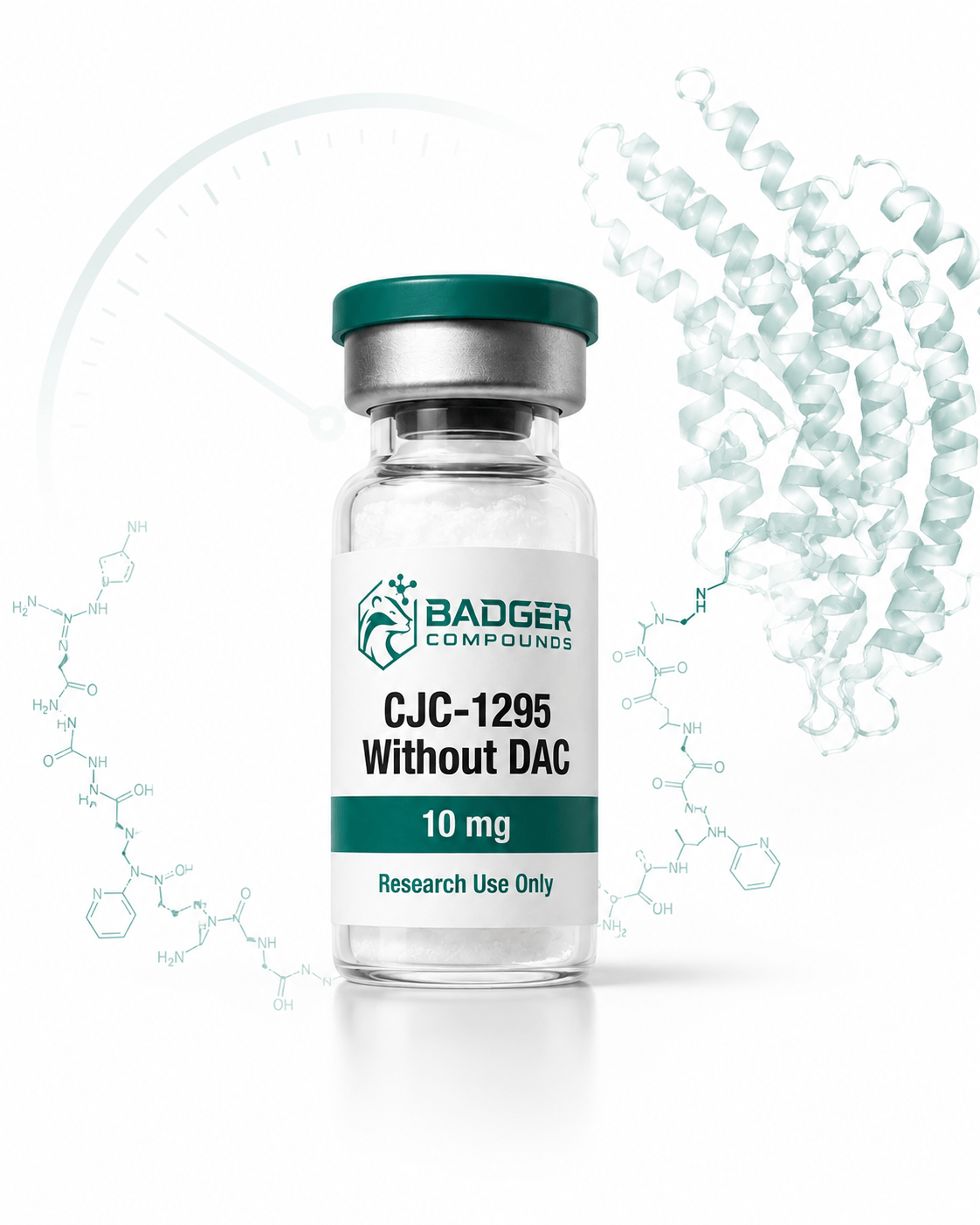
CJC-1295 half-life is the defining property of this long-acting GHRH analog, and the focus of the research overview below.
CJC-1295 is studied as a model for how peptide engineering can extend half-life. We look at the albumin-binding chemistry behind its long duration and what pharmacokinetic research suggests about its sustained activity on the growth hormone axis.
CJC-1295 is a synthetic analog of growth hormone-releasing hormone (GHRH), built on the first 29 amino acids of human GHRH, known as GRF(1-29). Native GHRH has a very short circulating half-life, on the order of minutes, which has historically limited its research utility. CJC-1295 was designed to address that limitation directly, which makes it a useful case study in peptide half-life research.
Two Modifications That Extend Half-Life
Research describes two distinct design features working together. First, the GRF(1-29) backbone carries amino acid substitutions that make it more resistant to breakdown by dipeptidyl peptidase IV (DPP-IV), an enzyme that rapidly inactivates native GHRH. Second, the version commonly studied with a drug affinity complex (DAC) carries a reactive group that covalently bonds to circulating serum albumin after administration. Because albumin itself has a long circulating life, the bound peptide is reported to remain in circulation far longer than the unmodified sequence.
Relative Duration In Research Models
Baseline
Native GHRH
Reported to have a very short circulating half-life, measured in minutes, due to rapid enzymatic degradation.
DPP-IV Resistant
Modified GRF(1-29)
Amino acid substitutions improve in vitro stability against DPP-IV, extending activity relative to native GHRH.
Albumin Bound
CJC-1295 With DAC
Covalent albumin binding has been reported to extend the estimated half-life to several days in human studies.
Receptor Activity
GRF Receptor Binding
Albumin bioconjugates retained the ability to activate the GRF receptor and stimulate GH secretion in preclinical assays.
Pharmacokinetic Findings
In a randomized, placebo-controlled study in healthy adults, a single subcutaneous administration of CJC-1295 was associated with the pharmacokinetic and pharmacodynamic observations summarized below. We present these as reported research findings.
| Parameter Studied | Reported Observation |
|---|---|
| Estimated half-life | Approximately 5.8 to 8.1 days |
| Mean plasma GH | Increased 2 to 10-fold for 6 days or more |
| Mean plasma IGF-1 | Increased 1.5 to 3-fold for 9 to 11 days |
| IGF-1 after multiple doses | Remained above baseline for up to 28 days |
On pulsatility: A companion analysis reported that pulsatile GH secretion was preserved during sustained GHRH stimulation by CJC-1295, with GH continuing to be released in discrete pulses rather than at a flat continuous level.
Preclinical Dosing-Frequency Research
Animal work has examined how administration frequency interacts with the extended half-life. In a GHRH knockout mouse model, CJC-1295 given at 24-hour intervals was reported to support normal body weight and length, while the same dose spaced at 48 or 72-hour intervals was less effective. This illustrates that an extended half-life and the practical dosing interval are related but distinct research variables.
For peptide half-life research, CJC-1295 is a clear illustration of how targeted structural changes, enzymatic resistance plus albumin conjugation, can transform the pharmacokinetic profile of a short-lived signaling peptide. We share this material strictly for its scientific and laboratory interest.
Explore our research-grade peptide catalog and batch-level certificates of analysis.
View the CatalogReferences
- Teichman SL, Neale A, Lawrence B, et al. Prolonged stimulation of growth hormone (GH) and insulin-like growth factor I secretion by CJC-1295, a long-acting analog of GH-releasing hormone, in healthy adults. J Clin Endocrinol Metab. 2006. PubMed: 16352683
- Jette L, Leger R, Thibaudeau K, et al. Human growth hormone-releasing factor (hGRF)1-29-albumin bioconjugates activate the GRF receptor on the anterior pituitary in rats: identification of CJC-1295 as a long-lasting GRF analog. Endocrinology. 2005. PubMed: 15817669
- Alba M, Fintini D, Sagazio A, et al. Once-daily administration of CJC-1295, a long-acting growth hormone-releasing hormone (GHRH) analog, normalizes growth in the GHRH knockout mouse. Am J Physiol Endocrinol Metab. 2006. PubMed: 16822960
- Ionescu M, Frohman LA. Pulsatile secretion of growth hormone (GH) persists during continuous stimulation by CJC-1295, a long-acting GH-releasing hormone analog. J Clin Endocrinol Metab. 2006. PubMed: 17018654
All products and materials referenced are intended exclusively for in-vitro laboratory and research use only. They are not intended for human or animal consumption, diagnosis, treatment, or the prevention of any disease. Nothing in this article constitutes medical advice or a claim of therapeutic benefit. Statements describe published research findings only.