No products in the cart.
U.S. FILLED & FINISHED | ≥99% COA-VERIFIED PURITY
LC-MS VERIFIED IDENTITY | INDEPENDENTLY TESTED
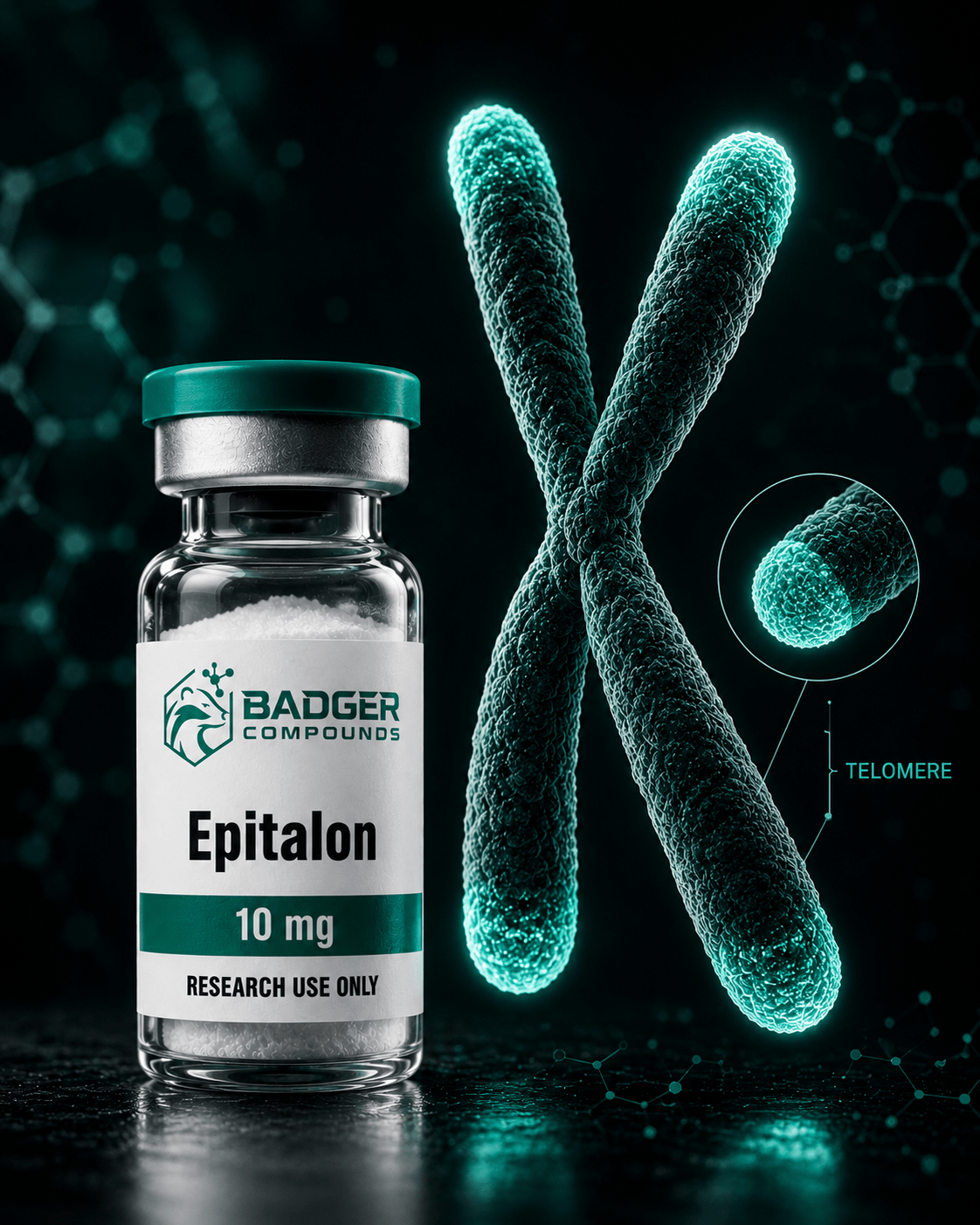
Epithalon telomere biology research has positioned this pineal-derived AEDG tetrapeptide as a focal point in the study of telomerase activation and telomere maintenance, where preclinical investigations have examined its capacity to influence hTERT expression and telomere length across multiple cell models.
Epithalon Telomere Biology: The AEDG Tetrapeptide and Telomerase Research
Epithalon (Ala-Glu-Asp-Gly) is a synthetic tetrapeptide modeled on the pineal extract epithalamin. Preclinical investigations have characterized its capacity to induce telomerase activity and influence telomere length in cell-based research models, making it one of the most studied peptides in telomere maintenance research.
What Is Epithalon?
Epithalon, also written Epitalon, is a four-amino-acid peptide with the sequence Ala-Glu-Asp-Gly (AEDG) and a molecular weight of approximately 390.35 Da. It was developed by Professor Vladimir Khavinson and colleagues at the St. Petersburg Institute of Bioregulation and Gerontology as a synthetic analog of epithalamin, a polypeptide complex originally extracted from the pineal gland. The peptide was designed to represent the minimal bioactive sequence associated with the geroprotective properties observed in earlier pineal extract research.
This post focuses specifically on the telomere and telomerase research surrounding Epithalon. For the broader picture of how this peptide has been studied in the context of organismal and cellular aging, see our pillar article on Epitalon and cellular aging research, which situates the telomere findings discussed here within the wider geroprotective literature.
Telomeres, Telomerase, and the Hayflick Limit
Telomeres are repetitive nucleotide sequences that cap the ends of chromosomes, protecting coding DNA from degradation during cell division. Because conventional DNA replication cannot fully copy the ends of linear chromosomes, telomeres shorten with each division, a phenomenon tied to the replicative limit of somatic cells known as the Hayflick limit. When telomeres become critically short, cells typically exit the cell cycle and enter senescence.
Telomerase is the ribonucleoprotein enzyme that counteracts this attrition by adding telomeric repeats, with its catalytic subunit encoded by hTERT. Most somatic cells express little or no telomerase, which is why telomere length is frequently studied as a biomarker of cellular aging. Research interest in Epithalon centers on observations that the peptide may influence telomerase activity and, by extension, telomere dynamics in certain cell models.
Research framing: All findings referenced in this post derive from preclinical cell-based and animal research models. Epithalon is supplied by Badger Compounds for laboratory research use only and is not intended for human or veterinary use. No therapeutic or clinical conclusions should be drawn from the preclinical data discussed here.
Foundational Telomerase Research
The foundational telomere study by Khavinson and colleagues, published in Bulletin of Experimental Biology and Medicine (2003), examined the addition of Epithalon to cultures of telomerase-negative human fetal fibroblasts. The research reported that the peptide induced expression of the catalytic telomerase subunit, was associated with detectable telomerase enzymatic activity, and corresponded to telomere elongation in the treated cells. The authors framed these observations as evidence that the tetrapeptide could influence telomere maintenance machinery in a cell-based research model.
This early work established the central research hypothesis that has guided subsequent investigation: that Epithalon may act as an inducer of telomerase activity rather than as a structural component of the telomere itself. The mechanistic details of how a small tetrapeptide produces this effect remain an active area of research interest and have not been fully characterized.
hTERT Induction
Preclinical investigations report that Epithalon exposure was associated with increased expression of the hTERT catalytic subunit in telomerase-negative cell models.
Telomerase Activity
Research models indicate detectable telomerase enzymatic activity following Epithalon treatment in cells that ordinarily express little or none.
Telomere Elongation
Treated cell cultures demonstrated increased telomere length in research settings, the downstream readout most associated with telomerase upregulation.
Independent Replication: The 2025 Brunel Study
For much of its history, the Epithalon telomere literature originated largely from a single research program, which limited independent verification. A 2025 study by Al-dulaimi and colleagues at Brunel University London, published in Biogerontology, addressed this gap by quantitatively examining the peptide across several human cell lines. Normal human mammary epithelial cells and IBR.3 fibroblasts exposed to Epithalon showed dose-dependent telomere length extension associated with hTERT upregulation and increased telomerase activity, consistent with the direction of the earlier foundational work.
Notably, the same study examined breast cancer cell lines (21NT and BT474) and reported that telomere extension in those cancer lines occurred predominantly through the Alternative Lengthening of Telomeres (ALT) pathway rather than classical telomerase activation, with only minor ALT activity in normal cells. This distinction is an important part of the research picture and underscores why telomerase-modulating compounds are studied carefully across both normal and transformed cell models.
| Research Model | System | Telomere / Telomerase Observation |
|---|---|---|
| Telomerase-negative human fibroblasts | Cell culture (Khavinson 2003) | Induced hTERT expression, telomerase activity, telomere elongation |
| Normal human epithelial and fibroblast cells (HMEC, IBR.3) | Cell culture, 3-week exposure (Al-dulaimi 2025) | Dose-dependent telomere extension via hTERT and telomerase upregulation |
| Breast cancer lines (21NT, BT474) | Cell culture (Al-dulaimi 2025) | Telomere extension predominantly via ALT pathway |
| Bovine cumulus-oocyte complexes | In vitro maturation (Ullah 2025) | Telomerase activation; altered maturation and embryo development endpoints |
| Neurogenesis cell models | Cell culture (Khavinson 2020) | Modulated gene expression and protein synthesis during neurogenesis |
Epithalon is a research-use-only peptide. Badger Compounds supplies Epithalon exclusively for qualified research applications in controlled laboratory settings. The preclinical data summarized here does not establish safety or efficacy in any human population.
Beyond Telomeres: Related Research Pathways
While telomerase and telomere length remain the central focus of Epithalon research, the peptide has also been examined in adjacent contexts that may intersect with its proposed mechanism. Khavinson and colleagues (2020) reported that the AEDG peptide modulated gene expression and protein synthesis during neurogenesis in a cell model, proposing a possible epigenetic mode of action. A 2025 study by Ullah and colleagues examined Epithalon-activated telomerase in the context of bovine oocyte maturation and post-thaw embryo development, extending telomerase-related research into reproductive cell biology.
Additional 2025 work by Gatta and colleagues investigated the tetrapeptide in an in vitro model of diabetic retinopathy, examining antioxidant and wound-healing-associated endpoints. For a consolidated survey of this expanding body of literature, the comprehensive 2025 review by Araj and colleagues catalogs in vitro, in vivo, and in silico Epithalon research across more than two decades of study.
Distinct Spelling, Same Peptide
Epithalon and Epitalon are interchangeable names for the same AEDG tetrapeptide. Research literature uses both spellings, so database searches benefit from including each variant.
Mechanism Still Under Study
How a four-residue peptide influences telomerase expression is not fully resolved. Proposed models include direct DNA interaction and epigenetic regulation, both active research questions.
Research Pathways Associated with Epithalon
Preclinical literature has examined Epithalon across several interconnected research contexts:
Telomerase (hTERT) induction Telomere length maintenance Alternative Lengthening of Telomeres (ALT) Cellular senescence and the Hayflick limit Neurogenesis gene expression Pineal and circadian research Antioxidant and wound-healing models Possible epigenetic regulationEpithalon Peptide – Research Grade, ≥99% (HPLC)
Badger Compounds supplies Epithalon as a lyophilized research peptide, six-round independently tested per batch with publicly viewable COAs. For qualified laboratory research use only.
View Epithalon- Khavinson VKh, Bondarev IE, Butyugov AA. Epithalon peptide induces telomerase activity and telomere elongation in human somatic cells. Bull Exp Biol Med. 2003;135(6):590-592. PMID 12937682
- Al-dulaimi S, Thomas R, Matta S, Roberts T. Epitalon increases telomere length in human cell lines through telomerase upregulation or ALT activity. Biogerontology. 2025;26(5):178. PMID 40908429
- Khavinson V, Diomede F, Mironova E, et al. AEDG peptide (epitalon) stimulates gene expression and protein synthesis during neurogenesis: possible epigenetic mechanism. Molecules. 2020;25(3):609. PMID 32019204
- Ullah S, Haider Z, Perera CD, et al. Epitalon-activated telomerase enhance bovine oocyte maturation rate and post-thawed embryo development. Life Sci. 2025;362:123381. PMID 39788414
- Gatta M, Dovizio M, Milillo C, et al. The antioxidant tetrapeptide epitalon enhances delayed wound healing in an in vitro model of diabetic retinopathy. Stem Cell Rev Rep. 2025;21(6):1822-1834. PMID 40493162
- Araj SK, Brzezik J, Madra-Gackowska K, Szeleszczuk L. Overview of epitalon: highly bioactive pineal tetrapeptide with promising properties. Int J Mol Sci. 2025;26(6):2691. PMID 40141333
Related Reading
For the broader picture of Epitalon’s role in cellular aging research beyond telomerase, including antioxidant and neuroendocrine mechanisms, see our overview of Epitalon and cellular aging research.
Disclaimer: Epithalon is supplied by Badger Compounds for laboratory and in vitro research use only. It is not intended for human or veterinary use, and no product sold by Badger Compounds is approved for therapeutic, diagnostic, or clinical application. All research findings referenced in this post are derived from preclinical cell-based and animal model studies. No clinical efficacy or safety conclusions should be drawn from the data summarized here.