No products in the cart.
U.S. FILLED & FINISHED | ≥99% COA-VERIFIED PURITY
LC-MS VERIFIED IDENTITY | INDEPENDENTLY TESTED
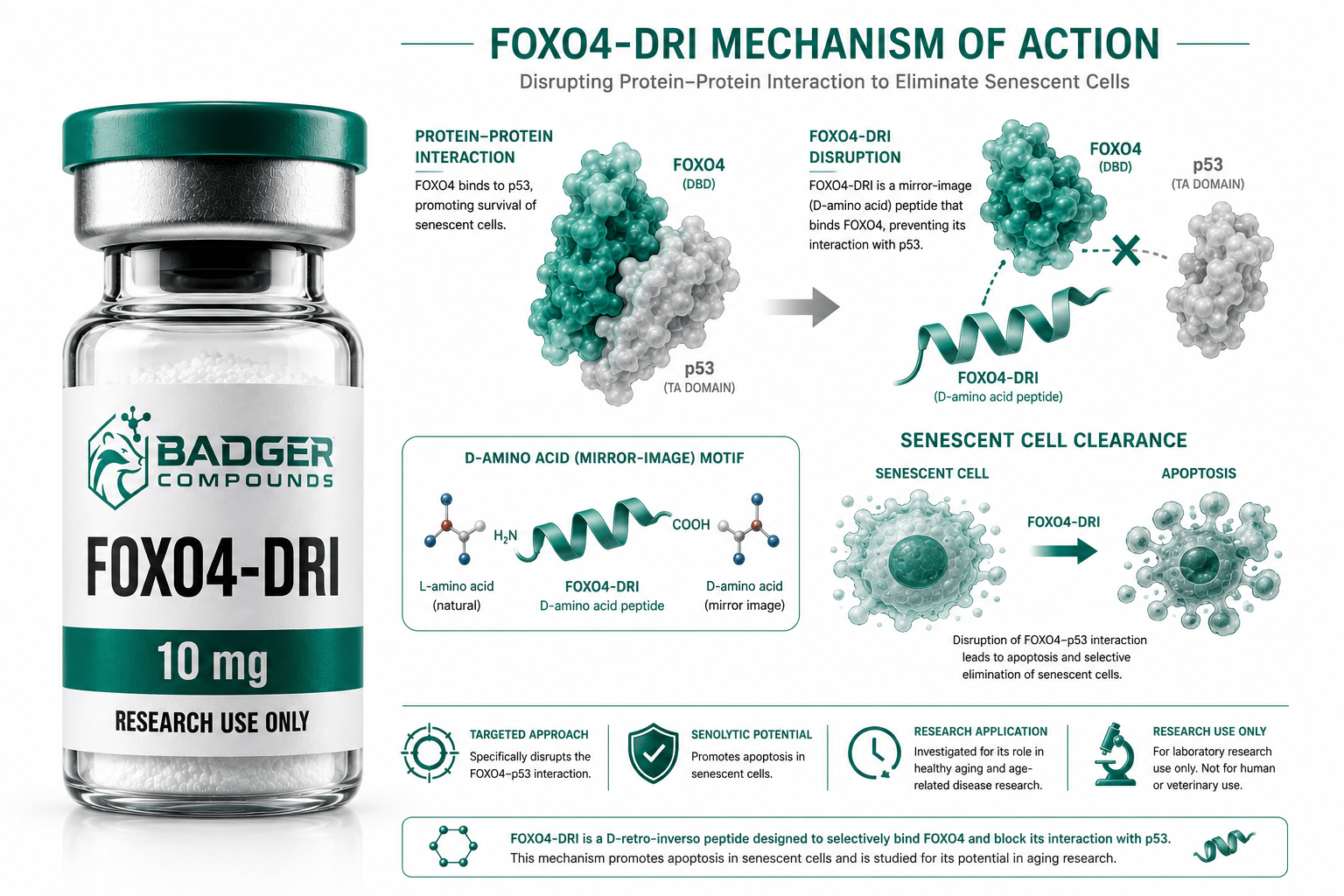
FOXO4-DRI senolytic research centers on a synthetic D-retro-inverso peptide engineered to disrupt the interaction between the transcription factor FOXO4 and the tumor suppressor p53, where preclinical investigations have examined how this disruption selectively triggers apoptosis in senescent cells across multiple tissue models.
FOXO4-DRI Senolytic Research: Disrupting the FOXO4-p53 Interaction
FOXO4-DRI is a synthetic D-retro-inverso peptide engineered to interrupt the interaction between the transcription factor FOXO4 and the tumor suppressor p53. Preclinical investigations have characterized this disruption as a mechanism that selectively triggers apoptosis in senescent cells while sparing normal proliferating cells across multiple tissue models.
What Is FOXO4-DRI?
FOXO4-DRI is a synthetic peptide derived from a region of the FOXO4 transcription factor known to interact with p53. It is built as a D-retro-inverso peptide, meaning it is assembled from D-amino acids in reverse sequence order, a chemical mirror-image construction that produces a molecule with similar binding topology to the natural L-amino acid sequence but far greater resistance to proteolytic degradation. This stability property is central to why the peptide functions in vivo rather than being rapidly broken down.
The peptide was developed by de Keizer and colleagues at Erasmus University Medical Center Rotterdam and first reported in a landmark 2017 study. It is designed as a competitive inhibitor: by mimicking the FOXO4 region that binds p53, FOXO4-DRI displaces the endogenous interaction, and this displacement is the entire basis of its research profile as a senolytic, meaning it is studied for its capacity to selectively eliminate senescent cells rather than to broadly modulate FOXO4 signaling.
The FOXO4-p53 Mechanism in Senescent Cells
Cellular senescence is a state in which cells permanently exit the cell cycle in response to stress, damage, or aging, yet remain metabolically active and resistant to the apoptosis that would normally clear damaged cells. The foundational research by Baar and colleagues (2017), published in Cell, identified FOXO4 as a pivotal factor in this apoptosis resistance. In senescent cells, FOXO4 was found to be upregulated and to sequester p53 within nuclear DNA damage foci, physically preventing p53 from reaching the mitochondria and initiating cell-intrinsic apoptosis.
FOXO4-DRI was designed to interrupt exactly this sequestration. By competitively binding the p53-interacting region of FOXO4, the peptide displaces p53 from the complex, allowing phosphorylated p53 to exit the nucleus. This nuclear exclusion is reported to activate the intrinsic apoptotic pathway, including BAX and cleaved caspase-3, resulting in apoptosis that is selective for senescent cells because FOXO4 overexpression is itself a senescence-associated feature. Cells without elevated FOXO4 are correspondingly less affected by the same treatment.
Competitive Displacement
FOXO4-DRI occupies the FOXO4 binding interface on p53, competitively displacing the endogenous FOXO4-p53 interaction in senescent cell research models.
p53 Nuclear Exclusion
Displacement allows phosphorylated p53 to exit the nucleus, a step research associates with activation of the intrinsic mitochondrial apoptotic pathway.
Senescence Selectivity
Because FOXO4 is characteristically upregulated in senescent cells, the mechanism is reported to selectively affect senescent populations over normal proliferating cells.
Research framing: All findings referenced in this post derive from preclinical cell-based and animal research models. FOXO4-DRI is supplied by Badger Compounds for laboratory research use only and is not intended for human or veterinary use. No therapeutic conclusions should be drawn from the preclinical data discussed here.
The Foundational 2017 Study
Baar and colleagues (2017) tested FOXO4-DRI across several aging-related research models. In fast-aging XpdTTD/TTD mice and in naturally aged mice, the peptide was associated with restored fitness, increased fur density, and improved renal function. In a chemotoxicity model, FOXO4-DRI neutralized the effects of doxorubicin-induced damage under conditions where the compound was well tolerated in vivo. The study’s authors concluded that therapeutic targeting of senescent cells is feasible even after health has already declined, and that tissue homeostasis can be restored under these conditions.
This paper established the FOXO4-p53 axis as a druggable target for senescent cell research and prompted a wave of follow-up studies examining the peptide across other senescence-associated tissue contexts, several of which are summarized below.
Tissue-Specific Senescence Research
Subsequent research has applied FOXO4-DRI across a range of senescent cell populations. Zhang and colleagues (2020) reported that FOXO4 is specifically expressed in human Leydig cells and that its nuclear translocation in aging is associated with decreased testosterone synthesis. Using hydrogen-peroxide-induced senescent Leydig cells, the research found that FOXO4-DRI selectively induced p53 nuclear exclusion and apoptosis in these cells, and that in naturally aged mice the peptide improved the testicular microenvironment and alleviated age-related testosterone secretion insufficiency.
A 2026 study by Hu and colleagues examined FOXO4-DRI in vascular aging, reporting that injection in both naturally aged and progeroid model mice suppressed aortic aging and improved aortic function, and that the peptide alleviated senescence in endothelial cells exposed to oxygen-glucose deprivation by activating the p53/BCL-2/caspase-3 pathway. Separately, Kong and colleagues (2025) examined keloid scar tissue, characterized by elevated senescent fibroblast populations, and reported that FOXO4-DRI promoted apoptosis and reduced cell-cycle arrest in keloid organ cultures and fibroblasts, proposing the peptide as a research tool for studying senescence-driven scar aggressiveness.
| Research Model | System | Reported Observation |
|---|---|---|
| Naturally aged and progeroid mice | Whole-animal aging model (Baar 2017) | Restored fitness, fur density, renal function; neutralized chemotoxicity |
| Senescent Leydig cells | H2O2-induced senescence, aged mice (Zhang 2020) | Selective apoptosis; improved testicular microenvironment; alleviated testosterone insufficiency |
| Senescent endothelial cells | OGD model, aged and progeroid mice (Hu 2026) | Reduced aortic aging; activated p53/BCL-2/caspase-3 apoptotic pathway |
| Keloid fibroblasts | Organ culture and cell culture (Kong 2025) | Increased apoptosis; decreased G0/G1 arrest in senescent subpopulations |
| Expanded human chondrocytes | In vitro ACI expansion model (Huang 2021) | Removed over half of senescent cells; did not enhance chondrogenic potential |
FOXO4-DRI is a research-use-only peptide. Badger Compounds supplies FOXO4-DRI exclusively for qualified research applications in controlled laboratory settings. The preclinical data summarized here does not establish safety or efficacy in any human population.
Chondrocyte Research: A Precise Reading of a Nuanced Result
One study deserves a careful, unrounded summary because its actual finding is more specific than headlines about it suggest. Huang and colleagues (2021) examined FOXO4-DRI in human chondrocytes expanded in vitro for autologous chondrocyte implantation, a cartilage repair procedure that requires expanding cells to a population doubling level at which senescence accumulates and degrades cartilage quality. The research reported that FOXO4-DRI treatment removed more than half of the senescent cells in expanded chondrocytes and reduced expression of senescence-associated secretory factors in the resulting cartilage tissue.
The precise and important caveat is that the same study reported FOXO4-DRI pretreatment did not enhance the chondrogenic potential of the expanded chondrocytes in standard pellet culture assays. The authors’ own conclusion was that the peptide’s utility in promoting cartilage formation from expanded chondrocytes needs further investigation. Removing senescent cells and improving cartilage-forming capacity are related but distinct outcomes, and this study demonstrated the former without establishing the latter. This compound and its mechanism are unrelated to Cartalax, a different short-peptide bioregulator discussed elsewhere on this site.
Structural Basis and Scope of the Evidence
A 2025 structural study by Bourgeois, Madl, and colleagues, published in Nature Communications, used solution NMR to characterize how FOXO4-DRI physically engages p53. The research found that the disordered FOXO4-DRI peptide binds the disordered p53 transactivation domain to form a transiently folded complex, with both the FOXO4-derived region and the peptide’s cell-penetrating segment contributing to the interaction. The study also reported that phosphorylation of p53 enhances its affinity for both FOXO4 and FOXO4-DRI, adding structural detail to the mechanism first proposed in 2017.
Transparency about this literature requires noting a relevant financial interest. Several authors on this 2025 structural paper, including a senior author from the original 2017 discovery paper, disclosed holding patents and equity in Cleara Biotech, a company developing FOXO4-DRI-related compounds. This is a legitimate scientific collaboration but a real financial interest in the research outcome, and it is worth factoring into how confidently any single group’s findings are weighted. It is also worth stating plainly that all FOXO4-DRI research to date is preclinical. No human clinical trial data has been reported for this compound.
Preclinical Stage Only
All current evidence derives from cell and animal models. No human clinical trials have been reported, and efficacy in humans remains unestablished.
Disclosed Financial Interest
Key researchers on recent structural work hold patents and equity in a company developing related compounds, a disclosed conflict worth weighing when reading the literature.
Research Pathways Associated with FOXO4-DRI
Preclinical literature has examined FOXO4-DRI across several interconnected research contexts:
FOXO4-p53 interaction disruption D-retro-inverso peptide stability p53 nuclear exclusion BAX / caspase-3 apoptosis Senescent cell selectivity Vascular and endothelial senescence Leydig cell and testosterone research Chondrocyte and fibroblast senescence modelsFOXO4-DRI – Research Grade, ≥99% (HPLC)
Badger Compounds supplies FOXO4-DRI as a lyophilized research peptide, six-round independently tested per batch with publicly viewable COAs. For qualified laboratory research use only.
View FOXO4-DRI- Baar MP, Brandt RMC, Putavet DA, et al. Targeted apoptosis of senescent cells restores tissue homeostasis in response to chemotoxicity and aging. Cell. 2017;169(1):132-147.e16. PMID 28340339
- Huang Y, He Y, Makarcyzk MJ, Lin H. Senolytic peptide FOXO4-DRI selectively removes senescent cells from in vitro expanded human chondrocytes. Front Bioeng Biotechnol. 2021;9:677576. PMID 33996787
- Zhang C, Xie Y, Chen H, et al. FOXO4-DRI alleviates age-related testosterone secretion insufficiency by targeting senescent Leydig cells in aged mice. Aging (Albany NY). 2020;12(2):1272-1284. PMID 31959736
- Kong YX, Li ZS, Liu YB, et al. FOXO4-DRI induces keloid senescent fibroblast apoptosis by promoting nuclear exclusion of upregulated p53-serine 15 phosphorylation. Commun Biol. 2025;8(1):299. PMID 39994346
- Bourgeois B, Spreitzer E, Platero-Rochart D, et al. The disordered p53 transactivation domain is the target of FOXO4 and the senolytic compound FOXO4-DRI. Nat Commun. 2025;16(1):5672. PMID 40593617
- Hu Z, Li F, Hu C, et al. FOXO4-DRI regulates endothelial cell senescence via the p53 signaling pathway. Front Bioeng Biotechnol. 2026;13:1729166. PMID 41625068
Disclaimer: FOXO4-DRI is supplied by Badger Compounds for laboratory and in vitro research use only. It is not intended for human or veterinary use, and no product sold by Badger Compounds is approved for therapeutic, diagnostic, or clinical application. All research findings referenced in this post are derived from preclinical cell-based and animal model studies. No clinical efficacy or safety conclusions should be drawn from the data summarized here.