No products in the cart.
U.S. FILLED & FINISHED | ≥99% COA-VERIFIED PURITY
LC-MS VERIFIED IDENTITY | INDEPENDENTLY TESTED
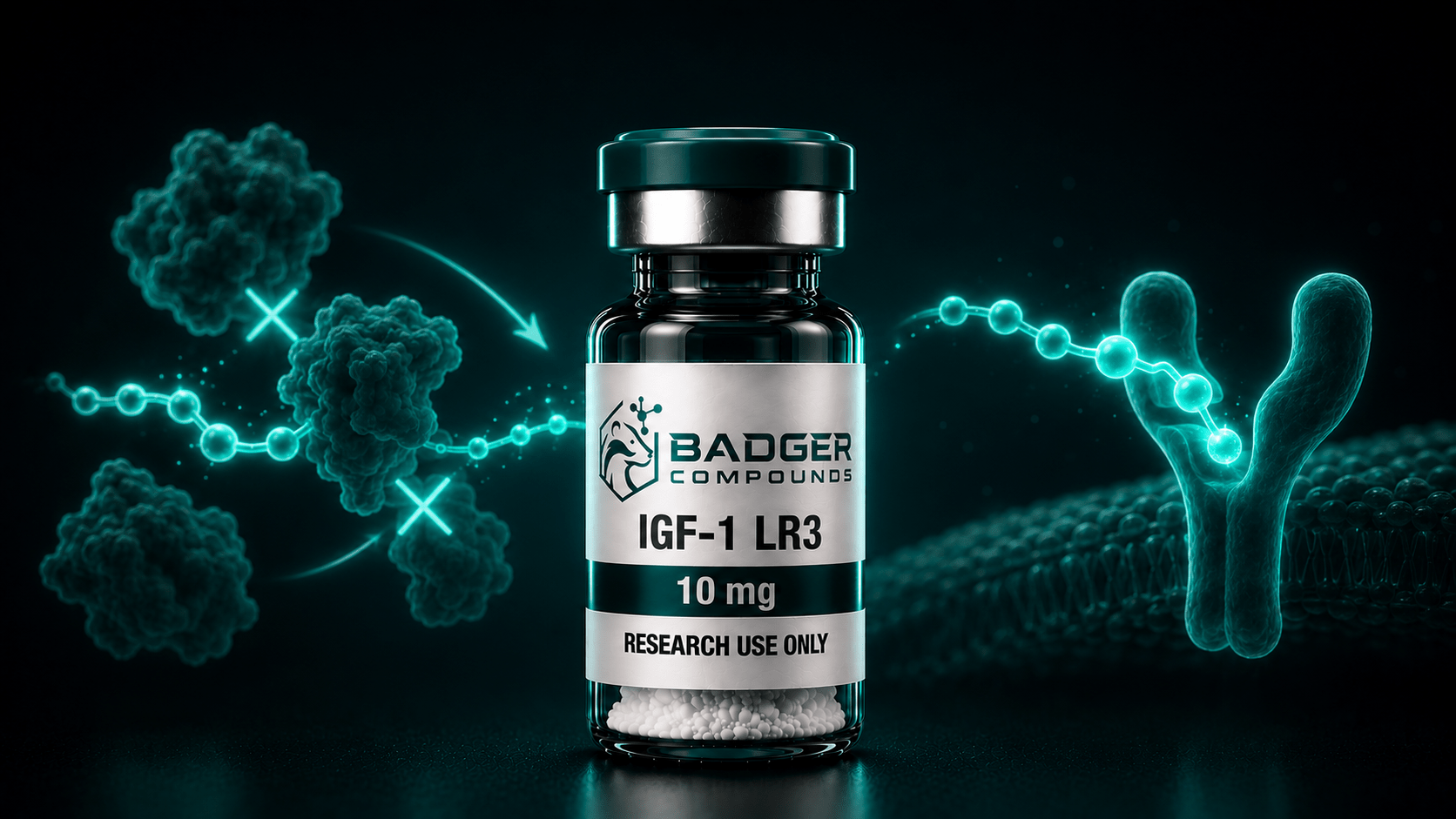
IGF-1 LR3 is one of the most structurally precise modifications in this catalog: two specific changes to native IGF-1 that dramatically alter how the molecule behaves in a research system, without changing what receptor it targets. This guide explains what those two changes are, why they matter, and what the resulting research profile looks like.
IGF-1 LR3 Research: Mechanism and IGFBP Binding
Native IGF-1 spends nearly all of its time bound to carrier proteins in circulation, with only a small free fraction available to actually engage its receptor. IGF-1 LR3 was engineered specifically to change that balance. Two defined modifications to the native sequence dramatically reduce how tightly the molecule is captured by those carrier proteins, without changing what it targets once free.
What Is IGF-1 LR3?
IGF-1 LR3, or Long-R3 IGF-1, is a synthetic 83-amino-acid analog of native human IGF-1. It carries two specific structural modifications: an arginine substituted for glutamate at position 3 of the native sequence, and a 13-amino-acid extension added to the N-terminus. Together these are the “Long” and “R3” that give the compound its name. The analog was first characterized by Francis and colleagues, who reported that these fusion-protein modifications enhanced biological potency by altering the balance between receptor binding and binding-protein sequestration [1].
Research framing: This article is intended for educational and research-context discussion only. IGF-1 LR3 is a research compound sold for laboratory investigation only. This content does not provide medical advice, dosing guidance, or treatment recommendations of any kind.
Why the IGFBP System Matters
In native physiology, circulating IGF-1 is overwhelmingly bound to a family of six insulin-like growth factor binding proteins (IGFBPs 1 through 6), which regulate how much of the hormone is actually available to engage the IGF-1 receptor (IGF-1R) at any given time. This binding-protein system functions as a reservoir and a brake, controlling the free, bioactive fraction of IGF-1 rather than the total amount present.
Native IGF-1
Binds tightly to IGFBPs, so only a small free fraction is available to engage IGF-1R at a given moment.
IGF-1 LR3
The N-terminal extension and Arg3 substitution reduce IGFBP binding affinity, comparative studies report differences of roughly three orders of magnitude, while IGF-1R binding is preserved [2,3].
What This Means for the Research Profile
Because IGF-1 LR3 largely escapes the IGFBP sequestration system, a much larger fraction of an administered dose remains free and receptor-available compared with native IGF-1. Research comparing the two directly, using infusion and injection protocols, found that IGF-I analogues with poor IGFBP binding maintained substantially superior potency relative to native IGF-1 regardless of administration route [2]. This is the mechanistic basis for describing IGF-1 LR3 as more potent than native IGF-1 in research settings: not a stronger interaction with the receptor itself, but a larger pool of molecule actually reaching that receptor.
IGF-1 LR3 does not bind IGF-1R any more tightly than native IGF-1. It simply is not captured by the IGFBP system nearly as effectively, which leaves more of it free to act. The modification targets availability, not receptor affinity.
IGF-1 LR3 vs Native IGF-1
| Property | Native IGF-1 | IGF-1 LR3 |
|---|---|---|
| Length | 70 amino acids | 83 amino acids |
| IGF-1R binding | High affinity | High affinity, preserved |
| IGFBP binding | High affinity across IGFBP 1-6 | Substantially reduced [2,3] |
| Origin | Endogenous hormone | Synthetic research analog [1] |
Research Concepts Related to IGF-1 LR3
IGF-1 receptor (IGF-1R) IGF binding proteins (IGFBPs) Free vs bound hormone fraction N-terminal sequence modification Receptor binding vs bioavailability Cell proliferation signalingIGF-1 LR3 – Research Grade, ≥99% (HPLC)
Badger Compounds supplies IGF-1 LR3 as a lyophilized research peptide, six-round independently tested per batch with publicly viewable COAs. For qualified laboratory research use only.
View IGF-1 LR3- Francis GL, Ross M, Ballard FJ, Milner SJ, Senn C, McNeil KA, Wallace JC, King R, Wells JRE. Novel recombinant fusion protein analogs of insulin-like growth factor (IGF)-I indicate the relative importance of IGF-binding protein and receptor binding for enhanced biological potency. J Mol Endocrinol. 1992;8(3):213-223. PMID 1376622
- Tomas FM, Lemmey AB, Read LC, Ballard FJ. Superior potency of infused IGF-I analogues which bind poorly to IGF-binding proteins is maintained when administered by injection. J Endocrinol. 1996;150(1):77-84. PMID 8708568
- Kolle S, Stojkovic M, Boie G, Wolf E, Sinowatz F. Insulin-like growth factor I (IGF-I) and long R(3)IGF-I differently affect development and mRNA abundance for IGF-binding proteins and type I IGF receptors in in vitro produced bovine embryos. Biol Reprod. 2001;64(6):1826-1834. PMID 11181549
Disclaimer: This article is for informational and educational purposes only. Products and compounds discussed are intended for research use only and are not for human consumption, veterinary use, clinical use, diagnostic use, food use, supplement use, pharmaceutical use, cosmetic use, or any consumer application. Statements have not been evaluated by the FDA. This content does not provide medical advice, treatment guidance, dosing information, or recommendations for personal use.