No products in the cart.
U.S. FILLED & FINISHED | ≥99% COA-VERIFIED PURITY
LC-MS VERIFIED IDENTITY | INDEPENDENTLY TESTED
Peptide Purity Research: Understanding the Analytical Standard
Peptide purity research is a critical consideration for any investigational laboratory working with synthetic compounds. This article explores what a 99% purity designation actually means analytically, how HPLC methodology determines that figure, and why batch-level verification matters for reproducible preclinical studies.
Research Education Series
What Does “99% Purity” Actually Mean in Peptide Research?
🧬 Badger Compounds
📂 Science & Quality
⏱ 7 min read
The phrase “99% purity” appears on countless research compound listings — but what does it actually tell a scientist? In peptide research, purity is a multidimensional analytical concept encompassing HPLC methodology, impurity profiling, and batch-level verification. This article breaks down what peptide purity really means and why it matters for reproducible, reliable preclinical investigation.
🔬
Key Insight: Purity percentage alone does not fully characterize a research peptide. The analytical method used, the impurities present, and the consistency across production batches all contribute meaningfully to a compound’s suitability for investigational use. Understanding these factors helps researchers make more informed sourcing decisions.
What Purity Percentage Represents
Breaking down the analytical foundation behind that single number on a certificate of analysis.
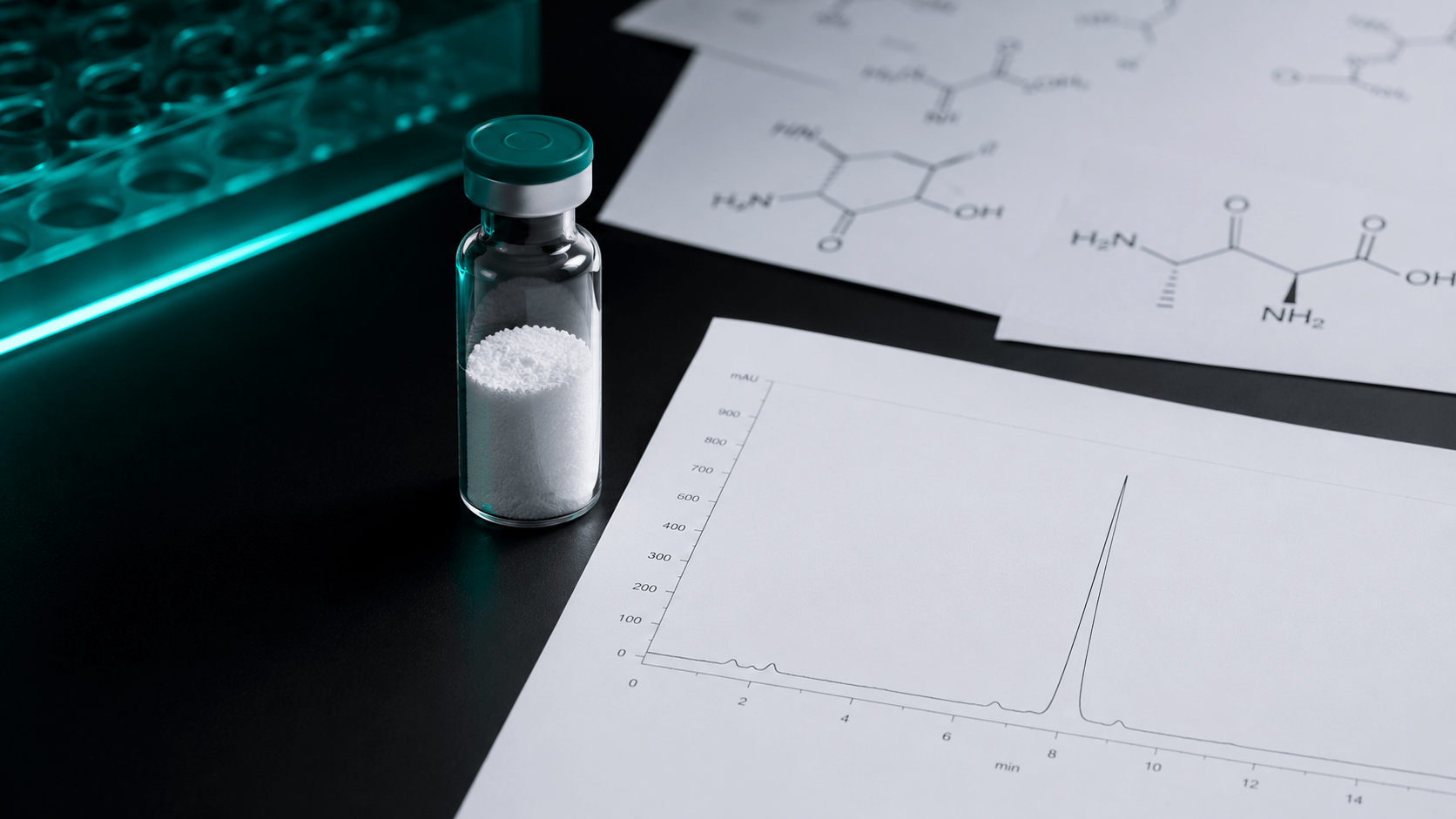
When a peptide research compound carries a 99% purity designation, that figure is most commonly derived from High-Performance Liquid Chromatography (HPLC) analysis — specifically, reversed-phase HPLC. The percentage refers to the proportion of the detected UV absorbance (typically at 214 nm or 220 nm) attributable to the target peptide relative to all detected species in the sample.
In practical terms, a 99% purity reading indicates that approximately 99% of the UV-absorbing material eluting through the analytical column is the intended peptide sequence. The remaining ~1% may consist of truncated sequences, deletion peptides, oxidized variants, racemized amino acid residues, or residual protecting groups from the solid-phase synthesis process.
It is important to recognize that this measurement is detector-dependent. HPLC with UV detection captures only UV-absorbing species — meaning compounds or impurities that do not absorb at the monitored wavelength may go undetected. This is why complementary analytical techniques such as mass spectrometry (MS) are critical for comprehensive characterization.
Key Analytical Dimensions of Peptide Purity
📊
HPLC Chromatographic Purity
Reversed-phase HPLC quantifies the area percentage of the target peptide peak relative to all UV-detected peaks. The primary method used in most Certificates of Analysis.
Primary Assay⚖️
Mass Spectrometry Confirmation
ESI-MS or MALDI-TOF analysis confirms the molecular weight of the peptide, verifying correct sequence assembly and detecting molecular-level modifications that HPLC alone cannot resolve.
Identity Verification🧂
Counterion & Residual Content
Trifluoroacetate (TFA) counterions from synthesis and residual solvents may not affect HPLC purity readings but can influence research assay environments if not adequately characterized.
Often Overlooked🔁
Batch-to-Batch Consistency
A single high-purity result is insufficient for reproducible research. Consistent purity across multiple production batches is what enables longitudinal investigational studies.
Reproducibility🧩
Sequence Impurities
Deletion sequences (where one amino acid was missed during synthesis) and truncated chains can co-elute close to the target peak, making high-resolution HPLC conditions critical.
Synthesis Artifacts🔆
Optical Purity / Stereochemistry
Racemization of L-amino acids to D-forms during synthesis can occur. Stereochemical purity is a distinct quality dimension not captured by standard UV-HPLC purity figures.
Advanced QC
How HPLC Purity Is Measured
The analytical conditions used significantly affect the purity value reported.
Reversed-phase HPLC separates peptide components based on their hydrophobicity, using a gradient of aqueous and organic solvent (typically acetonitrile with 0.1% TFA or formic acid) across a C18 or C8 stationary phase column. The detector most commonly used for peptides is a UV/Vis detector set to 214–220 nm, which detects the peptide bond backbone.
The reported purity is calculated as:
% Purity = (Target Peak Area / Sum of All Detected Peak Areas) × 100
Because this calculation is area-percent based, it is relative — not absolute. This means the result is dependent on:
- The gradient conditions (a shallower gradient reveals more impurities)
- The column type and particle size (smaller particles improve resolution)
- The detection wavelength (aromatic residues absorb more strongly at 280 nm)
- Sample concentration and injection volume
A purity value reported using a fast, steep gradient on a standard C18 column may appear higher than the same compound analyzed under high-resolution, orthogonal HPLC conditions. This is why research-grade peptide suppliers should provide detailed analytical method parameters alongside purity figures, not just a percentage in isolation.
Peptide Purity Grade Comparison
How different purity levels compare in terms of research suitability and analytical assurance.
| Purity Level | Typical Use Context | Impurity Tolerance | MS Confirmation | Research Suitability |
|---|---|---|---|---|
| < 90% | Early screening / crude synthesis | High (>10%) | Often absent | Limited |
| 90–95% | General research use, non-quantitative assays | Moderate (5–10%) | Sometimes included | Acceptable |
| 95–98% | Quantitative in vitro studies | Low (2–5%) | Usually included | Good |
| ≥ 99% | High-precision preclinical investigations | Very low (<1%) | Required at this tier | Preferred |
| ≥ 99% + Full CoA | Multi-assay, reproducible research programs | Minimal, profiled | Always included | Optimal |
🔬 Research Context
Why Analytical Method Transparency Matters
Peer-reviewed research investigating peptide compounds — including studies in metabolic signaling, neuroprotective pathway research, and cellular regeneration models — consistently emphasizes the importance of compound characterization. Studies published in journals such as the Journal of Peptide Science and Analytical Chemistry underscore that impurity profiles, not just purity percentages, can influence biological assay outcomes. Researchers relying on compounds from Badger Compounds can review full batch-level Certificates of Analysis that include HPLC chromatograms, MS confirmation data, and lot-specific purity figures.
What a Research-Grade Certificate of Analysis Should Include
A CoA is only as useful as the information it contains. Here is what to look for.
📄
HPLC Chromatogram
The actual chromatographic trace — not just a number. This allows the researcher to visually evaluate peak shape, baseline resolution, and the relative size of any detected impurity peaks.
🔭
Mass Spec Data
Confirmation of the expected molecular ion (M+H⁺ or M+2H²⁺). This verifies that the synthesized compound has the correct molecular weight and sequence — ruling out gross synthesis errors.
🏷️
Lot / Batch Number
Unique batch identification enables full traceability. Researchers can cross-reference experimental data to specific production batches, a critical requirement for reproducible study design.
📐
Analytical Method Details
Column type, gradient conditions, detection wavelength, and instrument type should be disclosed so the researcher can evaluate the rigor of the purity determination and, if needed, replicate the analysis.
🧊
Physical State & Storage Conditions
Lyophilized peptides require specific storage conditions to maintain stability. A proper CoA will document recommended temperature, light sensitivity, and reconstitution guidance for laboratory use.
🏢
Third-Party or Independent Verification
CoAs generated by an independent, ISO-accredited analytical laboratory carry additional weight, as they remove potential conflicts of interest inherent to in-house testing alone.
Common Impurity Sources in Synthetic Peptides
Understanding where impurities originate helps contextualize what that residual ~1% may contain.
Solid-Phase Peptide Synthesis (SPPS) Artifacts
The majority of research-grade peptides are produced via SPPS, in which amino acids are sequentially coupled to a resin-bound growing chain. Incomplete coupling reactions at any step produce deletion sequences — peptides missing one or more internal residues. Similarly, incomplete deprotection of side-chain protecting groups can leave residual chemical modifications on the final product.
Oxidative and Deamidation Products
Methionine and cysteine residues are particularly susceptible to oxidation during synthesis, purification, and storage. Asparagine and glutamine residues can undergo deamidation, converting to aspartate and glutamate respectively — subtly altering the peptide’s charge state and biological recognition properties in research models.
Racemization
Under harsh coupling conditions, L-amino acid residues can partially convert to their D-enantiomers. D-amino acid incorporation is typically undetectable by standard UV-HPLC but may affect receptor binding characteristics in pathway signaling research models. Chiral analysis (e.g., Marfey’s method) provides specific detection of these species.
Residual Reagents and Counterions
Purification via TFA-containing mobile phases leaves trifluoroacetate as the primary counterion. While this does not affect HPLC purity values, high TFA content has been observed to influence certain cell-based assay systems. Ion-exchange or lyophilization steps can be used to reduce counterion content in higher-specification research compounds.
Final Thoughts: Purity Is a Starting Point, Not a Finish Line
In peptide research, a 99% purity figure is a meaningful quality indicator — but it is best understood as one data point within a broader analytical picture. The method used to determine that number, the nature of the remaining 1%, the consistency of that result across production batches, and the availability of supporting mass spectrometry data all contribute to a compound’s overall suitability for investigational use.
Researchers seeking to establish reproducible experimental systems benefit from suppliers who provide full analytical transparency: detailed Certificates of Analysis, chromatographic data, mass confirmation, and batch traceability — not a headline purity number alone.
At Badger Compounds, every research compound is supported by comprehensive batch-level documentation designed to meet the standards that modern preclinical investigation demands. Our commitment to analytical transparency is part of our broader mission to support the scientific community with premium research-use-only compounds.
PubMed References
- Behrendt R, White P, Offer J. Advances in Fmoc solid-phase peptide synthesis. J Pept Sci. 2016;22(1):4–27. https://pubmed.ncbi.nlm.nih.gov/26518820/
- Stawikowski M, Fields GB. Introduction to peptide synthesis. Curr Protoc Protein Sci. 2012;Chapter 18:Unit 18.1. https://pubmed.ncbi.nlm.nih.gov/22470057/
- Waliczek M, et al. Profiling of Peptide Libraries: Purity Evaluation by HPLC and Mass Spectrometry. Molecules. 2021;26(16):4769. https://pubmed.ncbi.nlm.nih.gov/34443356/
- Miranda LP, Alewood PF. Challenges for protein chemical synthesis in the 21st century: bridging genomics and proteomics. Biopolymers. 2000;55(3):217–226. https://pubmed.ncbi.nlm.nih.gov/10861382/
- Antolínez S, et al. Effect of trifluoroacetate on biological assays and methods to remove it from peptide samples. Anal Biochem. 2021;628:114278. https://pubmed.ncbi.nlm.nih.gov/34273375/
Research Use Only — Disclaimer
All content published by Badger Compounds is intended solely for educational and informational purposes within a scientific research context. The compounds discussed in this article are sold exclusively as Research Use Only (RUO) materials and are not intended for human or veterinary use, diagnosis, treatment, cure, or prevention of any condition or disease. This content does not constitute medical advice and should not be interpreted as such. The information presented reflects current scientific literature and is not a claim of safety or efficacy. All research involving these compounds must be conducted by qualified professionals in appropriate licensed laboratory settings in full compliance with applicable regulations. Badger Compounds makes no representations regarding the suitability of any compound for any specific research application.
Peptide purity research standards continue to evolve as analytical instrumentation improves. Researchers sourcing compounds for preclinical investigations should always request full batch-level documentation alongside any stated purity figure.