No products in the cart.
99% COA-Verified Purity | 6× Independent Testing | Batch-Level COAs | USA Based

What Makes Triple Agonist Research Different?
Triple agonist research has become an increasingly important topic in metabolic pathway investigations. Unlike single or dual receptor models, triple agonist compounds are designed to interact with three receptor systems that are commonly studied in relation to incretin signaling, nutrient response, and energy-balance research.
In current metabolic research, the term triple agonist often refers to compounds that target GLP-1, GIP, and glucagon receptor pathways. This article explains what makes triple agonist research different, why these pathways are being studied together, and how this model compares with dual agonist research.
Research focus: This article is intended for educational and research-context discussion only. It reviews receptor pathways, investigational models, and scientific interest in triple agonist compounds without providing medical advice, dosing information, or treatment guidance.
What Is a Triple Agonist?
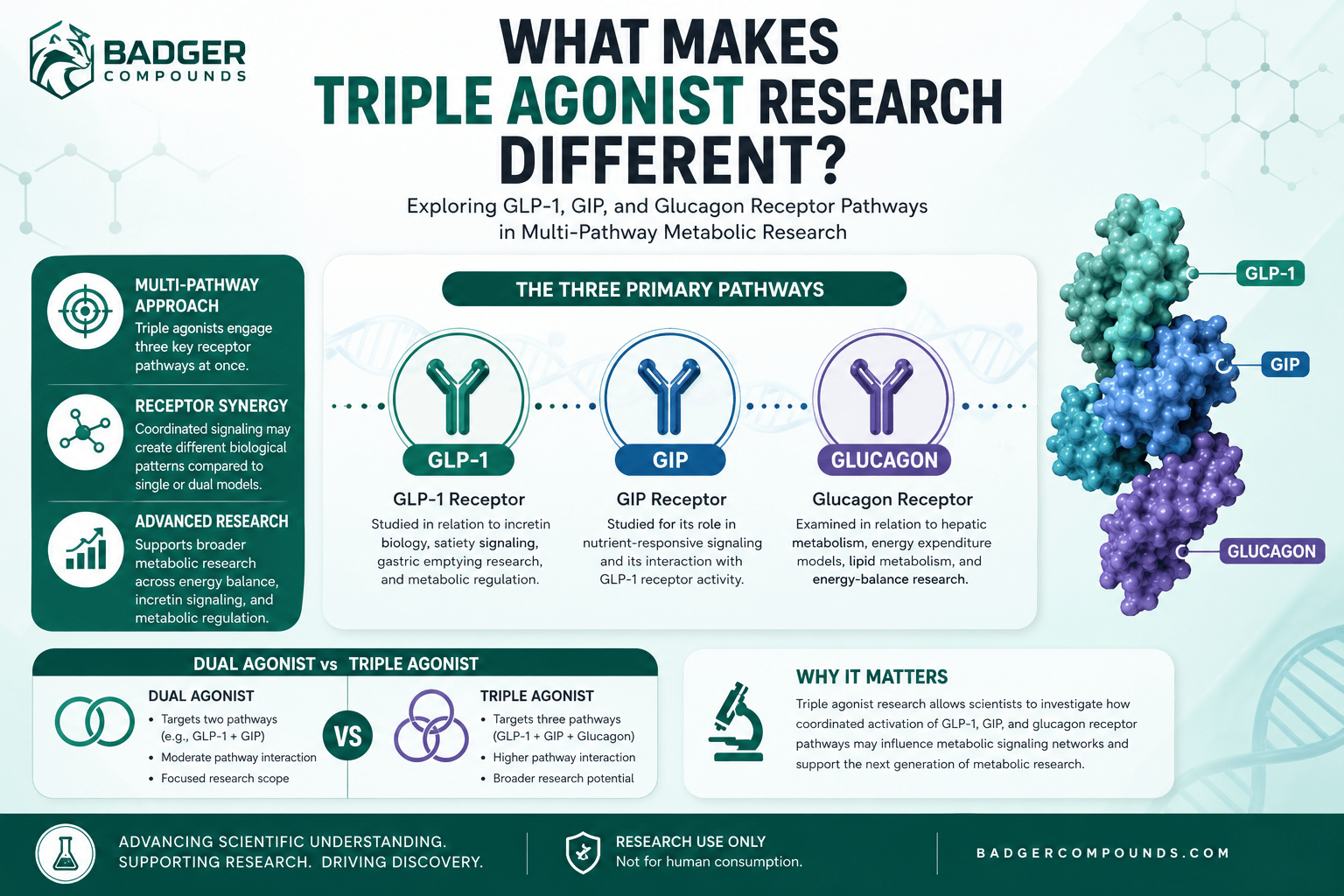
A triple agonist is a compound designed to activate or engage three receptor pathways. In metabolic research, this usually refers to simultaneous activity at the GLP-1 receptor, GIP receptor, and glucagon receptor. Each pathway is associated with different aspects of metabolic signaling and biological regulation.
The goal of studying triple agonist models is not simply to add more receptor targets. Instead, researchers are interested in how coordinated signaling across multiple pathways may create different biological patterns compared with single or dual receptor models.
Simple Research Definition
Triple agonist research studies compounds designed to interact with three receptor pathways, most commonly GLP-1, GIP, and glucagon receptors, in order to examine multi-pathway metabolic signaling.
The Three Primary Pathways
Triple agonist research is often centered around three major receptor systems. Each pathway contributes a different area of scientific interest, which is why researchers study them both individually and together.
Pathway 1
GLP-1 Receptor
GLP-1 receptor signaling is widely studied in relation to incretin biology, nutrient response, insulin-signaling models, gastric emptying research, satiety-related signaling, and broader metabolic regulation.
Pathway 2
GIP Receptor
GIP receptor activity is studied in relation to nutrient-responsive signaling, incretin pathway interaction, and how GIP may coordinate with GLP-1 receptor activity in metabolic research models.
Pathway 3
Glucagon Receptor
Glucagon receptor signaling is investigated in relation to hepatic metabolism, energy expenditure models, lipid metabolism research, and broader energy-balance pathway studies.
Why Triple Agonist Research Is Different
Triple agonist research differs from earlier metabolic peptide research because it expands the experimental model beyond one or two receptor systems. Instead of focusing only on GLP-1 receptor activity or a dual incretin framework, triple agonist models examine how GLP-1, GIP, and glucagon receptor pathways may interact within coordinated signaling networks.
This added complexity is one reason triple agonist compounds have become a major topic in metabolic research. By engaging three receptor pathways, researchers can explore questions related to receptor synergy, pathway balance, and the biological effects of multi-signal receptor activation.
Traditional Single-Pathway Models
- Focus on one receptor system
- Often easier to isolate experimentally
- Useful for studying specific signaling pathways
- Less complex than dual or triple agonist models
Triple Agonist Models
- Engage three receptor systems
- Allow study of pathway interaction
- Support broader metabolic signaling research
- Introduce greater experimental complexity
Triple Agonist vs Dual Agonist Research
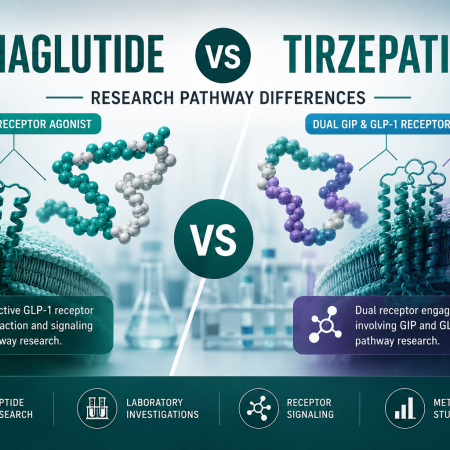
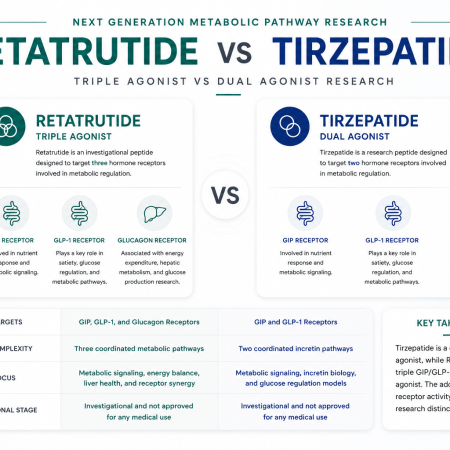
Dual agonist compounds are generally designed to interact with two receptor pathways. A common example in metabolic research is dual GIP and GLP-1 receptor activity. Triple agonist compounds build on this concept by adding a third pathway, most commonly glucagon receptor activity.
This difference is important because the glucagon receptor pathway introduces additional research questions related to hepatic metabolism, energy-balance models, and lipid metabolism signaling. For this reason, triple agonist research is often discussed as a next-stage framework in multi-receptor metabolic investigations.
| Research Feature | Dual Agonist Model | Triple Agonist Model |
|---|---|---|
| Number of Pathways | Two receptor pathways | Three receptor pathways |
| Common Metabolic Example | GIP and GLP-1 receptor activity | GIP, GLP-1, and glucagon receptor activity |
| Research Complexity | Moderate pathway interaction model | Higher-complexity pathway interaction model |
| Main Research Question | How two incretin pathways interact | How incretin and glucagon pathways coordinate |
| Experimental Interest | Dual receptor signaling | Multi-pathway receptor synergy |
Related reading: For a direct comparison of dual and triple agonist research compounds, see our article on Retatrutide vs Tirzepatide research.
The Role of Receptor Synergy
One of the central questions in triple agonist research is whether multiple receptor pathways can produce coordinated signaling patterns that differ from single-pathway activity. This concept is often described as receptor synergy.
In a research context, receptor synergy does not imply a guaranteed outcome. Instead, it refers to the scientific investigation of how multiple biological signaling systems may interact when activated within the same experimental model.
Signal Interaction
Researchers study how GLP-1, GIP, and glucagon receptor pathways may interact when evaluated together.
Pathway Balance
Triple agonist models raise questions about how receptor activity is balanced across multiple signaling systems.
System-Level Effects
Multi-pathway compounds allow researchers to evaluate broader signaling networks rather than isolated receptor activity.
Current Areas of Investigation
Triple agonist research continues to expand as investigators study how multi-receptor compounds behave across controlled experimental frameworks. Current areas of interest include incretin pathway interaction, glucagon receptor signaling, metabolic regulation, and receptor-selectivity models.
Incretin Pathway Research
GLP-1 and GIP receptor pathways remain central to research on nutrient-responsive signaling and metabolic pathway regulation.
Glucagon Pathway Research
Glucagon receptor activity is studied in relation to hepatic signaling, lipid metabolism models, and energy-balance investigations.
Receptor Selectivity
Researchers evaluate how strongly a compound interacts with each receptor pathway and how that balance may affect experimental interpretation.
Multi-Pathway Design
Triple agonist compounds are studied as examples of how peptide design can be used to investigate coordinated biological signaling.
Why Researchers Are Paying Attention
The increasing interest in triple agonist research is connected to the broader evolution of metabolic peptide studies. Scientific attention has moved from single-receptor GLP-1 models toward dual agonist and triple agonist frameworks that allow researchers to investigate more complex signaling relationships.
Retatrutide is one of the most frequently discussed examples of a triple agonist compound in current literature because it is being investigated for activity at GLP-1, GIP, and glucagon receptors. Its research profile has made triple agonist design a major topic in modern metabolic pathway discussions.
Key Takeaway
Triple agonist research is different because it studies three coordinated receptor pathways rather than one or two. In metabolic research, this usually means GLP-1, GIP, and glucagon receptor systems are evaluated together.
Final Thoughts
Triple agonist research represents a major step in the study of multi-receptor metabolic compounds. By combining GLP-1, GIP, and glucagon receptor activity into a single research framework, triple agonist models allow investigators to examine how multiple signaling systems may interact across metabolic and energy-balance pathways.
As this field continues to develop, triple agonist research will likely remain an important area of scientific investigation, especially for researchers studying incretin biology, receptor synergy, and multi-pathway metabolic signaling.
Explore GLP-1 & Metabolic Research
Review research-focused compounds categorized by receptor pathway, metabolic signaling interest, and laboratory research applications.
Explore GLP-1 & Metabolic ResearchReferences
[1] Rosenstock J, et al. Retatrutide, a GIP, GLP-1 and glucagon receptor agonist, for people with type 2 diabetes. View via PubMed
[2] Jastreboff AM, et al. Triple-Hormone-Receptor Agonist Retatrutide for Obesity. View via PubMed
[3] Goldney J, et al. Triple Agonism Based Therapies for Obesity. View via PubMed
[4] Nauck MA, et al. Tirzepatide, a dual GIP/GLP-1 receptor co-agonist for the treatment of type 2 diabetes. View via PubMed
[5] Abouelmagd AA, et al. Efficacy and safety of retatrutide, a novel GLP-1, GIP, and glucagon receptor agonist. View via PubMed
Disclaimer: This article is for informational and educational purposes only. Products and compounds discussed are intended for research use only and are not for human consumption, veterinary use, clinical use, diagnostic use, food use, supplement use, pharmaceutical use, cosmetic use, or any consumer application. Statements have not been evaluated by the FDA. This content does not provide medical advice, treatment guidance, dosing information, or recommendations for personal use.