No products in the cart.
U.S. FILLED & FINISHED | ≥99% COA-VERIFIED PURITY
LC-MS VERIFIED IDENTITY | INDEPENDENTLY TESTED
CJC-1295 No DAC pulsatile GH research centers on the DPP-IV-resistant modified GRF(1-29) peptide administered without its albumin-binding drug affinity complex, where preclinical and clinical investigations have examined how its shorter duration of action preserves physiological, pulsatile growth hormone release and supports synergistic pairing with ghrelin-receptor secretagogues.
CJC-1295 No DAC Pulsatile GH Research
CJC-1295 No DAC, also called Modified GRF(1-29), is a DPP-IV-resistant analog of growth hormone-releasing hormone administered without the albumin-binding drug affinity complex used in the long-acting form. Preclinical and clinical investigations have examined how its shorter duration of action preserves the discrete, pulsatile pattern of growth hormone release characteristic of the native hypothalamic-pituitary axis.
What Is CJC-1295 No DAC?
CJC-1295 No DAC is a synthetic 29-amino-acid peptide built on the GRF(1-29) backbone, the same first 29 residues of human growth hormone-releasing hormone (GHRH) that underlie several peptides discussed on this site. It carries amino acid substitutions engineered for resistance to dipeptidyl peptidase IV (DPP-IV), the enzyme that rapidly degrades native GHRH, but it lacks the maleimidopropionamide-lysine modification that allows the DAC-bearing version of CJC-1295 to bind covalently to circulating serum albumin.
This is the key structural distinction from the long-acting form. For the albumin-binding chemistry and pharmacokinetics of that version, see our dedicated overview of CJC-1295 and peptide half-life research. This post takes the opposite angle: rather than examining how half-life is extended, it examines what research has found when that extension is deliberately left out.
Why Pulsatility Is a Research Variable, Not Just a Limitation
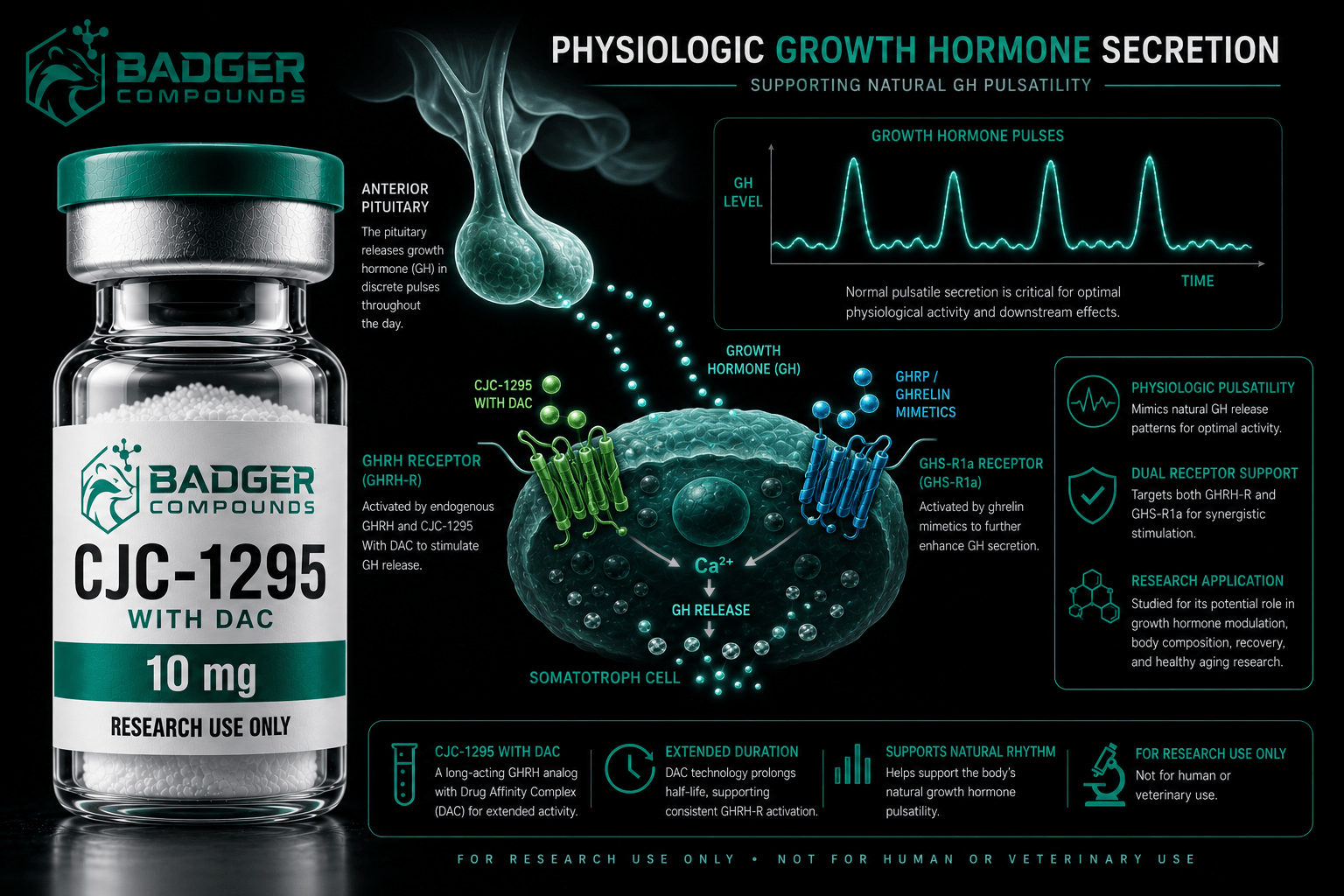
Endogenous growth hormone is not secreted at a constant rate. It is released from the anterior pituitary in discrete pulses, driven by the interplay of hypothalamic GHRH and somatostatin, and this pulsatile pattern is considered physiologically important, distinct from simply raising average GH levels. A short-acting GHRH analog, cleared from circulation within roughly 30 to 60 minutes, produces a research profile in which each administration corresponds to a discrete stimulatory event rather than a sustained one.
The foundational paper by Jette and colleagues (2005), published in Endocrinology, is instructive here, even though its primary focus was the DAC-conjugated form. In the same experiment, the researchers reported that the DAC-bound compound produced a 4-fold increase in GH area under the curve compared with unconjugated hGRF(1-29), the No-DAC molecule, over a 2-hour observation window in rats. This head-to-head data point is useful precisely because it comes from a single controlled comparison: the unmodified short-acting peptide produced a real but smaller and more contained GH response than its albumin-bound counterpart.
DPP-IV Resistant Backbone
Amino acid substitutions in the GRF(1-29) sequence confer resistance to enzymatic degradation shared by both the No-DAC and DAC-bearing forms.
Discrete Stimulatory Events
Without covalent albumin binding, clearance within roughly 30 to 60 minutes produces a research profile of individual, time-limited GH secretory events rather than sustained receptor occupancy.
Smaller, Contained Response
Preclinical comparison data reported a measurably smaller GH area under the curve for the unconjugated peptide relative to the DAC-bound form over the same observation window.
Research framing: All findings referenced in this post derive from preclinical and clinical research conducted by third parties. CJC-1295 No DAC is supplied by Badger Compounds for laboratory research use only and is not intended for human or veterinary use. No therapeutic conclusions should be drawn from the research discussed here.
Pulsatility Is Preserved Even With the Long-Acting Form
An important and somewhat counterintuitive finding comes from Ionescu and Frohman (2006), publishing in the Journal of Clinical Endocrinology and Metabolism, who examined GH pulsatility after a single injection of the long-acting, DAC-bound CJC-1295 in healthy men. The research reported that GH secretion increased with preserved pulsatility. The frequency and magnitude of GH secretory pulses were unaltered by the long-acting compound; instead, the drug primarily raised basal (trough) GH levels roughly 7.5-fold, which contributed most of the overall increase in mean GH and IGF-1 output.
This finding is useful context for No-DAC research specifically. It indicates that the pituitary’s pulse-generating machinery is not simply overridden by sustained GHRH receptor engagement, but it also clarifies what the No-DAC form is, and is not, expected to change relative to the DAC form. Researchers interested in studying discrete, time-limited secretory events without an accompanying rise in basal trough GH may find the shorter-acting molecule better suited to that specific research question.
Synergy With Ghrelin-Receptor Secretagogues
GHRH analogs and ghrelin-receptor agonists (growth hormone-releasing peptides, or GHRPs) stimulate GH release through distinct receptors and are frequently studied together because of a well-documented synergistic interaction. Pihoker and colleagues (1995), publishing in the Journal of Clinical Endocrinology and Metabolism, administered GHRH and the GHRP-family secretagogue GHRP-2 together intravenously in a pediatric research cohort and reported a synergistic GH response, consistent with earlier observations in adults of normal stature. This combined-stimulation effect is a recurring theme across the GHRH and GHRP literature and is the physiological rationale researchers cite for pairing a short-acting GHRH analog with a GHRP-family compound.
Ipamorelin is a common research pairing in this context. Raun and colleagues (1998), publishing in the European Journal of Endocrinology, characterized ipamorelin as a pentapeptide GHRP-receptor agonist with GH-releasing potency comparable to GHRP-6, but notable for its selectivity: across the doses tested, ipamorelin did not significantly raise ACTH or cortisol, in contrast to GHRP-6 and GHRP-2. This selectivity profile is the reason ipamorelin is frequently the GHRP-family compound paired with modified GRF(1-29) in research settings where isolating the GH axis from broader HPA-axis activation is a design priority.
| Research Focus | System | Reported Observation |
|---|---|---|
| DAC vs. unconjugated comparison | Rat anterior pituitary and plasma (Jette 2005) | DAC form showed 4-fold greater GH AUC than unconjugated hGRF(1-29) |
| GH pulsatility under long-acting stimulation | Healthy men, overnight sampling (Ionescu 2006) | Pulse frequency and magnitude preserved; trough GH markedly increased |
| GHRH + GHRP-2 combined administration | Pediatric research cohort (Pihoker 1995) | Synergistic GH response, consistent with adult findings |
| Ipamorelin receptor selectivity | Rat pituitary cells, swine, anaesthetized rats (Raun 1998) | GH-releasing potency similar to GHRP-6; minimal ACTH/cortisol effect |
CJC-1295 No DAC is a research-use-only peptide. Badger Compounds supplies CJC-1295 No DAC exclusively for qualified research applications in controlled laboratory settings. The research summarized here does not establish safety or efficacy in any human population.
Choosing Between No-DAC and DAC Forms as a Research Variable
Because both forms share the same DPP-IV-resistant GRF(1-29) backbone and act through the same GHRH receptor, the choice between them functions as an experimental design variable rather than a simple potency comparison. The No-DAC form’s short window of activity makes it a closer pharmacokinetic match to native, pulsatile GHRH signaling and to the timing requirements of combined GHRH-plus-GHRP research protocols. The DAC-bound form trades that discrete pulse timing for sustained receptor engagement and a markedly elevated trough GH level, as the Ionescu findings above illustrate.
Neither profile is inherently superior; they answer different research questions. Investigators modeling sustained GH axis activation, comparable to a continuous secretagogue exposure, are better served by the DAC form and the pharmacokinetic data summarized in our dedicated CJC-1295 half-life article. Investigators modeling discrete pulsatile events, or designing protocols timed around a GHRP-family co-administration, are working within the research context this No-DAC-specific literature addresses.
Shared Backbone, Different Duration
Both forms carry the same DPP-IV-resistant GRF(1-29) modifications. Only the DAC form adds the moiety responsible for covalent albumin binding and extended half-life.
A Design Choice, Not a Potency Ranking
Selecting between the two forms depends on whether a research protocol is modeling discrete pulsatile events or sustained receptor engagement.
Research Pathways Associated with CJC-1295 No DAC
Preclinical and clinical literature has examined this GRF(1-29) analog and its research context across several interconnected themes:
GHRH receptor agonism DPP-IV resistance Pulsatile GH secretion GHRH + GHRP synergy GHS-R1a (ghrelin receptor) co-stimulation Trough vs. pulse GH dynamics IGF-1 secretion Somatotroph pituitary signalingCJC-1295 No DAC – Research Grade, ≥99% (HPLC)
Badger Compounds supplies CJC-1295 No DAC as a lyophilized research peptide, six-round independently tested per batch with publicly viewable COAs. For qualified laboratory research use only.
View CJC-1295 No DAC- Jette L, Leger R, Thibaudeau K, et al. Human growth hormone-releasing factor (hGRF)1-29-albumin bioconjugates activate the GRF receptor on the anterior pituitary in rats: identification of CJC-1295 as a long-lasting GRF analog. Endocrinology. 2005;146(7):3052-3058. PMID 15817669
- Ionescu M, Frohman LA. Pulsatile secretion of growth hormone (GH) persists during continuous stimulation by CJC-1295, a long-acting GH-releasing hormone analog. J Clin Endocrinol Metab. 2006;91(12):4792-4797. PMID 17018654
- Pihoker C, Middleton R, Reynolds GA, Bowers CY, Badger TM. Diagnostic studies with intravenous and intranasal growth hormone-releasing peptide-2 in children of short stature. J Clin Endocrinol Metab. 1995;80(10):2987-2992. PMID 7559885
- Raun K, Hansen BS, Johansen NL, et al. Ipamorelin, the first selective growth hormone secretagogue. Eur J Endocrinol. 1998;139(5):552-561. PMID 9849822
Disclaimer: CJC-1295 No DAC is supplied by Badger Compounds for laboratory and in vitro research use only. It is not intended for human or veterinary use, and no product sold by Badger Compounds is approved for therapeutic, diagnostic, or clinical application. All research findings referenced in this post are derived from preclinical and clinical studies conducted by third parties. No clinical efficacy or safety conclusions should be drawn from the data summarized here.