No products in the cart.
U.S. FILLED & FINISHED | ≥99% COA-VERIFIED PURITY
LC-MS VERIFIED IDENTITY | INDEPENDENTLY TESTED
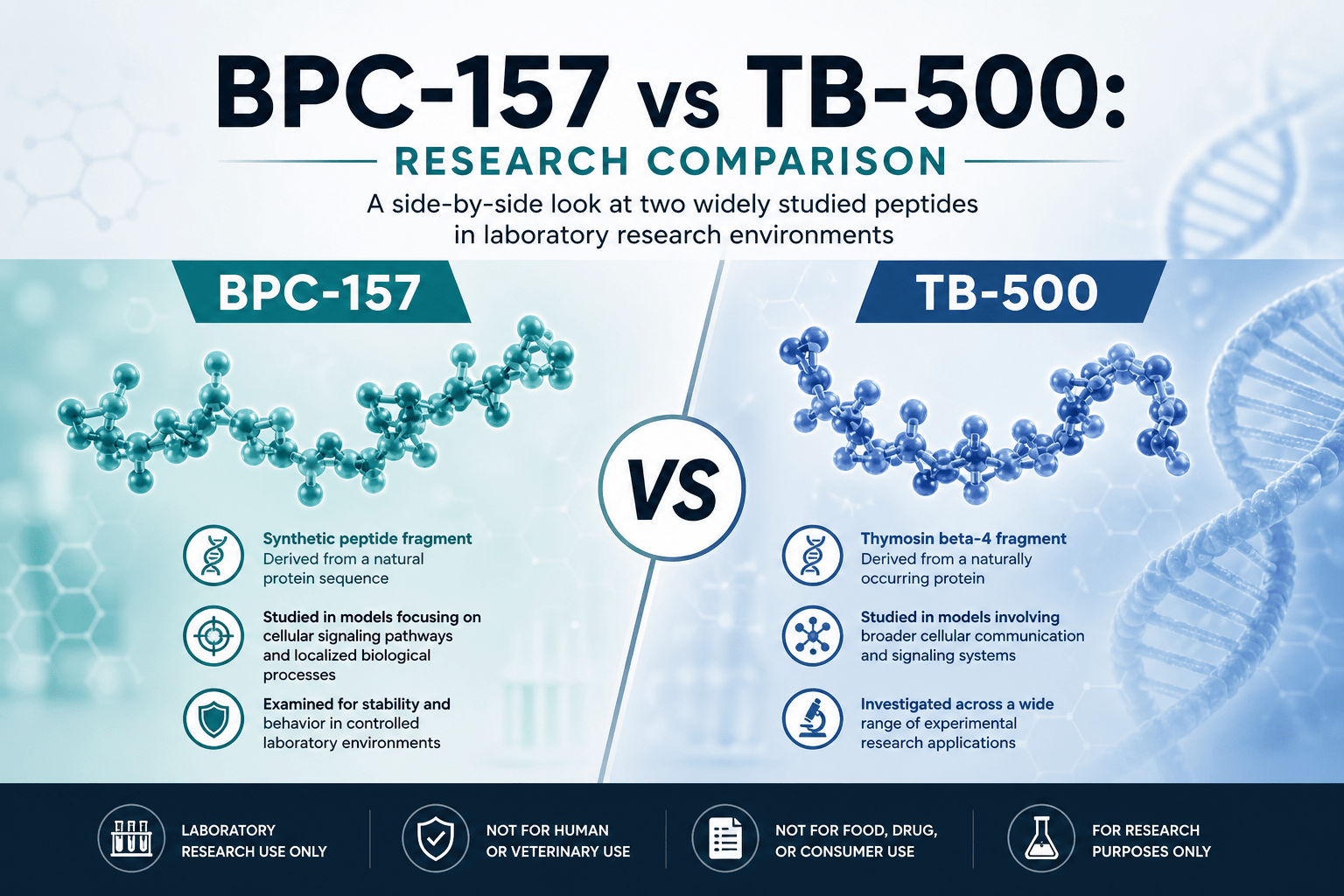
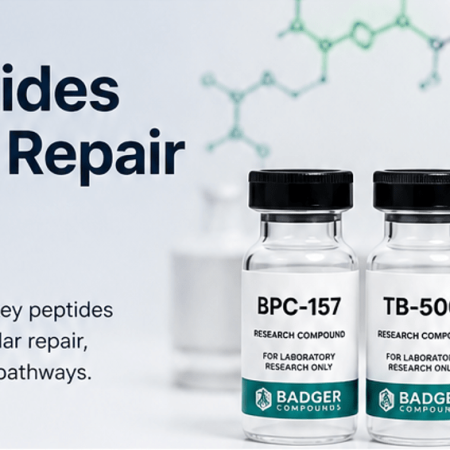
BPC-157 vs TB-500 is one of the most common pairings in tissue-repair research, but the two compounds differ in origin, structure, and mechanism, and, less commonly discussed, in how far their evidence base has actually progressed. This guide compares them directly.
BPC-157 vs TB-500: Key Differences in Research Applications
BPC-157 and TB-500 are studied together so often that it’s easy to assume they’re interchangeable. They are not. One is a synthetic 15-amino-acid fragment derived from a gastric protein; the other is a synthetic fragment of a completely different, naturally circulating protein. Their proposed mechanisms don’t overlap, and, less obviously, their evidence bases have progressed to very different points.
Structural Origin
BPC-157 is a 15-amino-acid pentadecapeptide derived from a larger protein isolated from human gastric juice in 1993. TB-500 is a synthetic fragment corresponding to an active region of thymosin beta-4, a naturally occurring 43-amino-acid protein found throughout the body. The two share no sequence relationship; they are unrelated molecules that happen to be studied within the same tissue-repair research category.
Research framing: This article is intended for educational and research-context discussion only. BPC-157 and TB-500 are research compounds sold for laboratory investigation only. This content does not provide medical advice, dosing guidance, or treatment recommendations of any kind.
Mechanism Comparison
BPC-157
Research has linked BPC-157 to VEGF-driven angiogenesis, eNOS-mediated nitric oxide signaling, and modulation of the immediate-response gene EGR-1.
TB-500
TB-500’s parent protein, thymosin beta-4, is the major actin-sequestering protein in mammalian cells, and TB-500 research centers on that cytoskeletal regulation and downstream cell migration and survival signaling through ILK and Akt.
These are genuinely different biochemical systems: one centers on vascular signaling molecules, the other on the structural machinery cells use to move and rebuild themselves.
Comparison Table
| Feature | BPC-157 | TB-500 |
|---|---|---|
| Origin | Fragment of a gastric juice protein | Fragment of thymosin beta-4 |
| Length | 15 amino acids | Shorter fragment of a 43-amino-acid protein |
| Core mechanism | VEGF, eNOS, EGR-1 | Actin sequestration, ILK-Akt |
| Strongest preclinical focus | GI tract, tendon and ligament | Cardiac tissue, cell migration |
| Human evidence | Three small pilot studies | One randomized controlled trial (96 patients) |
The evidence-stage gap is worth noting on its own. TB-500’s parent compound, recombinant thymosin beta-4, has been tested in a genuine randomized, placebo-controlled human trial for cardiac injury. BPC-157’s human evidence, by contrast, is limited to three small pilot studies. Neither compound is FDA-approved, but they are not at the same point in the research pipeline.
Why They Are Studied Together Anyway
Despite their unrelated origins and mechanisms, BPC-157 and TB-500 are frequently paired in tissue-repair research because their proposed effects, vascular signaling on one side and cytoskeletal/migratory signaling on the other, are considered complementary rather than redundant components of the broader repair process. For the fuller picture of that rationale, see our overview of BPC-157 and TB-500 research.
Learn More About Each Compound
For a full, dedicated look at each compound individually, including proposed mechanisms and the current evidence picture, see our in-depth guides:
BPC-157 Research TB-500 ResearchExplore Regenerative Research Compounds – ≥99% (HPLC)
Badger Compounds supplies BPC-157 and TB-500 individually, each six-round independently tested per batch with publicly viewable COAs. For qualified laboratory research use only.
Explore Regenerative Compounds- Sikirić P, Petek M, Rucman R, et al. A new gastric juice peptide, BPC. J Physiol Paris. 1993;87(5):313-327. PMID 8298609
- Goldstein AL, Hannappel E, Kleinman HK. Thymosin beta4: actin-sequestering protein moonlights to repair injured tissues. Trends Mol Med. 2005;11(9):421-429. PMID 16099219
- McGuire FP, Martinez R, Lenz A, Skinner L, Cushman DM. Regeneration or risk? A narrative review of BPC-157 for musculoskeletal healing. Curr Rev Musculoskelet Med. 2025;18(12):611-619. PMID 40789979
- Zhang Y, Dong Q, Bian X, Qiao Z, Cui C, et al. Recombinant human thymosin beta 4 improves ischemic cardiac dysfunction in mice and patients with acute ST-segment elevation myocardial infarction after reperfusion. Cardiovasc Res. 2025;121(17):2747-2758. PMID 41229390
Disclaimer: This article is for informational and educational purposes only. Products and compounds discussed are intended for research use only and are not for human consumption, veterinary use, clinical use, diagnostic use, food use, supplement use, pharmaceutical use, cosmetic use, or any consumer application. Statements have not been evaluated by the FDA. This content does not provide medical advice, treatment guidance, dosing information, or recommendations for personal use.