No products in the cart.
U.S. FILLED & FINISHED | ≥99% COA-VERIFIED PURITY
LC-MS VERIFIED IDENTITY | INDEPENDENTLY TESTED
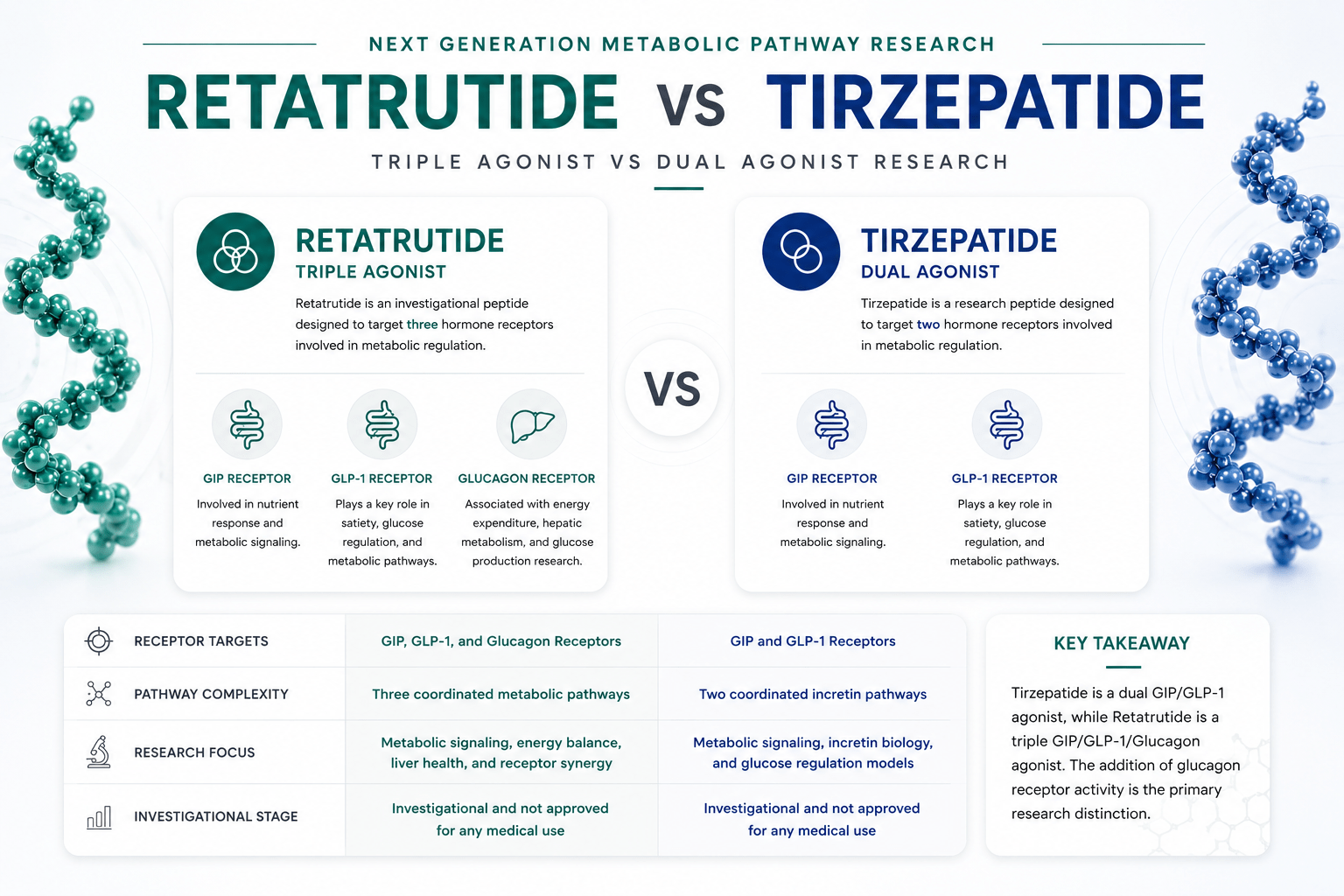
Retatrutide vs Tirzepatide: Triple Agonist vs Dual Agonist Research
Multi-receptor metabolic research has become one of the most closely watched areas in peptide and incretin pathway studies. Two compounds frequently discussed in this field are tirzepatide and retatrutide, which differ primarily in the number of receptor pathways they are designed to engage.
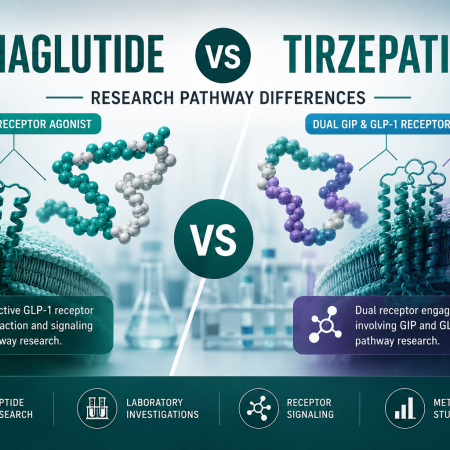
Tirzepatide is commonly described in the literature as a dual GIP and GLP-1 receptor agonist, while retatrutide is being investigated as a triple agonist targeting GIP, GLP-1, and glucagon receptor pathways. This article reviews how these research compounds differ from a receptor-signaling perspective.
Research focus: This article is intended for educational and research-context discussion only. It compares receptor targets, investigational pathways, and laboratory research interest surrounding dual agonist and triple agonist compounds. The retatrutide vs tirzepatide comparison is frequently discussed in modern metabolic receptor research.
Why Multi-Receptor Metabolic Research Matters
Incretin-based research focuses on receptor pathways involved in incretin-receptor signaling and multi-receptor pathway interaction. Earlier research often focused on single receptor pathways, especially GLP-1 receptor activity. More recent investigations have expanded into dual and triple receptor approaches.
The scientific interest behind this shift is based on the idea that multiple coordinated pathways may produce different biological signaling patterns compared with single-pathway models. This is why compounds such as tirzepatide and retatrutide are often discussed in relation to receptor selectivity and multi-receptor pathway interaction.
Dual Agonist Research
Dual agonist compounds are designed to interact with two receptor systems. Tirzepatide is commonly categorized as a dual GIP and GLP-1 receptor agonist in published research.
Triple Agonist Research
Triple agonist compounds are designed to interact with three receptor systems. Retatrutide is being investigated for activity at GIP, GLP-1, and glucagon receptors.
What Is Tirzepatide?
Tirzepatide is a synthetic peptide-based research compound widely discussed for its dual receptor activity. In the scientific literature, it is described as a dual agonist of the glucose-dependent insulinotropic polypeptide receptor, commonly abbreviated GIP, and the glucagon-like peptide-1 receptor, commonly abbreviated GLP-1.
From a research standpoint, tirzepatide is often studied because it allows investigators to evaluate how GIP and GLP-1 receptor pathways may interact within receptor signaling models. This dual-pathway design has made it an important reference point for newer multi-receptor compounds.
Primary Research Characteristics of Tirzepatide
- Dual receptor agonist model
- Targets GIP and GLP-1 receptor pathways
- Frequently studied in metabolic and incretin pathway research
- Often used as a comparison point for newer triple agonist compounds
What Is Retatrutide?
Retatrutide, also known in research literature as LY3437943, is being investigated as a triple hormone receptor agonist. Unlike dual agonist models, retatrutide is designed to engage three receptor pathways: GIP, GLP-1, and glucagon.
The addition of glucagon receptor activity is one of the main reasons retatrutide is drawing attention in metabolic research. Glucagon receptor signaling introduces a third receptor target, making retatrutide distinct from dual incretin models in receptor-selectivity research.
Primary Research Characteristics of Retatrutide
- Triple receptor agonist model
- Targets GIP, GLP-1, and glucagon receptor pathways
- Investigated in receptor-binding and multi-receptor selectivity research models
- Represents a newer multi-pathway approach compared with dual agonist compounds
Retatrutide vs Tirzepatide: Research Comparison
| Research Feature | Tirzepatide | Retatrutide |
|---|---|---|
| Receptor Category | Dual agonist | Triple agonist |
| Primary Targets | GIP and GLP-1 receptors | GIP, GLP-1, and glucagon receptors |
| Research Position | Established dual incretin pathway model | Emerging triple hormone receptor model |
| Pathway Complexity | Two coordinated incretin pathways | Three coordinated receptor signaling pathways |
| Key Research Interest | GIP and GLP-1 pathway interaction | GIP, GLP-1, and glucagon pathway interaction |
The Role of GLP-1 Pathway Research
GLP-1 receptor signaling remains a central area of incretin-receptor research. GLP-1 pathways are commonly studied in relation to incretin-receptor signaling models and receptor-selectivity characterization.
Both tirzepatide and retatrutide include GLP-1 receptor activity as part of their research profile. However, their broader receptor designs differ. Tirzepatide combines GLP-1 with GIP receptor activity, while retatrutide combines GLP-1 with both GIP and glucagon receptor activity.
The Role of GIP Pathway Research
GIP, or glucose-dependent insulinotropic polypeptide, is another incretin pathway investigated in incretin-receptor signaling research. GIP receptor activity is often studied alongside GLP-1 receptor activity because both are incretin-receptor pathways examined in binding and selectivity models.
Tirzepatide and retatrutide both include GIP receptor activity. This shared pathway is one reason researchers often compare the two compounds. The distinction is that tirzepatide remains a dual agonist model, while retatrutide expands the receptor profile to include glucagon receptor activity.
Why Glucagon Receptor Activity Makes Retatrutide Different
The glucagon receptor component is the main feature that separates retatrutide from tirzepatide in research discussions. Glucagon receptor signaling is studied as a third receptor target in receptor-selectivity and multi-receptor pathway research.
In a triple agonist design, researchers are able to investigate how glucagon receptor activity may interact with GIP and GLP-1 receptor signaling. This added pathway creates a more complex research model and is one of the reasons retatrutide is frequently described as a next-generation multi-receptor compound.
Tirzepatide Research Model
- GIP receptor pathway
- GLP-1 receptor pathway
- Dual incretin signaling framework
Retatrutide Research Model
- GIP receptor pathway
- GLP-1 receptor pathway
- Glucagon receptor pathway
- Triple hormone receptor framework
Current Areas of Investigation
Both compounds are part of a larger scientific trend toward multi-pathway metabolic research. Current investigations are focused on how receptor combinations may influence signaling patterns in controlled study environments.
Receptor Signaling
Researchers continue to evaluate how incretin and hormone receptor pathways contribute to receptor signaling networks.
Multi-Receptor Models
Triple agonist research has increased interest in how glucagon receptor activity may broaden multi-receptor selectivity studies.
Receptor Synergy
Dual and triple agonist compounds allow researchers to examine whether combined receptor targeting creates distinct signaling patterns.
Comparative Pathway Research
Tirzepatide and retatrutide are frequently compared because they represent different stages of multi-receptor incretin research.
Why Researchers Compare Retatrutide and Tirzepatide
Retatrutide and tirzepatide are often compared because both are designed around incretin-related receptor systems, yet they represent different levels of receptor complexity. Tirzepatide is a dual agonist model involving GIP and GLP-1 receptor activity. Retatrutide builds on that framework by adding glucagon receptor activity.
This comparison is useful for researchers because it helps clarify how changes in receptor targeting may affect experimental design, pathway interpretation, and broader receptor signaling hypotheses.
Key takeaway: Tirzepatide is primarily discussed as a dual GIP/GLP-1 receptor agonist, while retatrutide is being investigated as a triple GIP/GLP-1/glucagon receptor agonist. The added glucagon receptor pathway is the main research distinction.
Final Thoughts
The comparison between retatrutide and tirzepatide highlights the rapid development of multi-receptor metabolic research. Tirzepatide represents a dual agonist approach focused on GIP and GLP-1 receptor pathways, while retatrutide represents an emerging triple agonist approach that adds glucagon receptor activity to the research model.
For researchers studying incretin pathways and receptor signaling, these compounds provide two distinct frameworks for understanding how multi-receptor targeting may inform binding and selectivity research models. As retatrutide vs tirzepatide research continues evolving, investigators remain interested in how dual and triple agonist compounds differ across receptor signaling models.
Explore GLP-1 and Metabolic Research Compounds
Review research-focused compounds categorized by receptor pathway, signaling interest, and laboratory research applications.
Explore GLP-1 & Metabolic ResearchReferences
[1] Rosenstock J, et al. Retatrutide, a GIP, GLP-1 and glucagon receptor agonist, for people with type 2 diabetes. View via PubMed
[2] Jastreboff AM, et al. Triple-Hormone-Receptor Agonist Retatrutide for Obesity. View via PubMed
[3] Nauck MA, et al. Tirzepatide, a dual GIP/GLP-1 receptor co-agonist for the treatment of type 2 diabetes. View via PubMed
[4] Thomas MK, et al. Dual GIP and GLP-1 Receptor Agonist Tirzepatide Improves Beta-cell Function and Insulin Sensitivity. View via PubMed
[5] Sanyal AJ, et al. Triple hormone receptor agonist retatrutide for metabolic dysfunction-associated steatotic liver disease. View via PubMed
Disclaimer: This article is for informational and educational purposes only. Products and compounds discussed are intended for research use only and are not for human consumption, veterinary use, clinical use, diagnostic use, food use, supplement use, pharmaceutical use, cosmetic use, or any consumer application. Statements have not been evaluated by the FDA. This content does not provide medical advice, treatment guidance, dosing information, or recommendations for personal use.