No products in the cart.
U.S. FILLED & FINISHED | ≥99% COA-VERIFIED PURITY
LC-MS VERIFIED IDENTITY | INDEPENDENTLY TESTED
Why Third-Party Testing Matters in Research Compounds
Third-party testing for research compounds is one of the most important yet most overlooked quality indicators when sourcing peptides and other investigational materials. When a supplier claims high purity, that figure is only as credible as the verification process behind it.
Independent analytical confirmation by an accredited laboratory outside the manufacturing chain is the clearest signal that a research compound meets the standards required for rigorous preclinical investigation. This article explores why independent verification matters and what researchers should look for when evaluating sourcing transparency.
Research focus: This article is intended for educational and research-context discussion only. It reviews analytical testing standards, Certificate of Analysis documentation, and quality verification frameworks without providing medical advice, dosing information, or treatment guidance.
The Problem with Self-Reported Quality Data
When a research compound supplier reports that a peptide is 99% pure, that figure is meaningful only if the underlying analytical process is credible, rigorous, and free from commercial bias. In-house testing, where the same organization that manufactures and sells a compound also performs its quality analysis, creates an inherent conflict of interest that independent scientific standards are designed to eliminate.
This is not a hypothetical concern. Investigations into research compound markets have identified significant discrepancies between supplier-reported purity figures and results obtained through independent analytical verification. For researchers whose experimental outcomes depend on compound consistency, these discrepancies can introduce confounding variables that undermine the reproducibility of preclinical investigations.
Why Independence Matters
Third-party testing for research compounds removes the conflict of interest inherent in self-reported quality data. When an independent, accredited laboratory confirms purity, identity, and batch consistency, researchers gain an objective foundation for evaluating compound suitability.
What Third-Party Testing Actually Evaluates
Independent analytical laboratories assess research compounds across multiple quality dimensions simultaneously. A comprehensive third-party analysis goes well beyond confirming a single purity percentage.
Test 1
HPLC Purity
Reversed-phase HPLC quantifies the target peptide peak as a percentage of all UV-detected species. Independent labs validate method conditions to ensure the gradient and column used do not artificially inflate purity readings.
Test 2
Mass Spectrometry
ESI-MS or MALDI-TOF analysis confirms the molecular weight of the synthesized peptide matches the expected theoretical mass, ruling out sequence errors, truncations, or gross synthesis failures.
Test 3
Impurity Profiling
Beyond the headline purity figure, independent analysis characterizes the nature of any detected impurities, including deletion sequences, oxidized variants, and residual reagents from the synthesis process.
Test 4
Batch Traceability
Results are tied to a unique lot number, enabling researchers to cross-reference specific production batches with their experimental data – essential for reproducible multi-assay research programs.
Test 5
Method Validation
Accredited third-party labs operate under validated analytical methods and quality management systems, ensuring results are reproducible, defensible, and produced under controlled conditions.
Test 6
Independent CoA
A complete, independently generated Certificate of Analysis documents all analytical findings with the laboratory’s accreditation details, analyst signatures, and instrument identifiers.
The Badger Compounds 6x Testing Standard
Every Badger Compounds research product undergoes six independent analytical checkpoints before release. This multi-stage verification process is designed to provide researchers with the highest level of sourcing confidence available in the RUO compound space.
01
HPLC Purity
Reversed-phase chromatographic purity analysis confirming the target compound percentage.
02
Mass Spectrometry
Molecular weight confirmation verifying correct peptide sequence and identity.
03
Impurity Profiling
Characterization of all detected species beyond the primary peptide peak.
04
Physical Assessment
Appearance, lyophilization quality, and reconstitution behavior evaluation.
05
Batch Verification
Lot-specific documentation linking analytical results to production batch records.
06
Independent CoA
Third-party Certificate of Analysis issued by an accredited external laboratory.
In-House Testing vs Third-Party Testing
Understanding the difference between self-reported and independently verified quality data is essential for researchers making sourcing decisions. The table below outlines the key distinctions across research-relevant quality dimensions.
| Quality Dimension | In-House Testing Only | Third-Party Testing |
|---|---|---|
| Conflict of Interest | Present – same entity tests and sells | Eliminated – independent laboratory |
| Method Validation | Variable – internal standards only | ISO-equivalent accredited conditions |
| Purity Reliability | May use optimized conditions | Validated, conservative methods |
| Identity Confirmation | Sometimes absent | Mass spec confirmation standard |
| Batch Traceability | Inconsistent | Lot-specific documentation |
| CoA Credibility | Self-reported only | Independently verified |
| Reproducibility Support | Limited | Strong |
How to Evaluate a Certificate of Analysis
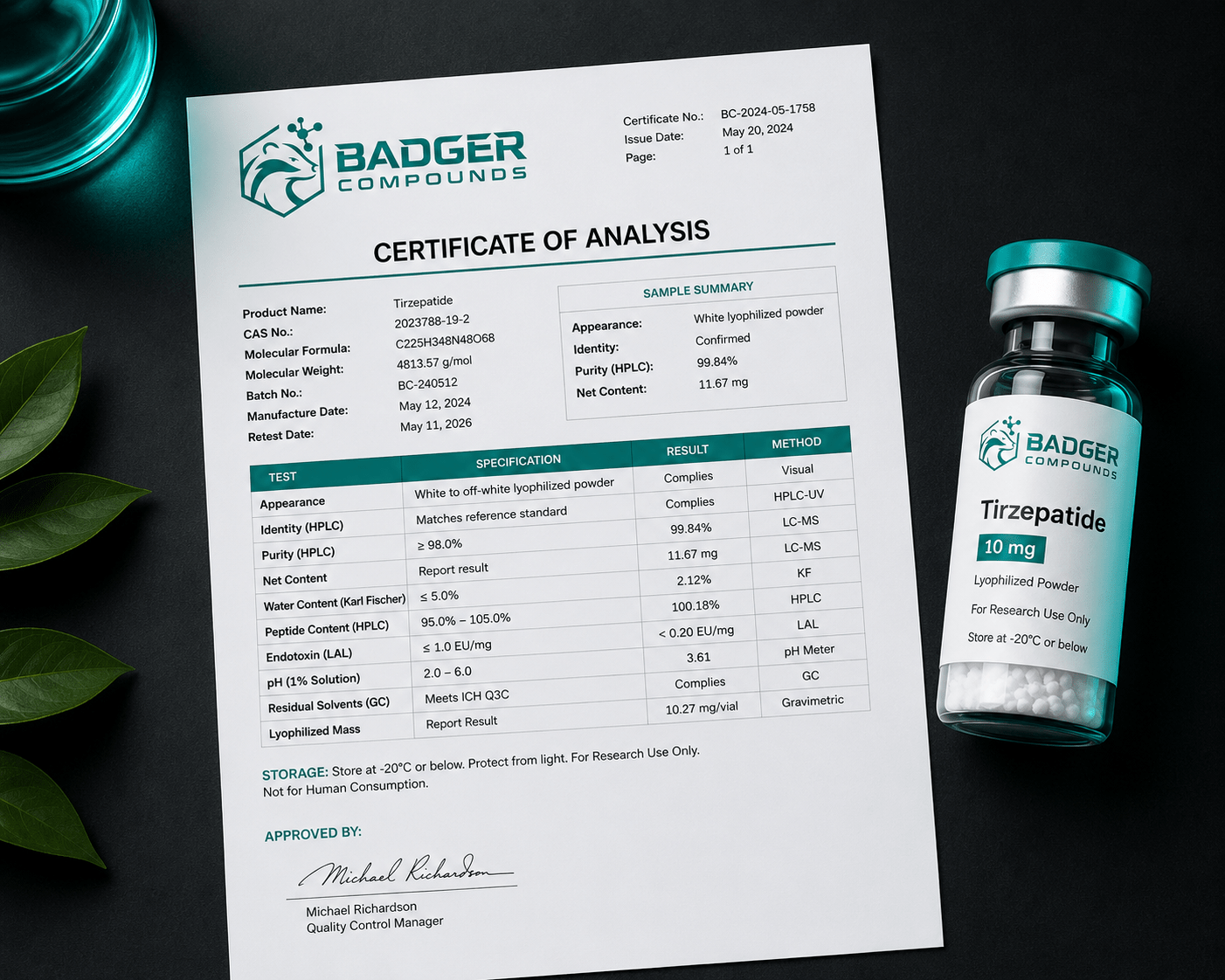
Not all Certificates of Analysis are created equal. A research-grade CoA communicates far more than a purity number. Knowing what to look for helps researchers distinguish genuinely verified documentation from a marketing placeholder.
Red Flags in a CoA
- No laboratory name or accreditation number
- Purity figure with no HPLC chromatogram
- No mass spectrometry data included
- Generic CoA applied to multiple batches
- No lot number or production date
- Analytical method details absent
Green Flags in a CoA
- Named, accredited third-party laboratory
- Full HPLC chromatogram with peak data
- Mass spectrum with correct molecular ion
- Unique lot number per production batch
- Complete analytical method parameters
- Analyst name, date, and instrument ID
Why Chromatogram Visibility Matters
A purity percentage without a visible chromatogram is an unverifiable claim. The chromatographic trace allows a researcher to independently assess peak shape, baseline resolution, and the relative magnitude of any impurity peaks – information that a single number cannot convey.
Suppliers who provide full chromatogram data alongside purity figures demonstrate a higher standard of analytical transparency and give researchers the tools to make informed sourcing decisions. This level of documentation is standard practice at Badger Compounds for every research-use-only product in our catalog.
Related reading: For a deeper look at what purity percentages actually represent analytically, see our article on What Does 99% Purity Actually Mean in Peptide Research?
Final Thoughts
Third-party testing for research compounds is not a premium add-on or a marketing differentiator – it is a fundamental requirement for any supplier serious about supporting reproducible scientific investigation. In preclinical research, the integrity of experimental outcomes is inseparable from the quality of the compounds used to generate them.
Researchers evaluating peptide compound suppliers should treat independent CoA availability as a baseline qualification. The presence of a third-party verified Certificate of Analysis, complete with chromatographic data, mass confirmation, and batch traceability, is the most reliable indicator that a supplier’s quality claims are grounded in objective, verifiable analytical science.
View Our Research Compound Catalog
Every Badger Compounds product is supported by our 6x independent testing standard and full third-party CoA documentation.
Explore Research CompoundsReferences
[1] Venhuis BJ, et al. Analytical profiles of designer drugs and research chemicals. Drug Test Anal. 2014;6(7-8):637-651. View via PubMed
[2] Waliczek M, et al. Profiling of Peptide Libraries: Purity Evaluation by HPLC and Mass Spectrometry. Molecules. 2021;26(16):4769. View via PubMed
[3] Behrendt R, White P, Offer J. Advances in Fmoc solid-phase peptide synthesis. J Pept Sci. 2016;22(1):4-27. View via PubMed
[4] Stawikowski M, Fields GB. Introduction to peptide synthesis. Curr Protoc Protein Sci. 2012;Chapter 18:Unit 18.1. View via PubMed
[5] Dresen S, et al. Research chemicals and the challenge of quality verification in analytical toxicology. J Pharm Biomed Anal. 2010;53(5):1188-1195. View via PubMed
Disclaimer: This article is for informational and educational purposes only. Products and compounds discussed are intended for research use only and are not for human consumption, veterinary use, clinical use, diagnostic use, food use, supplement use, pharmaceutical use, cosmetic use, or any consumer application. Statements have not been evaluated by the FDA. This content does not provide medical advice, treatment guidance, dosing information, or recommendations for personal use.