No products in the cart.
U.S. FILLED & FINISHED | ≥99% COA-VERIFIED PURITY
LC-MS VERIFIED IDENTITY | INDEPENDENTLY TESTED
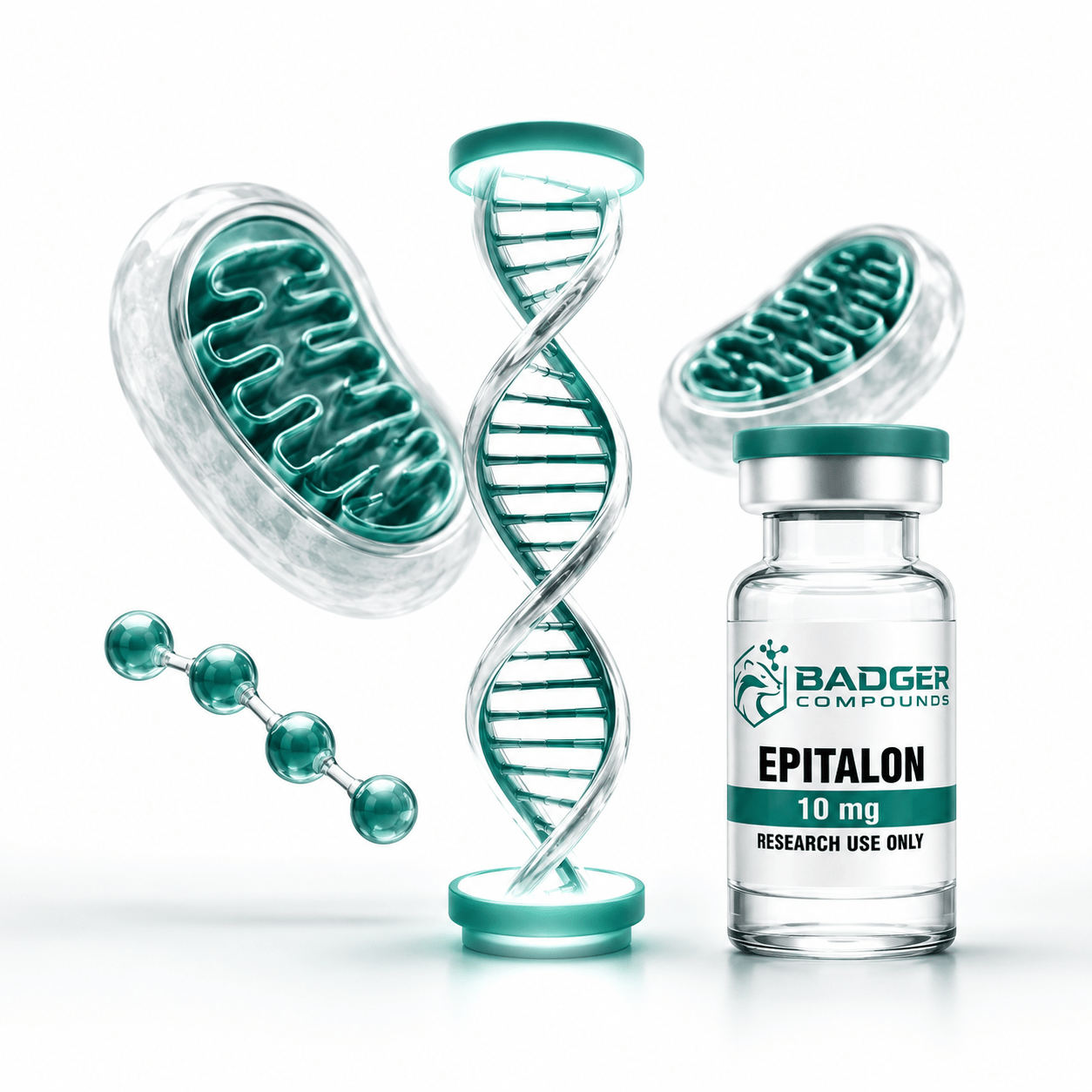
Epitalon is a synthetic pineal tetrapeptide that has become a recurring subject in cellular aging research. Below we review what preclinical investigations and cell-culture studies suggest about how Epitalon interacts with telomere biology, antioxidant defense, mitochondrial function, and genomic stability in research models.
Epitalon is one of the most extensively studied pineal peptides in the longevity research field. We look at what cell-culture and preclinical investigations suggest about its role in cellular aging, from telomere maintenance to oxidative balance.
Epitalon, also written as Epithalon, is a synthetic tetrapeptide with the sequence Ala-Glu-Asp-Gly (AEDG). It was designed from the amino acid composition of epithalamin, a peptide complex originally extracted from the pineal gland, and it has been a recurring subject in geroscience literature for more than two decades. In research settings, scientists study how this short peptide interacts with several of the core biological pathways associated with aging.
Across in vitro, in vivo, and in silico work, a 2025 review describes Epitalon as showing geroprotective and neuroendocrine activity in research models, attributed to antioxidant, neuroprotective, and antimutagenic mechanisms. Here we summarize the main pathways that cellular aging research has examined.
Cellular Aging Pathways Studied With Epitalon
Telomere Biology
Telomerase and Telomere Length
Cell-culture studies report that Epitalon can induce telomerase expression and telomere elongation in human somatic cells, a key focus area in replicative aging research.
Redox Balance
Antioxidant Activity
Research suggests Epitalon behaves as an antioxidant in several models and may influence the activity of endogenous antioxidant enzymes.
Bioenergetics
Mitochondrial Function
In vitro work has examined Epitalon in the context of mitochondrial membrane potential and mitochondrial DNA content in aging cell models.
Genomic Stability
Chromosomal Integrity
Preclinical investigations have looked at markers of genomic stability, including chromosome aberration frequency in aging research models.
Telomere Biology and Replicative Aging
The most cited line of Epitalon research concerns telomere biology. In a foundational 2003 study, addition of Epithalon to telomerase-negative human fetal fibroblast cultures was reported to induce expression of the telomerase catalytic subunit, increase enzymatic activity of telomerase, and produce telomere elongation. The authors framed this as a possible reactivation of the telomerase gene in somatic cells.
A follow-up study examined what this meant for the proliferative limit of cells. Human fetal fibroblasts that had lost proliferative potential by passage 34 showed telomere elongation after Epithalon exposure, and the treated cells were reported to complete roughly ten additional divisions compared with controls, extending the population beyond its prior division ceiling in that model.
Going deeper on telomeres: We cover the telomerase mechanism, the human cell-line data, and the limits of the current evidence in our dedicated companion article, Epithalon and Telomere Biology Research.
Antioxidant and Mitochondrial Research
Beyond telomeres, Epitalon is frequently described in research as an antioxidant. A 2022 in vitro study using a post-ovulatory aging oocyte model reported that Epitalon reduced intracellular reactive oxygen species, increased mitochondrial membrane potential, raised mitochondrial DNA copy number, and lowered apoptosis markers across the aging time course studied. This places Epitalon within the broader research interest in oxidative balance and mitochondrial quality as contributors to cellular aging.
In Vivo Geroprotection Research
Animal studies have explored Epitalon as a candidate geroprotector. In a long-term study in female Swiss-derived SHR mice, monthly subcutaneous administration from three months of age was associated with several observations relevant to aging biology. We summarize the reported findings below.
| Reported Observation | Result In That Model |
|---|---|
| Maximum life span vs control | Increased by approximately 12.3% |
| Life span of the last 10% of survivors | Increased by approximately 13.3% |
| Bone marrow chromosome aberrations | Reduced by approximately 17.1% |
| Total spontaneous tumor incidence | No significant change reported |
| Leukemia development | Reported reduction relative to control |
The authors of that study interpreted the data as suggesting geroprotector activity and reported that long-term administration was well tolerated in the mice studied. As with all of this work, these are findings in animal and cell-culture research models rather than conclusions about humans.
The collective picture from the literature is that Epitalon is an actively studied research peptide with reproducible signals in several aging-related pathways. At the same time, much of the human-relevant evidence remains preliminary, and the fie