No products in the cart.
U.S. FILLED & FINISHED | ≥99% COA-VERIFIED PURITY
LC-MS VERIFIED IDENTITY | INDEPENDENTLY TESTED
AOD-9604 metabolic research centers on a synthetic C-terminal fragment of human growth hormone engineered to isolate the hormone’s lipolytic domain, where preclinical investigations have examined its effects on adipocyte lipid metabolism and fat oxidation independent of the growth hormone receptor.
AOD-9604 Metabolic Research: The hGH Lipolytic Fragment
AOD-9604 is a synthetic 16-residue analog corresponding to the C-terminal lipolytic domain of human growth hormone. Preclinical investigations have characterized its effects on adipose tissue lipid metabolism while reporting no engagement of the growth hormone receptor and no elevation of IGF-1 in the research models studied.
What Is AOD-9604?
Human growth hormone is a 191-amino-acid polypeptide with pleiotropic actions, encompassing both somatogenic (growth-promoting) and lipolytic (fat-metabolizing) activity. Research at Monash University established that these activities reside in structurally distinct regions of the molecule, and that the C-terminal region carries much of the lipolytic signal. AOD-9604 is the synthetic realization of that observation: a 16-residue compound comprising hGH residues 177 through 191 with an additional tyrosine residue at the N-terminus, occupying position 176. It carries a disulfide bridge and a molecular weight of approximately 1817 Da.
The compound was developed by Metabolic Pharmaceuticals as an obesity drug candidate, advancing through preclinical work and into human trials in the 2000s before development was discontinued. It did not receive pharmaceutical approval. The body of published research it generated, however, remains a substantive resource for investigators studying adipocyte metabolism and the structural dissection of growth hormone activity.
Separating Lipolysis from Somatogenic Signaling
The central research premise behind AOD-9604 is receptor selectivity. Intact growth hormone binds the growth hormone receptor, driving hepatic IGF-1 production, cell proliferation, and effects on glucose homeostasis alongside its lipolytic activity. Heffernan and colleagues (2001), publishing in the International Journal of Obesity, used in vitro assays specifically to test whether AOD-9604 acts through this receptor. The research reported that the fragment’s metabolic effects were not mediated through the growth hormone receptor, and that the compound did not induce cell proliferation via that receptor.
This distinguishes AOD-9604 mechanistically from growth hormone secretagogues, which act upstream to raise endogenous growth hormone and consequently IGF-1. For that contrasting mechanism, see our overview of Tesamorelin and growth hormone-releasing hormone research, where GHRH receptor agonism drives the full growth hormone axis rather than isolating a single downstream activity.
No GH Receptor Engagement
In vitro assays reported that AOD-9604’s metabolic effects were not mediated through the growth hormone receptor in the models tested.
No Proliferative Signal
The same research reported the fragment did not induce cell proliferation via the growth hormone receptor, a key point of structural separation from intact hGH.
Insulin Sensitivity
Euglycemic clamp research in obese Zucker rats reported no adverse effect on insulin sensitivity following chronic AOD-9604 treatment, in contrast to intact hGH.
Research framing: All findings referenced in this post derive from preclinical cell-based and animal research models. AOD-9604 is supplied by Badger Compounds for laboratory research use only and is not intended for human or veterinary use. Human clinical development of this compound was discontinued and it holds no pharmaceutical approval. No therapeutic or clinical conclusions should be drawn from the preclinical data discussed here.
Adipose Tissue and Lipolytic Activity
Ng and colleagues (2000), publishing in Hormone Research, examined AOD-9604 in obese Zucker rats. Chronic oral administration over 19 days was associated with a reduction of over 50 percent in body weight gain relative to control animals, and adipose tissue from treated animals showed increased lipolytic activity. Notably, euglycemic clamp analysis found no adverse effect on insulin sensitivity, standing in contrast to what the same research group observed with chronic intact hGH treatment.
Extending this into energy-balance measurements, Heffernan and colleagues (2001) reported in the International Journal of Obesity that chronic treatment of obese ob/ob mice with either hGH or AOD-9604 was associated with increased fat oxidation and reduced body weight. These findings positioned the fragment as a research tool for isolating substrate-oxidation effects from the broader endocrine cascade triggered by full-length growth hormone.
The Beta-3 Adrenergic Receptor Question
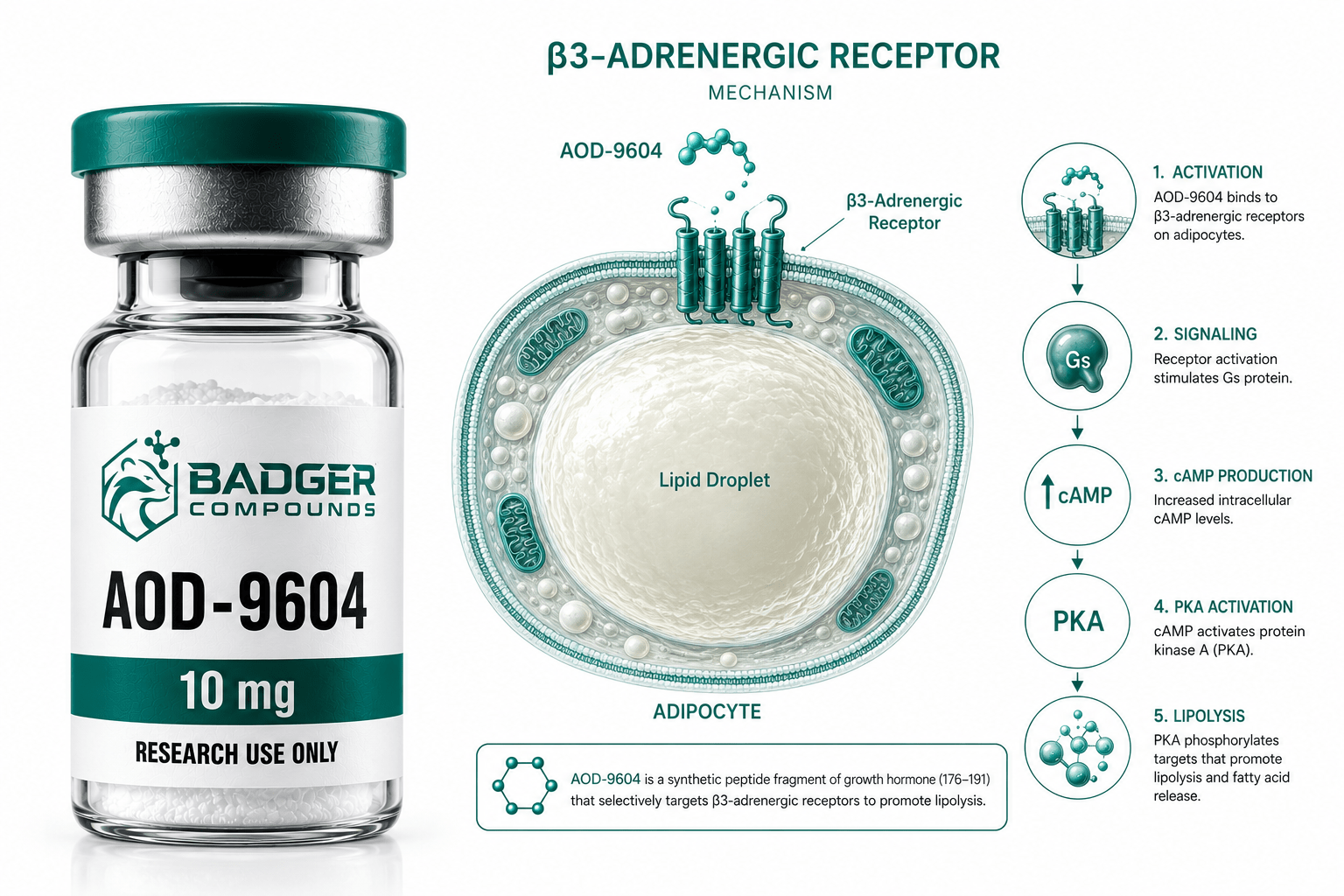
AOD-9604’s relationship to the beta-3 adrenergic receptor (beta-3 AR), the principal lipolytic receptor of adipose tissue, is frequently oversimplified. The primary study is Heffernan and colleagues (2001) in Endocrinology, which examined chronic treatment in both obese mice and beta-3 AR knockout mice. The research reported that hGH and AOD-9604 each reduced body weight and body fat in obese mice, and that these outcomes correlated with increased expression of beta-3 AR messenger RNA, restoring the repressed beta-3 AR RNA levels of obese mice toward those seen in lean controls.
In beta-3 AR knockout mice, long-term treatment with either compound failed to reproduce the change in body weight and the increase in lipolysis. Critically, however, in an acute experiment AOD-9604 remained capable of increasing energy expenditure and fat oxidation in those same knockout animals.
The authors’ stated conclusion is therefore precise: the lipolytic actions of hGH and AOD-9604 are not mediated directly through the beta-3 AR, although both compounds increase beta-3 AR expression, which may subsequently contribute to enhanced lipolytic sensitivity. The distinction matters. AOD-9604 is frequently described as a beta-3 AR agonist that binds and activates the receptor. The primary research supports upregulation of receptor expression, not direct receptor agonism, and the compound’s precise molecular target remains uncharacterized.
| Research Model | System | Reported Observation |
|---|---|---|
| Obese Zucker rats | Chronic oral administration (Ng 2000) | Reduced body weight gain; increased adipose lipolytic activity; insulin sensitivity unaffected |
| Obese ob/ob and lean mice | Chronic treatment, energy balance (Heffernan 2001, IJO) | Increased fat oxidation and weight loss; effects not mediated via hGH receptor |
| Beta-3 AR knockout mice | Chronic and acute treatment (Heffernan 2001, Endocrinology) | Chronic effects lost; acute fat oxidation and energy expenditure preserved |
| Obese mice adipose tissue | Beta-3 AR mRNA expression (Heffernan 2001, Endocrinology) | Repressed beta-3 AR RNA restored toward lean-control levels |
| Rabbit knee cartilage | Collagenase-induced osteoarthritis (Kwon and Park 2015) | Intra-articular injection associated with enhanced cartilage regeneration scores |
AOD-9604 is a research-use-only compound. Badger Compounds supplies AOD-9604 exclusively for qualified research applications in controlled laboratory settings. The preclinical data summarized here does not establish safety or efficacy in any human population.
Cartilage and Connective Tissue Research
Beyond adipose metabolism, AOD-9604 has been examined in a connective tissue context. Kwon and Park (2015) investigated ultrasound-guided intra-articular injection of AOD-9604, with and without hyaluronic acid, in a collagenase-induced knee osteoarthritis model in New Zealand white rabbits. The research reported that morphological and histopathological cartilage scores improved relative to saline control, and that the combination of AOD-9604 with hyaluronic acid outperformed either agent administered alone within that model.
This line of inquiry is considerably less developed than the metabolic literature and rests on a small number of animal studies. It is included here for completeness of the published research record rather than as an established property of the compound.
Stability, Metabolism, and Analytical Considerations
Cox and colleagues (2015), writing in Drug Testing and Analysis, characterized the in vitro metabolism of AOD-9604 in serum and urine, identifying six potential metabolites. Quantification in serum identified a single metabolite consisting of the residues CRSVEGSCG that proved substantially more stable than both the other metabolites and the parent compound. For investigators designing pharmacokinetic or analytical work, this metabolite stability profile is directly relevant to detection windows and assay design.
Researchers should note that AOD-9604 is a compound prohibited by the World Anti-Doping Agency. Any research involving human subjects or athlete populations carries regulatory obligations well beyond the scope of this overview.
Distinct from HGH Fragment 176-191
AOD-9604 and the unmodified hGH Fragment 176-191 share the C-terminal domain but are not identical compounds, and their published research citations are not interchangeable.
Human Development Discontinued
Clinical development for obesity did not proceed past later-phase trials. The compound holds no pharmaceutical approval and remains a research compound only.
Research Pathways Associated with AOD-9604
Preclinical literature has examined AOD-9604 across several interconnected research contexts:
Adipocyte lipolysis Antilipogenic activity Beta-3 adrenergic receptor expression Fat oxidation and energy expenditure GH receptor independence IGF-1 independence Insulin sensitivity in research models Cartilage regeneration modelsAOD-9604 – Research Grade, ≥99% (HPLC)
Badger Compounds supplies AOD-9604 as a lyophilized research compound, six-round independently tested per batch with publicly viewable COAs. For qualified laboratory research use only.
View AOD-9604- Ng FM, Sun J, Sharma L, Libinaka R, Jiang WJ, Gianello R. Metabolic studies of a synthetic lipolytic domain (AOD9604) of human growth hormone. Horm Res. 2000;53(6):274-278. PMID 11146367
- Heffernan M, Summers RJ, Thorburn A, Ogru E, Gianello R, Jiang WJ, Ng FM. The effects of human GH and its lipolytic fragment (AOD9604) on lipid metabolism following chronic treatment in obese mice and beta(3)-AR knock-out mice. Endocrinology. 2001;142(12):5182-5189. PMID 11713213
- Heffernan MA, Thorburn AW, Fam B, Summers R, Conway-Campbell B, Waters MJ, Ng FM. Increase of fat oxidation and weight loss in obese mice caused by chronic treatment with human growth hormone or a modified C-terminal fragment. Int J Obes Relat Metab Disord. 2001;25(10):1442-1449. PMID 11673763
- Cox HD, Smeal SJ, Hughes CM, Cox JE, Eichner D. Detection and in vitro metabolism of AOD9604. Drug Test Anal. 2015;7(1):31-38. PMID 25208511
- Kwon DR, Park GY. Effect of intra-articular injection of AOD9604 with or without hyaluronic acid in rabbit osteoarthritis model. Ann Clin Lab Sci. 2015;45(4):426-432. PMID 26275694
- Thevis M, Thomas A, Schanzer W. Detecting peptidic drugs, drug candidates and analogs in sports doping: current status and future directions. Expert Rev Proteomics. 2014;11(6):663-673. PMID 25382550
Disclaimer: AOD-9604 is supplied by Badger Compounds for laboratory and in vitro research use only. It is not intended for human or veterinary use, and no product sold by Badger Compounds is approved for therapeutic, diagnostic, or clinical application. All research findings referenced in this post are derived from preclinical cell-based and animal model studies. No clinical efficacy or safety conclusions should be drawn from the data summarized here.