No products in the cart.
U.S. FILLED & FINISHED | ≥99% COA-VERIFIED PURITY
LC-MS VERIFIED IDENTITY | INDEPENDENTLY TESTED
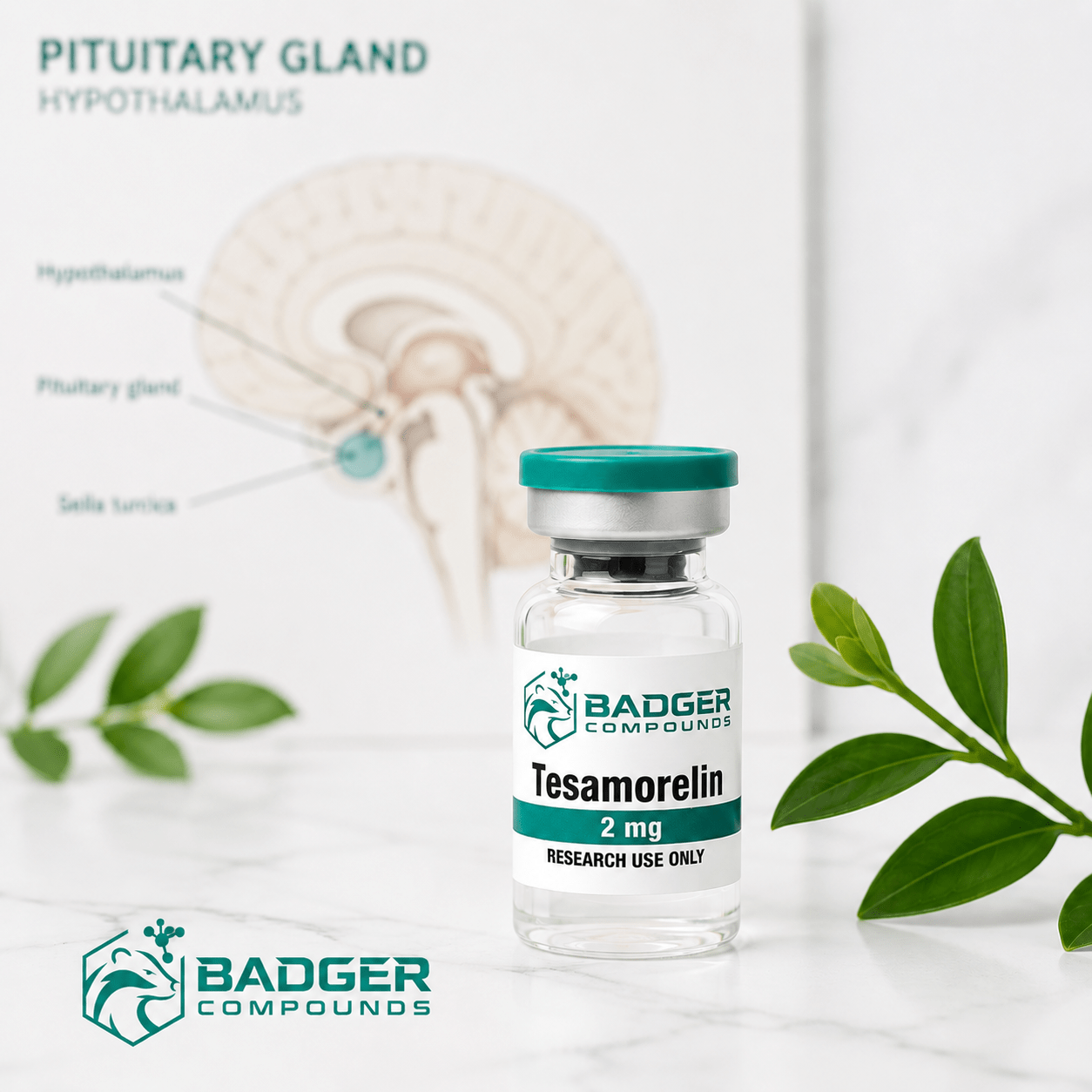
Tesamorelin growth hormone releasing hormone research occupies a distinctive position in the peptide endocrinology landscape. As a stabilized synthetic analog of endogenous growth hormone releasing hormone (GHRH), Tesamorelin acts at the GHRH receptor on anterior pituitary somatotrophs to stimulate physiological growth hormone secretion – a mechanism that differs fundamentally from growth hormone secretagogue receptor agonists like Ipamorelin.
This article explores what Tesamorelin is, how it interacts with the GHRH receptor and growth hormone axis, what distinguishes it from other growth hormone research compounds, and what current areas of preclinical and clinical investigation reveal about its biological research profile across metabolic, visceral adiposity, and cardiovascular research frameworks.
Research focus: This article is intended for educational and research-context discussion only. Tesamorelin is a research compound sold for laboratory investigation only. This content does not provide medical advice, dosing guidance, or treatment recommendations of any kind.
What Is Tesamorelin?
Tesamorelin is a synthetic analog of human growth hormone releasing hormone (GHRH), consisting of the full 44-amino acid sequence of GHRH with the addition of a trans-3-hexenoic acid group at the N-terminus. This structural modification significantly extends the half-life of the peptide compared to native GHRH, which is rapidly degraded by dipeptidyl peptidase-4 (DPP-4) in circulation – the same enzyme responsible for the rapid degradation of native GLP-1.
Tesamorelin acts as a full agonist at the GHRH receptor (GHRHR), a G protein-coupled receptor expressed primarily on anterior pituitary somatotrophs. By binding to and activating the GHRH receptor, Tesamorelin stimulates the synthesis and pulsatile release of endogenous growth hormone in a manner that preserves the normal physiological feedback mechanisms of the hypothalamic-pituitary-somatotropic axis – a characteristic that distinguishes it from direct growth hormone administration.
Tesamorelin at a Glance
Tesamorelin is a stabilized synthetic GHRH analog that activates the GHRH receptor to stimulate physiological pulsatile growth hormone secretion. Its N-terminal modification confers DPP-4 resistance and extended half-life while preserving full GHRH receptor agonist activity. It is one of the most extensively characterized GHRH analog research compounds in the scientific literature.
The GHRH Receptor and Growth Hormone Axis
Growth hormone releasing hormone (GHRH) is a 44-amino acid peptide produced by neurons in the arcuate nucleus of the hypothalamus. It is released into the hypophyseal portal circulation and acts on GHRH receptors on anterior pituitary somatotrophs to stimulate growth hormone gene transcription, synthesis, and pulsatile secretion into the systemic circulation.
The GHRH receptor is a Gs protein-coupled receptor that, upon activation, stimulates adenylate cyclase, increases intracellular cyclic AMP (cAMP), and activates protein kinase A – ultimately leading to growth hormone gene expression and somatotroph proliferation. This signaling cascade is distinct from the Gq-mediated pathway activated by GHS-R1a agonists like Ipamorelin, which is why combining GHRH receptor agonism and GHS-R1a agonism produces synergistic rather than redundant growth hormone stimulation.
Growth hormone secreted in response to GHRH receptor activation travels through the circulation to act on GH receptors in target tissues – most importantly the liver, where it stimulates IGF-1 production. IGF-1 then mediates many of the anabolic, metabolic, and tissue-related effects studied in growth hormone axis research.
Primary Research Pathways
Tesamorelin research spans multiple biological systems connected through the GHRH receptor and growth hormone axis. The following represent the primary pathway areas under active investigation.
Pathway 1
GHRH Receptor Biology
The primary research focus for Tesamorelin is its activity at the GHRH receptor. Preclinical and clinical studies have characterized the dose-response relationship, GH pulse dynamics, and IGF-1 production downstream of Tesamorelin administration, establishing a comprehensive pharmacological profile for GHRH receptor agonism.
Pathway 2
Visceral Adiposity Research
One of the most extensively studied areas of Tesamorelin research involves its effects on visceral adipose tissue. Clinical and preclinical investigations have examined how GHRH receptor-stimulated growth hormone secretion influences visceral fat distribution, adipocyte metabolism, and lipid mobilization from visceral adipose depots.
Pathway 3
Lipid Metabolism Research
Growth hormone exerts significant regulatory effects on lipid metabolism, particularly through its promotion of lipolysis in adipose tissue. Tesamorelin research has examined its effects on triglyceride levels, lipid profiles, and fatty acid oxidation parameters in metabolic research models and clinical investigations.
Pathway 4
Cardiovascular Research Models
Visceral adiposity is a recognized risk factor in cardiovascular biology research. Tesamorelin studies have examined whether GHRH receptor-mediated reductions in visceral fat influence cardiovascular risk markers, carotid intima-media thickness, and inflammatory markers associated with cardiometabolic research.
Pathway 5
Cognitive and Neurological Research
GHRH receptors are expressed in the brain, and GH and IGF-1 influence multiple aspects of neurological function in research models. Tesamorelin research has expanded into cognitive biology, with studies examining its effects on cognitive function markers, brain volume parameters, and neurological endpoints in research populations.
Pathway 6
Aging and Somatopause Research
The age-related decline in GHRH signaling and growth hormone secretion is a well-documented feature of biological aging. Tesamorelin research has examined whether GHRH receptor stimulation in aged research subjects can restore more physiological GH secretion patterns and influence age-related metabolic and body composition parameters.
Tesamorelin vs Other GHRH Analogs and Growth Hormone Compounds
Understanding how Tesamorelin compares to other growth hormone axis research compounds helps researchers select the most appropriate tool for their specific investigational framework and experimental design requirements.
| Compound | Receptor Target | Mechanism | Half-Life | Primary Research Focus |
|---|---|---|---|---|
| Tesamorelin | GHRH receptor | Full GHRH agonist, preserves axis feedback | Extended – DPP-4 resistant | Visceral adiposity, metabolic, cognitive research |
| Native GHRH (1-44) | GHRH receptor | Full GHRH agonist, rapidly degraded | Very short – minutes | Basic GHRH receptor biology research |
| CJC-1295 | GHRH receptor | GHRH analog with DAC technology for extended action | Very long – days to weeks | Extended GH pulse research, combination studies |
| Ipamorelin | GHS-R1a (ghrelin receptor) | Selective GHS-R1a agonist | Short – hours | Selective GH pulse research, body composition |
| Sermorelin | GHRH receptor | GHRH(1-29) truncated analog | Short – similar to native GHRH | GH axis stimulation, aging research |
| Recombinant GH | GH receptor directly | Direct GH receptor agonism – bypasses axis | Hours | Direct GH replacement research models |
Why GHRH Axis Research Differs from Direct GH Administration
One of the most scientifically important distinctions in growth hormone research is the difference between stimulating endogenous growth hormone secretion through the GHRH axis versus administering recombinant growth hormone directly. This distinction has significant implications for research design and the interpretation of experimental outcomes.
When researchers use a GHRH analog like Tesamorelin to stimulate growth hormone secretion, the normal physiological feedback mechanisms of the hypothalamic-pituitary-somatotropic axis remain intact. Somatostatin, the hypothalamic inhibitor of growth hormone secretion, can still suppress GH release when appropriate, and the pulsatile pattern of GH secretion that characterizes normal physiology is preserved. This means that GH levels in response to GHRH agonism are self-regulating within a physiological range.
In contrast, direct growth hormone administration bypasses the GHRH receptor and somatostatin feedback entirely – delivering exogenous GH regardless of the physiological state of the axis. This fundamental difference means that GHRH analog research and direct GH administration research are studying distinct biological conditions, and findings from one approach may not be directly comparable to the other.
GHRH Analog Research Characteristics
- Preserves hypothalamic-pituitary feedback mechanisms
- Stimulates pulsatile rather than continuous GH secretion
- GH levels remain within physiologically regulated range
- Somatostatin feedback can still suppress GH when appropriate
- More closely models normal growth hormone axis biology
- Useful for studying axis restoration and somatopause research
Direct GH Administration Characteristics
- Bypasses GHRH receptor and hypothalamic regulation entirely
- Delivers exogenous GH independent of axis state
- GH levels determined by administered dose, not physiology
- Suppresses endogenous GH secretion via feedback
- Studies direct GH receptor biology in peripheral tissues
- Different research question from GHRH agonism studies
Tesamorelin and Visceral Fat Research
Among all areas of Tesamorelin research, its effects on visceral adipose tissue have generated the most extensive and well-characterized body of evidence. Visceral adipose tissue – fat stored in the abdominal cavity surrounding internal organs – is metabolically distinct from subcutaneous fat and plays a different role in metabolic biology research models.
Growth hormone is known to promote lipolysis in visceral adipose tissue through GH receptor activation and downstream signaling that promotes fatty acid mobilization. Tesamorelin research has examined whether GHRH receptor-stimulated increases in endogenous GH secretion translate into measurable reductions in visceral adipose tissue volume and associated metabolic markers in both preclinical models and clinical research populations.
Key Research Distinction
Tesamorelin’s effects on visceral adiposity appear to be relatively selective compared to its effects on subcutaneous fat in research models – a finding that has generated significant interest in understanding how the growth hormone axis differentially regulates different adipose tissue depots at the molecular level.
Current Areas of Tesamorelin Investigation
Metabolic Syndrome Research
The relationship between visceral adiposity, insulin resistance, dyslipidemia, and other metabolic parameters is a central focus of metabolic syndrome research. Tesamorelin studies have examined how GHRH receptor-mediated changes in GH secretion influence the metabolic parameters associated with excess visceral fat accumulation in preclinical and clinical research models.
Liver Biology Research
Non-alcoholic fatty liver disease research is closely connected to visceral adiposity biology. Tesamorelin investigations have examined its effects on liver fat content, hepatic lipid metabolism markers, and liver function parameters in research populations with excess visceral adipose tissue accumulation.
Cognitive Function Research
The recognition that GH and IGF-1 influence neurological function has expanded Tesamorelin research into cognitive biology. Studies have examined its effects on cognitive performance markers, brain imaging parameters, and neurological endpoints in research populations, establishing a neurological research dimension alongside its metabolic profile.
Inflammatory Marker Research
Visceral adipose tissue is a source of pro-inflammatory cytokines in research models. Tesamorelin studies have examined whether reductions in visceral fat translate into changes in systemic inflammatory markers – including C-reactive protein, IL-6, and TNF-alpha – in research populations with elevated visceral adiposity.
Aging Research Models
The convergence of declining GHRH signaling and increasing visceral adiposity in aging research models has made Tesamorelin a subject of interest in aging biology. Studies have examined whether GHRH receptor stimulation in aged research subjects influences the metabolic and body composition changes associated with the somatopause phenotype.
Cardiovascular Risk Marker Research
Visceral adiposity is strongly associated with cardiovascular risk markers in research models. Tesamorelin studies have examined its effects on carotid intima-media thickness, endothelial function markers, and lipid parameters – connecting GHRH receptor biology to cardiovascular research questions.
Related reading: For a detailed comparison of Tesamorelin with GHS-R1a agonist research compounds, see our article on Ipamorelin Growth Hormone Secretagogue Research: An Overview.
What Researchers Should Know When Sourcing Tesamorelin
Tesamorelin is a 44-amino acid peptide with a specific N-terminal modification that is critical to its DPP-4 resistance and biological activity. As one of the larger research peptides in the growth hormone axis category, sequence integrity verification by mass spectrometry is particularly important to confirm correct synthesis and the presence of the trans-3-hexenoic acid modification.
Key Quality Considerations
- Minimum 99% HPLC purity confirmation
- Mass spectrometry identity verification
- Correct molecular weight: approximately 5135 Da
- N-terminal trans-3-hexenoic acid modification confirmed
- Lyophilized format for storage stability
- Independent third-party Certificate of Analysis
Storage and Handling in Research Settings
- Store lyophilized powder at -20 degrees Celsius
- Protect from light and moisture at all times
- Allow vial to reach room temperature before opening
- Reconstitute in sterile water for injection grade
- Avoid repeated freeze-thaw cycles after reconstitution
- Document lot number in all experimental records
Final Thoughts
Tesamorelin growth hormone releasing hormone research represents one of the most scientifically well-characterized areas of GHRH axis investigation. By preserving the normal physiological feedback mechanisms of the hypothalamic-pituitary-somatotropic axis while extending the half-life of native GHRH through structural modification, Tesamorelin provides researchers with a precise and physiologically relevant tool for studying growth hormone axis biology across metabolic, visceral adiposity, cardiovascular, cognitive, and aging research frameworks.
As research into the relationship between GHRH signaling, growth hormone secretion, visceral adiposity, and metabolic biology continues to expand, Tesamorelin is likely to remain a central compound in growth hormone axis research. Researchers sourcing Tesamorelin for investigational use should prioritize sequence verification including N-terminal modification confirmation, analytical transparency, and independent CoA documentation to ensure experimental integrity.
Related reading: To understand how third-party testing and CoA verification apply to growth hormone research compounds like Tesamorelin, see our article on Why Third-Party Testing Matters in Research Compounds.
Explore Growth Hormone Releasing Hormone Research Compounds
Tesamorelin and other GHRH axis research compounds are available in our catalog, each supported by independent third-party CoA documentation and our 6x testing standard.
View Research CompoundsReferences
[1] Falutz J, et al. Metabolic effects of a growth hormone-releasing factor in patients with HIV. N Engl J Med. 2007;357(23):2359-2370. View via PubMed
[2] Stanley TL, et al. Effect of tesamorelin on visceral fat and liver fat in HIV-infected patients with abdominal fat accumulation: a randomized clinical trial. JAMA. 2014;312(4):380-389. View via PubMed
[3] Clemmons DR. Metabolic actions of IGF-1 in normal physiology and diabetes. Endocrinol Metab Clin North Am. 2012;41(2):425-443. View via PubMed
[4] Sigalos JT, Pastuszak AW. The Safety and Efficacy of Growth Hormone Secretagogues. Sex Med Rev. 2018;6(1):45-53. View via PubMed
[5] Brinkman JE, et al. Physiology of Growth Hormone. StatPearls. 2023. View via PubMed
[6] Yuen KC, et al. American Association of Clinical Endocrinologists and American College of Endocrinology Guidelines for Management of Growth Hormone Deficiency in Adults and Patients Transitioning from Pediatric to Adult Care. Endocr Pract. 2019;25(11):1191-1232. View via PubMed
Disclaimer: This article is for informational and educational purposes only. Products and compounds discussed are intended for research use only and are not for human consumption, veterinary use, clinical use, diagnostic use, food use, supplement use, pharmaceutical use, cosmetic use, or any consumer application. Statements have not been evaluated by the FDA. This content does not provide medical advice, treatment guidance, dosing information, or recommendations for personal use.