No products in the cart.
U.S. FILLED & FINISHED | ≥99% COA-VERIFIED PURITY
LC-MS VERIFIED IDENTITY | INDEPENDENTLY TESTED
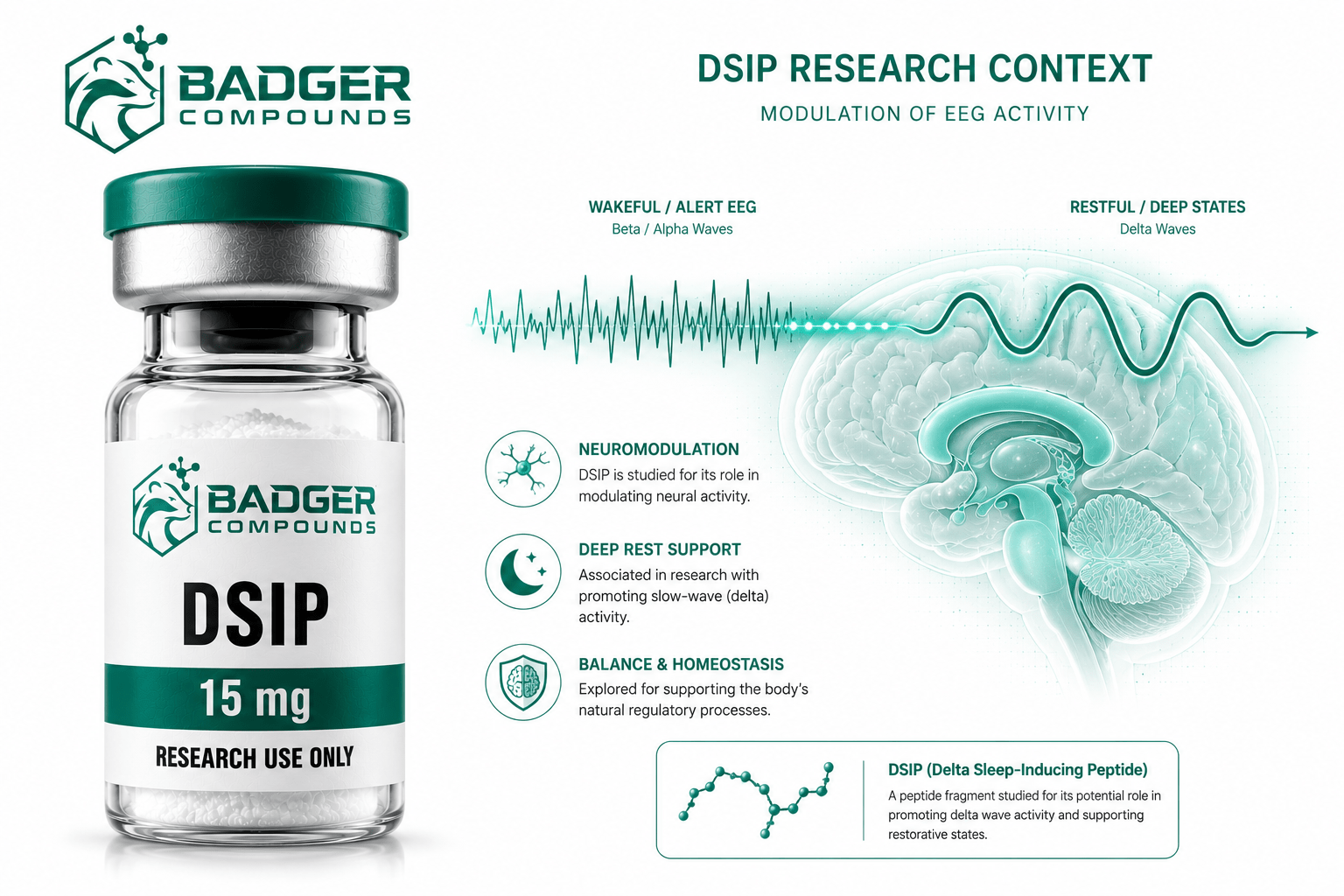
DSIP peptide sleep research centers on a naturally occurring nonapeptide first isolated from the cerebral venous blood of sleeping rabbits, where preclinical investigations have examined its association with slow-wave EEG activity and its broader role in stress and neuroendocrine signaling.
DSIP Peptide Sleep Research: The Delta EEG Nonapeptide
DSIP (Trp-Ala-Gly-Gly-Asp-Ala-Ser-Gly-Glu) is a naturally occurring nonapeptide named for its association with delta-wave sleep. Nearly five decades of preclinical investigation have produced a genuinely mixed picture, making DSIP one of the more scientifically intriguing and unresolved peptides in sleep neurobiology.
What Is DSIP?
Delta sleep-inducing peptide (DSIP) is a nine-amino-acid neuropeptide with the sequence Trp-Ala-Gly-Gly-Asp-Ala-Ser-Gly-Glu and a molecular weight of approximately 849 Da. It was first isolated in the 1970s by Schoenenberger, Monnier, and colleagues in Switzerland, who recovered it from the cerebral venous blood of rabbits kept asleep by electrical stimulation of the intralaminar thalamus. When this material was infused into the cerebral ventricles of recipient rabbits, it enhanced the slow-wave (delta) and spindle EEG activity characteristic of deep sleep, giving the peptide its name.
DSIP is unusual among signaling peptides. Decades after its discovery, no definitive receptor has been identified, and no confirmed encoding gene has been established in mammals. It has been detected in both free and protein-bound forms across the hypothalamus, limbic system, pituitary, and numerous peripheral tissues, which has complicated efforts to assign it a single mechanism. This combination of clear biological activity and unresolved molecular identity is a recurring theme in the research literature.
Delta Sleep and Slow-Wave EEG
Sleep is divided into distinct stages defined by characteristic EEG signatures. The deepest stage, slow-wave sleep, is dominated by high-amplitude, low-frequency delta waves and is associated with physical restoration and memory consolidation in the research literature. DSIP was named for its apparent capacity to enhance precisely this delta activity following central infusion in animal models.
A foundational review by Graf and Kastin (1984) summarized the early body of work, noting that DSIP induced mainly delta sleep in rabbits, rats, mice, and humans, while in cats the effect appeared more pronounced on REM sleep. The same review documented a U-shaped dose-response curve, meaning that both the dose and the timing of infusion had non-linear effects, an early signal that DSIP’s activity would prove difficult to characterize with simple models.
Research framing: All findings referenced in this post derive from preclinical animal models and early human research conducted by third parties. DSIP is supplied by Badger Compounds for laboratory research use only and is not intended for human or veterinary use. No therapeutic or clinical conclusions should be drawn from the research discussed here.
A Deliberately Mixed Evidence Base
Honest presentation of DSIP requires acknowledging that its research record is inconsistent, and this is where much of the available commentary overstates the case. On the supportive side, Schneider-Helmert and Schoenenberger (1981) reported that intravenous synthetic DSIP administered to chronic insomniac subjects was associated with longer sleep duration and improved sleep quality with fewer interruptions, and described a normalizing influence on human sleep regulation.
On the other side, a double-blind study by Bes and colleagues (1992) examined DSIP in 16 chronic insomniac patients using polysomnography. While objective measures showed higher sleep efficiency and shorter sleep latency with DSIP relative to placebo, the authors reported that the statistically significant effects were weak and could in part reflect an incidental change in the placebo group. Their conclusion was explicit: short-term treatment of chronic insomnia with DSIP is not likely to be of major therapeutic benefit. A credible reading of the DSIP literature must hold both of these findings at once.
Supportive Human Data
Early insomnia research associated intravenous DSIP with longer sleep duration and improved subjective sleep quality without daytime sedation.
Null Human Data
A double-blind polysomnography study concluded that short-term DSIP was not likely to be of major therapeutic benefit for chronic insomnia.
Paradoxical Findings
A later anaesthesia study reported that DSIP significantly reduced delta rhythm, the opposite of its namesake effect, under isoflurane.
Endogenous DSIP, Slow-Wave Sleep, and Growth Hormone
Some of the more mechanistically compelling evidence comes from studies of the peptide’s endogenous role rather than its administration. Iyer, Marks, Kastin, and McCann (1988), publishing in PNAS, deprived rats of sleep and observed the expected rebound increases in both slow-wave sleep and sleep-related growth hormone release. Critically, both rebound effects were blocked by microinjection of a highly specific antiserum to DSIP into the third cerebral ventricle, while control serum had no such effect.
This antiserum-blockade design is stronger evidence than simple administration studies, because it implicates endogenous DSIP as a physiological participant in slow-wave sleep and its associated growth hormone surge. The growth hormone connection is notable given that the deepest stages of sleep are when much of the body’s pulsatile growth hormone release naturally occurs. For the upstream side of that axis, see our overview of Sermorelin GHRH research, which examines direct GHRH receptor stimulation of the same growth hormone system.
Stress Protection and Mitochondrial Research
Beyond sleep, a recurring research theme is DSIP’s apparent role in stress adaptation. Khvatova and colleagues (2003), publishing in Peptides, examined DSIP’s effect on oxidative phosphorylation in isolated rat brain mitochondria. Using polarographic measurement of oxygen consumption, the research reported that DSIP increased the rate of phosphorylated respiration and enhanced the respiratory control ratio. Under experimental hypoxia, pretreatment with DSIP was reported to fully inhibit the hypoxia-induced reduction of mitochondrial respiratory activity in that model.
The authors framed these in vitro findings as a possible contributor to the stress-protective and antioxidant actions attributed to DSIP in whole-animal studies. This mitochondrial and stress-adaptation angle represents an active area of research interest that extends the peptide’s profile well beyond its original sleep association.
| Research Model | System | Reported Observation |
|---|---|---|
| Rabbit intraventricular infusion | EEG analysis (Schoenenberger and Monnier, 1970s) | Enhanced delta and spindle EEG activity; basis for the peptide’s name |
| Chronic insomniac subjects | Intravenous administration (Schneider-Helmert 1981) | Longer sleep duration; improved sleep quality; no daytime sedation |
| Chronic insomniac patients | Double-blind polysomnography (Bes 1992) | Weak, possibly incidental effects; no major therapeutic benefit concluded |
| Sleep-deprived rats | DSIP antiserum blockade (Iyer 1988) | Endogenous DSIP implicated in slow-wave sleep and GH rebound |
| Rat brain mitochondria | Polarographic respiration, hypoxia (Khvatova 2003) | Enhanced oxidative phosphorylation; hypoxia protection in vitro |
| Rat focal stroke (MCAO) | Intranasal administration (Tukhovskaya 2021) | Faster motor recovery; infarct volume reduction not statistically significant |
DSIP is a research-use-only peptide. Badger Compounds supplies DSIP exclusively for qualified research applications in controlled laboratory settings. The research summarized here does not establish safety or efficacy in any human population.
Neuroprotection Research: Reading the Data Carefully
DSIP has attracted recent interest in neuroprotection, and this is an area where precision matters because secondary sources frequently overstate the results. Tukhovskaya and colleagues (2021), publishing in Molecules, examined intranasal DSIP in a rat model of focal stroke induced by middle cerebral artery occlusion. The accurate reading of that study is specific: motor performance on the rotarod test recovered significantly faster in DSIP-treated animals, but the reduction in brain infarction volume, while present, did not reach statistical significance.
This distinction is important. The functional recovery finding is real, but claims that DSIP significantly shrinks infarct size are not supported by this primary source. Separately, dramatic infarct-reduction figures that circulate online generally derive from a structural analog designated KND rather than from DSIP itself, and the two should not be conflated. Researchers evaluating this literature should attend closely to which compound and which endpoint each claim actually refers to.
Research Pathways Associated with DSIP
Preclinical literature has examined DSIP across several interconnected research contexts:
Slow-wave (delta) EEG modulation Spindle activity Sleep-related growth hormone release Circadian and locomotor patterns Stress adaptation Mitochondrial oxidative phosphorylation Antioxidant enzyme expression Neuroprotection modelsDSIP Peptide – Research Grade, ≥99% (HPLC)
Badger Compounds supplies DSIP as a lyophilized research peptide, six-round independently tested per batch with publicly viewable COAs. For qualified laboratory research use only.
View DSIP- Graf MV, Kastin AJ. Delta-sleep-inducing peptide (DSIP): a review. Neurosci Biobehav Rev. 1984;8(1):83-93. PMID 6145137
- Schneider-Helmert D, Schoenenberger GA. The influence of synthetic DSIP (delta-sleep-inducing-peptide) on disturbed human sleep. Experientia. 1981;37(9):913-917. PMID 7028502
- Bes F, Hofman W, Schuur J, Van Boxtel C. Effects of delta sleep-inducing peptide on sleep of chronic insomniac patients. A double-blind study. Neuropsychobiology. 1992;26(4):193-197. PMID 1299794
- Iyer KS, Marks GA, Kastin AJ, McCann SM. Evidence for a role of delta sleep-inducing peptide in slow-wave sleep and sleep-related growth hormone release in the rat. Proc Natl Acad Sci U S A. 1988;85(10):3653-3656. PMID 3368469
- Khvatova EM, Samartzev VN, Zagoskin PP, Prudchenko IA, Mikhaleva II. Delta sleep inducing peptide (DSIP): effect on respiration activity in rat brain mitochondria and stress protective potency under experimental hypoxia. Peptides. 2003;24(2):307-311. PMID 12668217
- Tukhovskaya EA, Ismailova AM, Shaykhutdinova ER, et al. Delta sleep-inducing peptide recovers motor function in SD rats after focal stroke. Molecules. 2021;26(17):5173. PMID 34500605
- Pomfrett CJ, Dolling S, Anders NR, Glover DG, Bryan A, Pollard BJ. Delta sleep-inducing peptide alters bispectral index, the electroencephalogram and heart rate variability when used as an adjunct to isoflurane anaesthesia. Eur J Anaesthesiol. 2009;26(2):128-134. PMID 19142086
Disclaimer: DSIP is supplied by Badger Compounds for laboratory and in vitro research use only. It is not intended for human or veterinary use, and no product sold by Badger Compounds is approved for therapeutic, diagnostic, or clinical application. All research findings referenced in this post are derived from preclinical and early third-party human studies. No clinical efficacy or safety conclusions should be drawn from the data summarized here.