No products in the cart.
U.S. FILLED & FINISHED | ≥99% COA-VERIFIED PURITY
LC-MS VERIFIED IDENTITY | INDEPENDENTLY TESTED
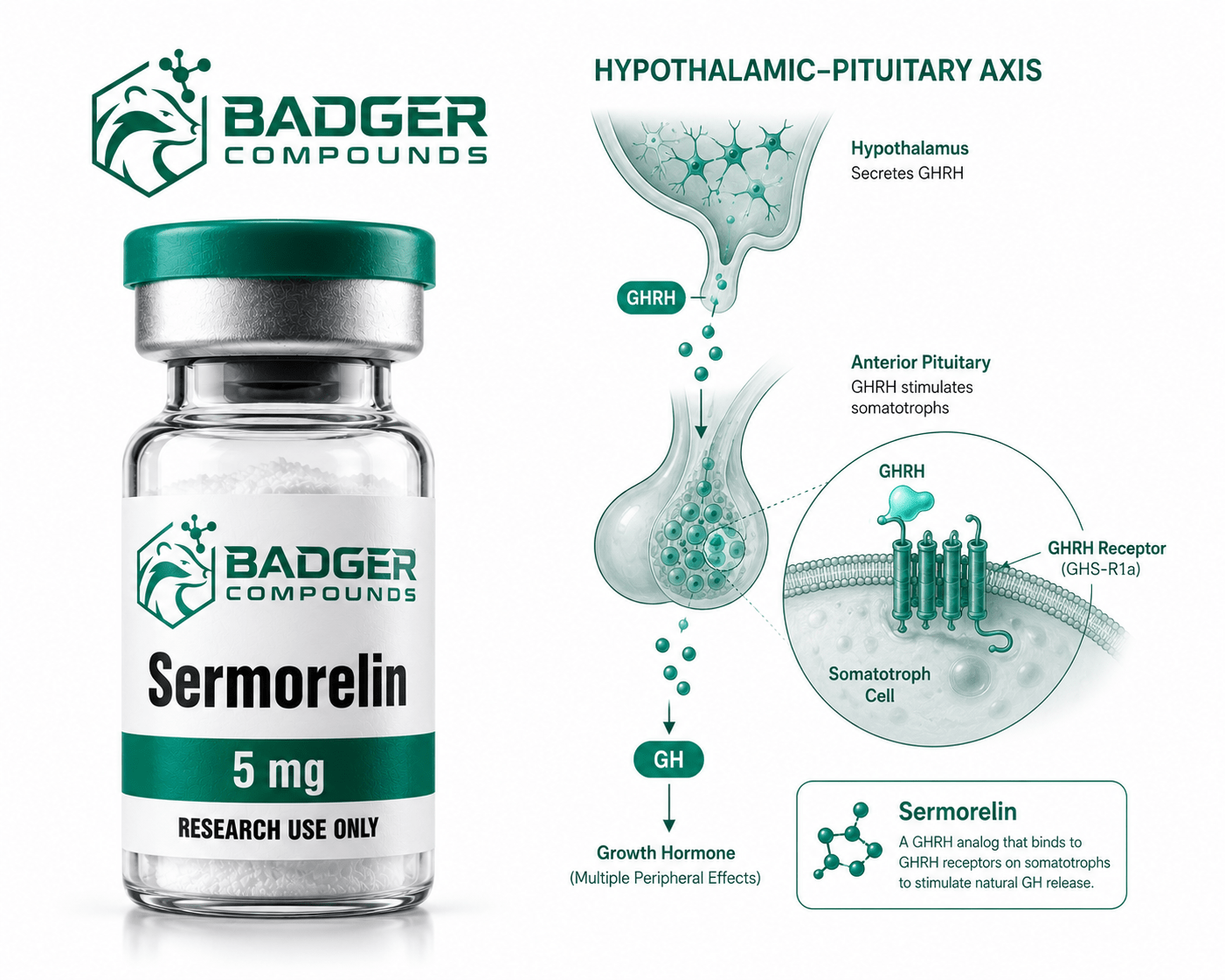
Sermorelin GHRH research centers on a synthetic 29-amino-acid analog corresponding to the biologically active N-terminal fragment of human growth hormone-releasing hormone, where preclinical and clinical investigations have examined its agonism at the pituitary GHRH receptor and its role in stimulating endogenous growth hormone secretion.
Sermorelin GHRH Research: The GHRH(1-29) Growth Hormone Analog
Sermorelin is a synthetic peptide corresponding to the first 29 amino acids of human growth hormone-releasing hormone, the shortest fragment that retains full activity at the pituitary GHRH receptor. Preclinical and clinical investigations have characterized its capacity to stimulate endogenous growth hormone secretion through physiological signaling pathways.
What Is Sermorelin?
Sermorelin, also designated GRF(1-29) or GHRH(1-29), is a synthetic 29-amino-acid peptide with a molecular weight of approximately 3358 Da. It represents the biologically active N-terminal fragment of the 44-amino-acid endogenous growth hormone-releasing hormone (GHRH). Research in the early 1980s established that the first 29 residues retain full intrinsic activity at the GHRH receptor, making sermorelin the shortest fully functional fragment of the native hormone.
Sermorelin represents the native GHRH sequence, in contrast to modified analogs engineered for extended duration of action. For the pharmacokinetic side of that distinction, see our overview of CJC-1295 half-life research, which examines how structural modifications to the GHRH scaffold alter clearance and persistence relative to the unmodified fragment discussed here.
The GHRH-GH-IGF-1 Axis
Growth hormone secretion is governed primarily by two opposing hypothalamic signals: GHRH, which stimulates synthesis and release of growth hormone from anterior pituitary somatotrophs, and somatostatin, which inhibits release. GHRH binds the GHRH receptor, a G-protein-coupled receptor on somatotroph cells, coupling to adenylyl cyclase and elevating intracellular cyclic AMP. This cascade drives both the transcription of growth hormone messenger RNA and the pulsatile release of stored growth hormone into circulation.
Because sermorelin acts upstream at the GHRH receptor rather than supplying growth hormone directly, research models describe it as working through the body’s own regulatory architecture. The downstream somatostatin brake remains intact, and growth hormone drives hepatic production of insulin-like growth factor 1 (IGF-1), the principal mediator of many peripheral growth hormone effects. This upstream position is the central mechanistic feature that distinguishes GHRH-analog research from exogenous growth hormone research.
Research framing: All findings referenced in this post derive from preclinical and clinical research characterizing GHRH receptor pharmacology and growth hormone secretion. Sermorelin is supplied by Badger Compounds for laboratory research use only and is not intended for human or veterinary use. No therapeutic or clinical conclusions should be drawn from the data discussed here.
Structure-Activity: Why the 1-29 Fragment?
Foundational medicinal chemistry work by Coy and colleagues (1987) examined how N-terminal modifications affect the biological potency of growth hormone releasing factor analogues across varying chain lengths. This line of structure-activity research helped establish that the biological activity of the full GHRH molecule resides in its N-terminal region, and that the 1-29 fragment carries full intrinsic growth-hormone-releasing potency. This finding is the basis for sermorelin’s identity as a minimal functional GHRH analog.
N-Terminal Activity
Structure-activity research localized GHRH biological activity to the N-terminal region, with the first residues essential for receptor engagement.
Minimal Functional Fragment
The 1-29 sequence retains full intrinsic potency in research models, making it the shortest fully functional GHRH fragment.
GHRH Receptor Coupling
Receptor binding couples to adenylyl cyclase and elevates cyclic AMP in somatotrophs, the signaling step preceding growth hormone release.
Growth Hormone Secretion Research
A comprehensive review by Prakash and Goa (1999) surveyed sermorelin research in the diagnosis and assessment of growth hormone secretion. A notable feature reported across this literature is specificity: sermorelin research described stimulation of growth hormone secretion without significant changes in other pituitary hormones such as prolactin, luteinizing hormone, follicle-stimulating hormone, or thyroid hormones, consistent with selective action at the GHRH receptor.
In the context of aging research, Corpas and colleagues (1992) examined GHRH(1-29) administration in older versus younger men, reporting that treatment raised growth hormone and IGF-1 levels in older subjects toward the range observed in younger subjects while preserving the pulsatile pattern of physiological growth hormone release. This study is frequently cited as an early demonstration that GHRH receptor stimulation can modulate the age-associated decline in the growth hormone axis within a research setting.
| Research Area | System | GHRH Receptor / GH Observation |
|---|---|---|
| Structure-activity | GRF analogue potency assays (Coy 1987) | N-terminal 1-29 fragment retains full growth-hormone-releasing potency |
| Secretion specificity | Clinical research review (Prakash and Goa 1999) | Stimulates GH without significant change in other pituitary hormones |
| Aging GH and IGF-1 decline | Older versus younger men (Corpas 1992) | GHRH(1-29) raised GH and IGF-1 toward younger-adult range, pulsatility preserved |
| Pituitary reserve | Review synthesis (Walker 2006) | Associated with hGH mRNA transcription and preservation of the neuroendocrine axis |
| Body composition | Secretagogue reviews (Sigalos 2018; Sinha 2020) | GH secretagogues raise GH and IGF-1; effects dependent on dosing frequency and timing |
Sermorelin is a research-use-only peptide. Badger Compounds supplies sermorelin exclusively for qualified research applications in controlled laboratory settings. The data summarized here does not establish safety or efficacy for any use in any human population.
Physiologic Versus Exogenous Approaches
A recurring theme in the sermorelin literature is the mechanistic contrast between GHRH-receptor stimulation and direct administration of growth hormone. A review by Walker (2006) discussed how sermorelin stimulates pituitary transcription of growth hormone messenger RNA, a mechanism proposed to increase pituitary reserve and preserve more of the growth hormone neuroendocrine axis. Because the intact somatostatin feedback system continues to regulate output, this upstream approach is described in the research literature as operating within physiological control loops rather than overriding them.
Broader reviews of growth hormone secretagogues by Sigalos and Pastuszak (2018) and Sinha and colleagues (2020) situate sermorelin among GHRH-receptor and ghrelin-receptor agonists studied for effects on growth hormone, IGF-1, and body composition. These reviews emphasize that measured outcomes across the secretagogue class depend heavily on dosing frequency and the timing of hormone measurement, an important methodological consideration for any research design in this area.
Research Pathways Associated with Sermorelin
Preclinical and clinical literature has examined sermorelin across several interconnected research contexts:
GHRH receptor agonism cAMP / adenylyl cyclase signaling Pulsatile GH secretion GH mRNA transcription GHRH-GH-IGF-1 axis Somatostatin feedback regulation Somatotroph pituitary reserve Age-associated GH axis declineSermorelin Peptide – Research Grade, ≥99% (HPLC)
Badger Compounds supplies sermorelin as a lyophilized research peptide, six-round independently tested per batch with publicly viewable COAs. For qualified laboratory research use only.
View Sermorelin- Coy DH, Murphy WA, Lance VA, Heiman ML. Differential effects of N-terminal modifications on the biological potencies of growth hormone releasing factor analogues with varying chain lengths. J Med Chem. 1987;30(1):219-222. PMID 3100799
- Prakash A, Goa KL. Sermorelin: a review of its use in the diagnosis and treatment of children with idiopathic growth hormone deficiency. BioDrugs. 1999;12(2):139-157. PMID 18031173
- Corpas E, Harman SM, Pineyro MA, Roberson R, Blackman MR. Growth hormone (GH)-releasing hormone-(1-29) twice daily reverses the decreased GH and insulin-like growth factor-I levels in old men. J Clin Endocrinol Metab. 1992;75(2):530-535. PMID 1379256
- Walker RF. Sermorelin: a better approach to management of adult-onset growth hormone insufficiency? Clin Interv Aging. 2006;1(4):307-308. PMID 18046908
- Sigalos JT, Pastuszak AW. The safety and efficacy of growth hormone secretagogues. Sex Med Rev. 2018;6(1):45-53. PMID 28400207
- Sinha DK, Balasubramanian A, Tatem AJ, et al. Beyond the androgen receptor: the role of growth hormone secretagogues in the modern management of body composition in hypogonadal males. Transl Androl Urol. 2020;9(Suppl 2):S149-S159. PMID 32257855
Disclaimer: Sermorelin is supplied by Badger Compounds for laboratory and in vitro research use only. It is not intended for human or veterinary use, and no product sold by Badger Compounds is approved for therapeutic, diagnostic, or clinical application. All research findings referenced in this post are derived from preclinical and clinical studies conducted by third parties. No clinical efficacy or safety conclusions should be drawn from the data summarized here.