No products in the cart.
U.S. FILLED & FINISHED | ≥99% COA-VERIFIED PURITY
LC-MS VERIFIED IDENTITY | INDEPENDENTLY TESTED
Endotoxin testing answers a question that purity testing does not: is the material free of bacterial contamination, not just free of related chemical impurities. The standard method, the LAL assay, has been the pharmaceutical industry’s gold standard for decades. This guide explains what endotoxins are, how the LAL assay detects them, and why this test sits alongside purity and identity as a separate, necessary part of quality documentation.
Endotoxin Testing: What LAL Testing Means for Research Peptides
A peptide can be chemically pure and still carry bacterial contamination that HPLC was never designed to catch. Endotoxin testing exists to close that gap, and the method behind it, the Limulus Amebocyte Lysate assay, has been the pharmaceutical industry’s standard for detecting it for decades.
What Is an Endotoxin?
Endotoxins are lipopolysaccharide (LPS) molecules found in the outer membrane of gram-negative bacteria. They are released when those bacteria die or divide, and they can persist in a solution or on equipment even after the bacteria themselves are gone. Endotoxins are heat-stable and can trigger a strong immune and inflammatory response, which is why their presence is tracked as a distinct contamination category from live microbial contamination.
Research framing: This article explains laboratory quality testing methods. Compounds referenced are supplied by Badger Compounds for research use only and are not intended for human or veterinary use. Nothing here is medical advice.
The LAL Assay: How Endotoxin Testing Works
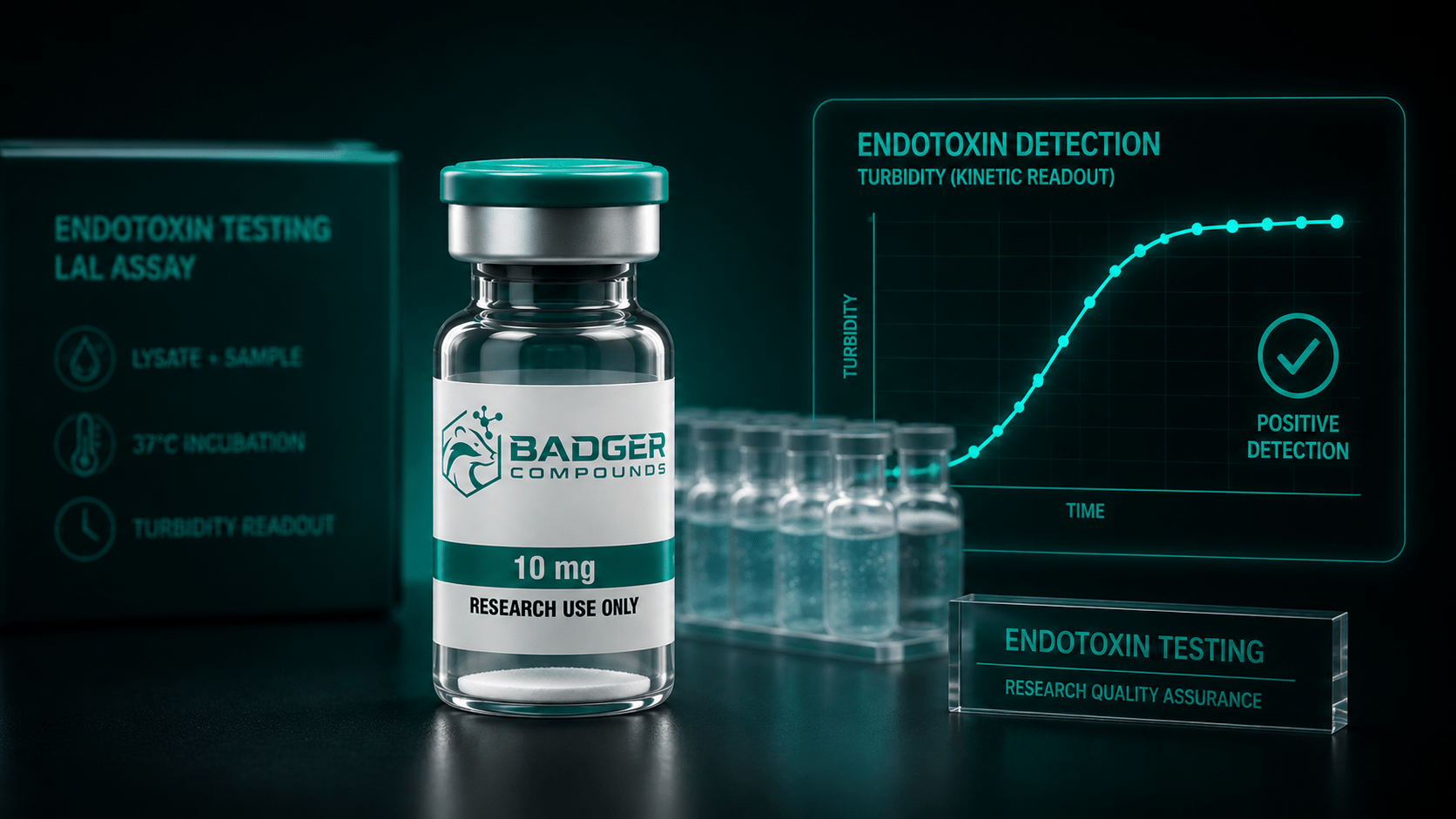
The Limulus Amebocyte Lysate (LAL) assay uses a reagent derived from the blood cells of the horseshoe crab, which reacts specifically and sensitively to endotoxin. When endotoxin is present, the lysate triggers a detectable reaction, gel formation, turbidity, or a color change depending on the assay format, that can be measured and quantified [1,2].
Gel-Clot
The classic format: a visible gel forms if endotoxin is present above a set threshold.
Turbidimetric
Measures cloudiness developing over time, allowing a quantitative endotoxin reading.
Chromogenic
Uses a color-producing reaction to quantify endotoxin concentration precisely.
The LAL assay became the standard specifically because it is highly sensitive, specific to endotoxin, and far more practical than the rabbit pyrogen test it replaced for most applications [3].
Endotoxin testing is a distinct question from purity or identity. HPLC confirms chemical purity; mass spectrometry confirms identity; the LAL assay confirms the material is free of bacterial contamination. None of the three substitutes for the others.
Why This Belongs on a Spec Sheet
Endotoxin results are typically reported in endotoxin units per milligram (EU/mg), a measure of contamination relative to the amount of material. This figure sits alongside the other panels on a complete Certificate of Analysis, purity, identity, and heavy metals, as one more independent check that answers a question none of the others do. For the full picture of how to read that document, see our guide on how to read a Certificate of Analysis, and for the broader testing framework, see our overview of third-party testing for research compounds.
Research Concepts Related to Endotoxin Testing
Lipopolysaccharide (LPS) Gram-negative bacteria Limulus Amebocyte Lysate Endotoxin units (EU/mg) Pyrogen testingSix-Round Tested, Including Endotoxin – ≥99% (HPLC)
Every compound in our catalog is independently tested per batch across a full panel, with publicly viewable COAs. For qualified laboratory research use only.
Browse the Catalog- Weary M, Baker B. The Limulus amebocyte lysate endotoxin assay: current status. Prog Clin Biol Res. 1979;29:331-346. PMID 573551
- Levin J. The Limulus amebocyte lysate assay. Ann N Y Acad Sci. 1980;348:379-382. PMID 7415922
- Cooper JF. Detection of endotoxin in biological products by the limulus test. Dev Biol Stand. 1977;34:7-13. PMID 838151
Disclaimer: This article is for informational and educational purposes only. Products discussed are research use only, not for human consumption, veterinary use, clinical use, or any consumer application. Statements have not been evaluated by the FDA. This content does not provide medical advice.
Endotoxin Testing: What LAL Testing Means for Research Peptides
A peptide can be chemically pure and still carry bacterial contamination that HPLC was never designed to catch. Endotoxin testing exists to close that gap, and the method behind it, the Limulus Amebocyte Lysate assay, has been the pharmaceutical industry’s standard for detecting it for decades.
What Is an Endotoxin?
Endotoxins are lipopolysaccharide (LPS) molecules found in the outer membrane of gram-negative bacteria. They are released when those bacteria die or divide, and they can persist in a solution or on equipment even after the bacteria themselves are gone. Endotoxins are heat-stable and can trigger a strong immune and inflammatory response, which is why their presence is tracked as a distinct contamination category from live microbial contamination.
Research framing: This article explains laboratory quality testing methods. Compounds referenced are supplied by Badger Compounds for research use only and are not intended for human or veterinary use. Nothing here is medical advice.
The LAL Assay: How Endotoxin Testing Works
The Limulus Amebocyte Lysate (LAL) assay uses a reagent derived from the blood cells of the horseshoe crab, which reacts specifically and sensitively to endotoxin. When endotoxin is present, the lysate triggers a detectable reaction, gel formation, turbidity, or a color change depending on the assay format, that can be measured and quantified [1,2].
Gel-Clot
The classic format: a visible gel forms if endotoxin is present above a set threshold.
Turbidimetric
Measures cloudiness developing over time, allowing a quantitative endotoxin reading.
Chromogenic
Uses a color-producing reaction to quantify endotoxin concentration precisely.
The LAL assay became the standard specifically because it is highly sensitive, specific to endotoxin, and far more practical than the rabbit pyrogen test it replaced for most applications [3].
Endotoxin testing is a distinct question from purity or identity. HPLC confirms chemical purity; mass spectrometry confirms identity; the LAL assay confirms the material is free of bacterial contamination. None of the three substitutes for the others.
Why This Belongs on a Spec Sheet
Endotoxin results are typically reported in endotoxin units per milligram (EU/mg), a measure of contamination relative to the amount of material. This figure sits alongside the other panels on a complete Certificate of Analysis, purity, identity, and heavy metals, as one more independent check that answers a question none of the others do. For the full picture of how to read that document, see our guide on how to read a Certificate of Analysis, and for the broader testing framework, see our overview of third-party testing for research compounds.
Research Concepts Related to Endotoxin Testing
Lipopolysaccharide (LPS) Gram-negative bacteria Limulus Amebocyte Lysate Endotoxin units (EU/mg) Pyrogen testingSix-Round Tested, Including Endotoxin – ≥99% (HPLC)
Every compound in our catalog is independently tested per batch across a full panel, with publicly viewable COAs. For qualified laboratory research use only.
Browse the Catalog- Pearson FC. The Limulus amebocyte lysate endotoxin assay: current status. Am J Med Technol. 1979;45(8):704-709. PMID 573551
- Spagna VA, Prior RB. The Limulus amebocyte lysate assay. Am Fam Physician. 1980;22(3):125-128. PMID 7415922
- Cooper JF, Pearson SM. Detection of endotoxin in biological products by the limulus test. Dev Biol Stand. 1977;34:7-13. PMID 838151
Disclaimer: This article is for informational and educational purposes only. Products discussed are research use only, not for human consumption, veterinary use, clinical use, or any consumer application. Statements have not been evaluated by the FDA. This content does not provide medical advice.