No products in the cart.
U.S. FILLED & FINISHED | ≥99% COA-VERIFIED PURITY
LC-MS VERIFIED IDENTITY | INDEPENDENTLY TESTED
How to read a Certificate of Analysis is a skill worth having before you trust any research peptide, because the COA is the document that connects a specific batch to its actual test results. This guide walks through each section of a peptide COA, from identity and purity to heavy metals and microbial testing, and shows how to verify that the vial in your hand matches the paperwork.
How to Read a Certificate of Analysis (COA) for Research Peptides
How to read a Certificate of Analysis is a skill worth having before you trust any research peptide, because the COA is the document that connects a specific batch to its actual test results. This guide walks through each section of a peptide COA, from identity and purity to heavy metals and microbial testing, and shows how to verify that the vial in your hand matches the paperwork.
What Is a Certificate of Analysis?
A Certificate of Analysis, or COA, is a document that reports the results of the tests run on a specific batch of material. It ties a set of measured values, what the compound is and how pure it is, to a single lot number, so that a vial can be traced back to the exact testing that was performed on the batch it came from.
A COA is only as meaningful as the tests behind it and the ability to match it to your material. A generic claim of high purity on a website is not the same as a batch-specific document showing the actual chromatogram and mass spectrum. Learning to read the document is what lets you tell the difference [4].
Research framing: This article explains laboratory documentation for research materials. Compounds discussed are supplied by Badger Compounds for research use only and are not intended for human or veterinary use. Nothing here is medical advice.
How to Read a Certificate of Analysis, Section by Section
A peptide COA is a stack of related tests, each answering a different question. Here is what the main sections mean.
Product and Batch Number
The compound name and the lot or batch number. This is the field you match against the label on your vial to confirm the COA belongs to your material.
Identity
Usually confirmed by mass spectrometry, comparing the observed molecular weight against the expected mass for the target peptide.
Purity
Typically measured by reverse-phase HPLC and reported as a percentage of the main peak relative to detected impurities.
Safety Panel
Additional tests such as heavy metals and microbial counts that HPLC purity does not capture, covering contamination rather than the peptide itself.
Identity: Does the Mass Match?
Before purity means anything, you need to know the material is the right molecule. Mass spectrometry is the standard method for this, and it works because the sequence of a synthetic peptide is already known, so the analysis focuses on confirming that the measured mass matches the theoretical mass for that sequence [1]. On a COA, this appears as an observed mass compared with the expected molecular weight.
The reason this section comes first in importance is simple: a high purity number on the wrong compound is worthless. If the observed mass does not match the target, no purity percentage can rescue the result, because the material may not be the intended peptide at all.
Purity: What the HPLC Percentage Means
Purity is the number most people look for, and it is usually generated by reverse-phase HPLC. The method separates the target peptide from structurally related impurities, and the reported figure, for example ≥99% (HPLC), represents the main peak as a percentage of the total detected material.
Those impurities are not random. In synthetic peptides they are predictable byproducts of the synthesis and handling process, such as deletion sequences, truncated chains, and degradation products, which is exactly what a good purity method is designed to detect and quantify [2]. For a deeper look at what a purity figure does and does not tell you, see our article on what ≥99% purity actually means.
| COA section | Typical method | Question it answers |
|---|---|---|
| Identity | Mass spectrometry | Is this the right molecule? |
| Purity | Reverse-phase HPLC | How much of it is the target versus impurities? |
| Peptide content | Quantitative assay | How much actual peptide is in the vial? |
| Heavy metals | ICP-MS | Are toxic elements present above limits? |
| Microbial | TAMC / TYMC | Is there bacterial or fungal contamination? |
Identity and purity answer different questions. Mass spectrometry confirms what the compound is; HPLC confirms how pure it is. A trustworthy COA shows both, tied to a batch number you can match against your vial.
Beyond Purity: Heavy Metals and Microbial Testing
A peptide can be highly pure by HPLC and still carry contaminants that HPLC was never designed to see. This is why a complete COA goes beyond a single purity number.
Heavy metals such as lead, arsenic, cadmium, and mercury can enter during manufacturing and are measured by inductively coupled plasma mass spectrometry (ICP-MS), the standard technique for detecting and quantifying elemental impurities in line with pharmacopeial limits [3]. Microbial testing, reported as total aerobic microbial count (TAMC) and total yeast and mold count (TYMC), addresses biological contamination. None of these overlap with the HPLC purity figure, which is precisely why they belong on the certificate as separate tests [4]. For why independent testing across these categories matters, see our overview of third-party testing for research compounds.
How to Verify Your COA
Reading the sections is half the job; the other half is confirming the document actually applies to your material. A few practical checks separate a meaningful COA from a decorative one:
Match the Batch
Confirm the lot or batch number on the COA matches the number printed on your vial. A COA for a different batch tells you nothing about yours.
Look for the Data
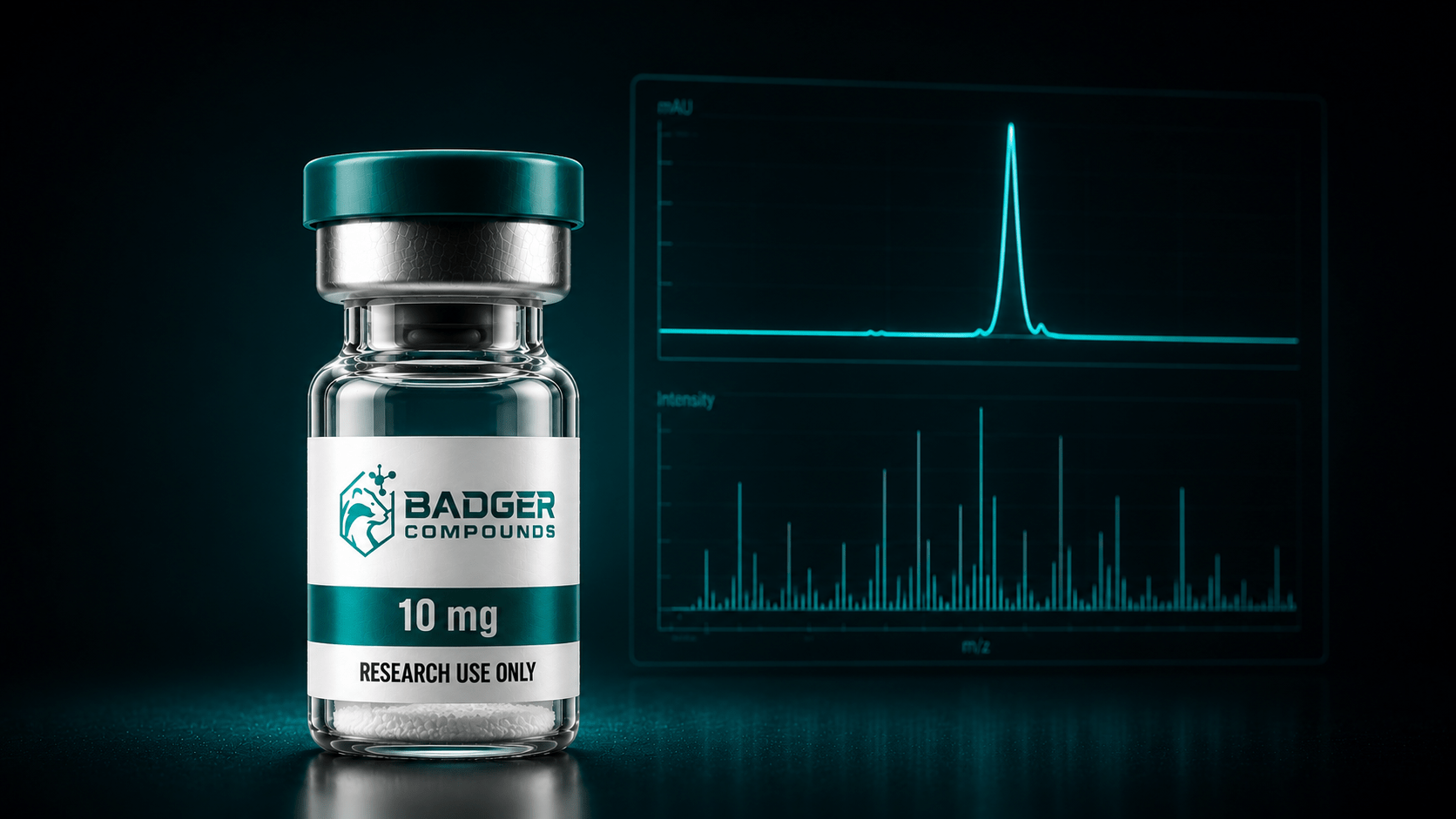
A strong COA shows the actual HPLC chromatogram and mass spectrum, not just a summary line. The raw traces are the evidence.
Check Independence
Third-party testing carries more weight than in-house-only claims. Confirm who ran the analysis and when.
Research Concepts Related to the COA
A Certificate of Analysis draws together several analytical concepts studied across the literature:
Mass spectrometry identity Reverse-phase HPLC purity Related peptide impurities Net peptide content ICP-MS heavy metals TAMC and TYMC microbial testing Batch traceability Third-party verificationEvery Batch, a Published COA – ≥99% (HPLC)
We publish batch-level Certificates of Analysis with six rounds of independent testing per batch, so you can match every vial to its own documented results. For qualified laboratory research use only.
View Our COAs- Chrone VG, Lorentzen A, Højrup P. Characterization of synthetic peptides by mass spectrometry. Methods Mol Biol. 2024;2821:83-89. PMID 38997482
- D’Hondt M, Bracke N, Taevernier L, et al. Related impurities in peptide medicines. J Pharm Biomed Anal. 2014;101:2-30. PMID 25044089
- Mittal M, Kumar K, Anghore D, Rawal RK. ICP-MS: analytical method for identification and detection of elemental impurities. Curr Drug Discov Technol. 2017;14(2):106-120. PMID 28003007
- Elsayed YY, Kühl T, Imhof D. Regulatory guidelines for the analysis of therapeutic peptides and proteins. J Pept Sci. 2025;31(3):e70001. PMID 39921384
Disclaimer: This article is for informational and educational purposes only. Products and compounds discussed are intended for research use only and are not for human consumption, veterinary use, clinical use, diagnostic use, food use, supplement use, pharmaceutical use, cosmetic use, or any consumer application. Statements have not been evaluated by the FDA. This content does not provide medical advice, treatment guidance, dosing information, or recommendations for personal use.