No products in the cart.
U.S. FILLED & FINISHED | ≥99% COA-VERIFIED PURITY
LC-MS VERIFIED IDENTITY | INDEPENDENTLY TESTED
Melanotan I photoprotection research centers on a synthetic, MC1R-selective analog of alpha-melanocyte-stimulating hormone, where preclinical and clinical investigations have examined its capacity to stimulate eumelanin synthesis independent of ultraviolet exposure, work that ultimately supported regulatory approval of the same peptide sequence for a specific photodermatosis.
Melanotan I Photoprotection Research: MC1R-Selective Melanogenesis
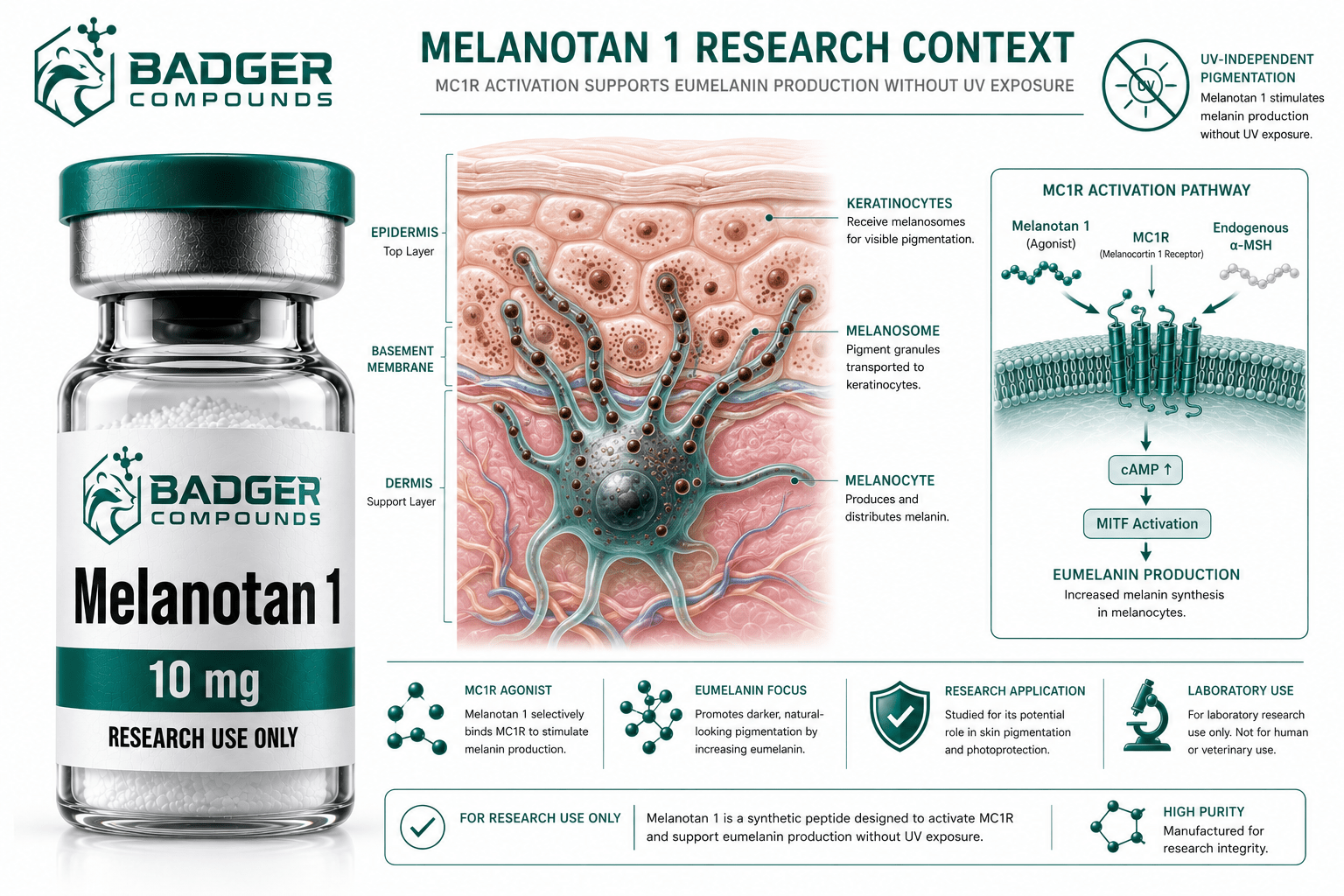
Melanotan I is a synthetic linear analog of alpha-melanocyte-stimulating hormone, chemically designated [Nle4, D-Phe7]-alpha-MSH and also known as NDP-MSH. Preclinical and clinical investigations have characterized it as a selective melanocortin 1 receptor agonist capable of driving eumelanin synthesis independent of ultraviolet exposure.
What Is Melanotan I?
Melanotan I is a synthetic 13-amino-acid peptide built on the full alpha-MSH backbone, modified with two substitutions, norleucine at position 4 and D-phenylalanine at position 7, that give it the formal name [Nle4, D-Phe7]-alpha-MSH. It is also referred to as NDP-MSH in the scientific literature. These substitutions confer substantially greater potency and a much longer duration of action than the native hormone, along with resistance to enzymatic degradation. Unlike Melanotan II, which is a cyclic, non-selective heptapeptide, Melanotan I retains a linear structure closer to native alpha-MSH and shows relative selectivity for the melanocortin 1 receptor (MC1R) over the other melanocortin receptor subtypes.
This is an important structural distinction from Melanotan II, discussed elsewhere on this site, which is non-selective across MC1R, MC3R, MC4R, and MC5R and carries a different research and safety profile as a result. Melanotan I’s relative MC1R selectivity is the structural basis for its more focused pigmentation research and, ultimately, its regulatory history described below.
Mechanism: Sustained MC1R Activation
Early mechanistic work by Hadley and colleagues (1985) examined Melanotan I in a Cloudman S91 melanoma cell line and found it to be roughly 100-fold more effective than native alpha-MSH at stimulating tyrosinase, the rate-limiting enzyme in melanin synthesis. The research also reported an unusually sustained effect: cells exposed briefly to Melanotan I continued to show elevated tyrosinase activity for up to six days after the peptide was removed from the culture medium, a duration far exceeding that seen with native alpha-MSH. The authors described this as an essentially irreversible activation of the melanogenic pathway, distinguishing the analog’s pharmacology from that of the endogenous hormone.
This sustained MC1R engagement, driving cyclic AMP production and downstream tyrosinase activity, is the mechanistic basis for pigmentation that develops independent of ultraviolet exposure, a property that shaped nearly all subsequent research on the compound.
MC1R Selectivity
Relative to non-selective melanocortin agonists, Melanotan I shows preferential activity at MC1R, the receptor subtype governing melanocyte pigmentation.
Sustained Tyrosinase Activation
Preclinical research reported tyrosinase stimulation persisting for days after peptide removal, described as an essentially irreversible activation in melanoma cell models.
UV-Independent Pigmentation
Because activation occurs through direct receptor engagement rather than UV-induced signaling, melanogenesis research with this peptide does not require ultraviolet exposure.
Research framing: All findings referenced in this post derive from preclinical and clinical research conducted by third parties. Melanotan I is supplied by Badger Compounds for laboratory research use only and is not intended for human or veterinary use. No therapeutic or cosmetic conclusions should be drawn from the research discussed here.
Early Toxicology and Human Pigmentation Research
Dorr and colleagues (1988) conducted early toxicology studies of Melanotan I in mice, administering the compound both topically and by injection over 4 to 12 weeks. The research found no toxic effects on organs, hematologic indices, or weight gain, with only a slight increase in triglyceride and platelet levels noted after prolonged weekly dosing. The authors explicitly framed the compound as entering Phase I clinical trials for potential use in hypomelanotic disorders such as vitiligo and for pharmacologic tanning without sunlight exposure, language that captures the original research direction for this peptide.
Human pigmentation research followed. Levine and colleagues (1991), publishing in JAMA, administered this same NDP-alpha-MSH compound to human volunteers by subcutaneous injection and reported measurable skin darkening without any ultraviolet exposure, providing early clinical evidence that the mechanism observed in cell culture translated to pigmentation in humans.
A Notable Regulatory History: From Research Peptide to Approved Drug
The same peptide sequence studied as Melanotan I underwent formal clinical development under the name afamelanotide, marketed as Scenesse, for a rare and severe disease called erythropoietic protoporphyria (EPP), a photodermatosis in which sunlight exposure causes excruciating pain. Langendonk and colleagues (2015), publishing in the New England Journal of Medicine, reported two multicenter, randomized, double-blind, placebo-controlled trials of a subcutaneous implant containing 16 mg of afamelanotide. In the United States study, the median duration of pain-free sun exposure after 6 months was 69.4 hours in the afamelanotide group versus 40.8 hours with placebo. In the European Union study, phototoxic reactions were reduced from 146 to 77 events, and quality of life improved in both trials.
This research supported the compound’s approval by European regulators and, in October 2019, by the U.S. Food and Drug Administration, specifically for EPP. A follow-up immunogenicity study by Lengweiler and colleagues (2015) found no antibody response against the peptide in 23 of 26 EPP patients treated for up to 6 years, supporting a favorable long-term tolerability profile in that population.
| Research Model | System | Reported Observation |
|---|---|---|
| Melanoma cell culture | Cloudman S91 tyrosinase assay (Hadley 1985) | 100-fold potency versus native alpha-MSH; sustained activity for days |
| Mouse toxicology | Topical and injected dosing, 4-12 weeks (Dorr 1988) | No organ or hematologic toxicity; entered Phase I development |
| Human pigmentation | Subcutaneous injection, volunteers (Levine 1991) | Measurable skin darkening without UV exposure |
| EPP phase III trials | Randomized, placebo-controlled, US and EU (Langendonk 2015) | Increased pain-free sun exposure; reduced phototoxic reactions |
| Long-term EPP treatment | Immunogenicity ELISA, up to 6 years (Lengweiler 2015) | No antibody response in 23 of 26 patients |
Melanotan I is a research-use-only peptide. Badger Compounds supplies Melanotan I exclusively for qualified research applications in controlled laboratory settings. It is not the approved pharmaceutical product Scenesse, and the research summarized here does not establish safety or efficacy in any human population.
An Important Distinction: Research Peptide Versus Approved Drug
This regulatory history creates a distinction worth stating with precision, since it is a point of genuine confusion in this space. Afamelanotide (Scenesse) is a specific, approved pharmaceutical product manufactured by Clinuvel Pharmaceuticals, formulated as a biodegradable, controlled-release subcutaneous implant containing 16 mg of the peptide, and its EU and FDA approvals apply specifically to that implant formulation for the treatment of EPP. Kim and Garnock-Jones (2016), reviewing the compound in the American Journal of Clinical Dermatology, described afamelanotide as a first-in-class melanocortin-1 receptor agonist approved in the EU for this specific indication and route of administration.
The Melanotan I supplied by Badger Compounds is the same peptide sequence, [Nle4, D-Phe7]-alpha-MSH, provided as a lyophilized powder for laboratory research use. It is not manufactured, formulated, or administered as the approved implant, and it carries none of the regulatory approvals that apply to Scenesse. Sharing a peptide sequence with an approved drug does not mean a research-grade compound is equivalent to, or interchangeable with, that approved product. This distinction is central to accurate, compliant research use of Melanotan I.
Same Sequence, Different Product
Afamelanotide (Scenesse) is a specific approved implant formulation. Research-grade Melanotan I is the same peptide sequence supplied as an unformulated powder for laboratory use.
Indication-Specific Approval
Regulatory approval applies narrowly to EPP treatment via the approved implant, not to the peptide sequence generally or to any other formulation or use.
Research Pathways Associated with Melanotan I
Preclinical and clinical literature has examined Melanotan I across several interconnected research contexts:
MC1R selective agonism Tyrosinase activation Eumelanin synthesis cAMP signaling UV-independent pigmentation Photodermatosis research Erythropoietic protoporphyria models Long-term immunogenicityMelanotan I – Research Grade, ≥99% (HPLC)
Badger Compounds supplies Melanotan I as a lyophilized research peptide, six-round independently tested per batch with publicly viewable COAs. For qualified laboratory research use only.
View Melanotan I- Hadley ME, Abdel Malek ZA, Marwan MM, Kreutzfeld KL, Hruby VJ. [Nle4, D-Phe7]-alpha-MSH: a superpotent melanotropin that “irreversibly” activates melanoma tyrosinase. Endocr Res. 1985;11(3-4):157-170. PMID 3009169
- Dorr RT, Dawson BV, al-Obeidi F, Hadley ME, Levine N, Hruby VJ. Toxicologic studies of a superpotent alpha-melanotropin, [Nle4, D-Phe7]alpha-MSH. Invest New Drugs. 1988;6(4):251-258. PMID 2852652
- Levine N, Sheftel SN, Eytan T, et al. Induction of skin tanning by subcutaneous administration of a potent synthetic melanotropin. JAMA. 1991;266(19):2730-2736. PMID 1658407
- Langendonk JG, Balwani M, Anderson KE, et al. Afamelanotide for erythropoietic protoporphyria. N Engl J Med. 2015;373(1):48-59. PMID 26132941
- Kim ES, Garnock-Jones KP. Afamelanotide: a review in erythropoietic protoporphyria. Am J Clin Dermatol. 2016;17(2):179-185. PMID 26979527
- Lengweiler S, Kreim S, Barman-Aksozen J, Maurer M, Minder EI. Evaluation of the immunogenicity of the synthetic alpha-MSH analogue afamelanotide ([Nle4-D-Phe7]-alpha-MSH, Scenesse) in erythropoietic protoporphyria patients by ELISA detecting both anti-afamelanotide and anti-alpha-MSH antibodies. Skin Pharmacol Physiol. 2015;28(2):103-113. PMID 25402764
Disclaimer: Melanotan I is supplied by Badger Compounds for laboratory and in vitro research use only. It is not intended for human or veterinary use, and no product sold by Badger Compounds is approved for therapeutic, diagnostic, or cosmetic application. The approved pharmaceutical product afamelanotide (Scenesse) is a distinct, specifically formulated and regulated product not sold by Badger Compounds. All research findings referenced in this post are derived from preclinical and third-party clinical studies. No clinical efficacy or safety conclusions should be drawn from the data summarized here.