No products in the cart.
U.S. FILLED & FINISHED | ≥99% COA-VERIFIED PURITY
LC-MS VERIFIED IDENTITY | INDEPENDENTLY TESTED
Melanotan II melanogenesis research centers on a synthetic cyclic analog of alpha-melanocyte-stimulating hormone that binds melanocortin receptors, where preclinical and early clinical investigations have examined its activation of MC1R and the resulting stimulation of eumelanin synthesis in melanocytes.
Melanotan II Melanogenesis Research: The MC1R Pigmentation Pathway
Melanotan II (MT-II) is a synthetic cyclic heptapeptide analog of alpha-melanocyte-stimulating hormone. Preclinical and early clinical investigations have characterized its non-selective activation of melanocortin receptors, with MC1R agonism driving the eumelanin synthesis that defines its research profile in pigmentation biology.
What Is Melanotan II?
Melanotan II is a cyclic heptapeptide with the structure Ac-Nle-cyclo[Asp-His-D-Phe-Arg-Trp-Lys]-NH2 and a molecular weight of approximately 1024 Da. It was developed at the University of Arizona in the 1980s as a superpotent, enzymatically stable analog of alpha-melanocyte-stimulating hormone (alpha-MSH). The cyclic lactam-bridged structure and the D-phenylalanine substitution confer resistance to enzymatic degradation and prolonged activity relative to the native linear hormone.
Unlike its more selective predecessor Melanotan I (afamelanotide), MT-II is a non-selective agonist across multiple melanocortin receptor subtypes, including MC1R, MC3R, MC4R, and MC5R. This broad receptor activity is the central fact of its pharmacology: the MC1R activity drives pigmentation, while activity at MC3R and MC4R produces the additional systemic effects documented across the research literature.
The Melanogenesis Pathway: How MC1R Drives Pigmentation
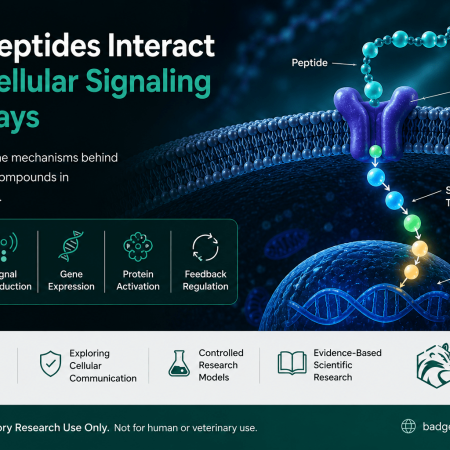
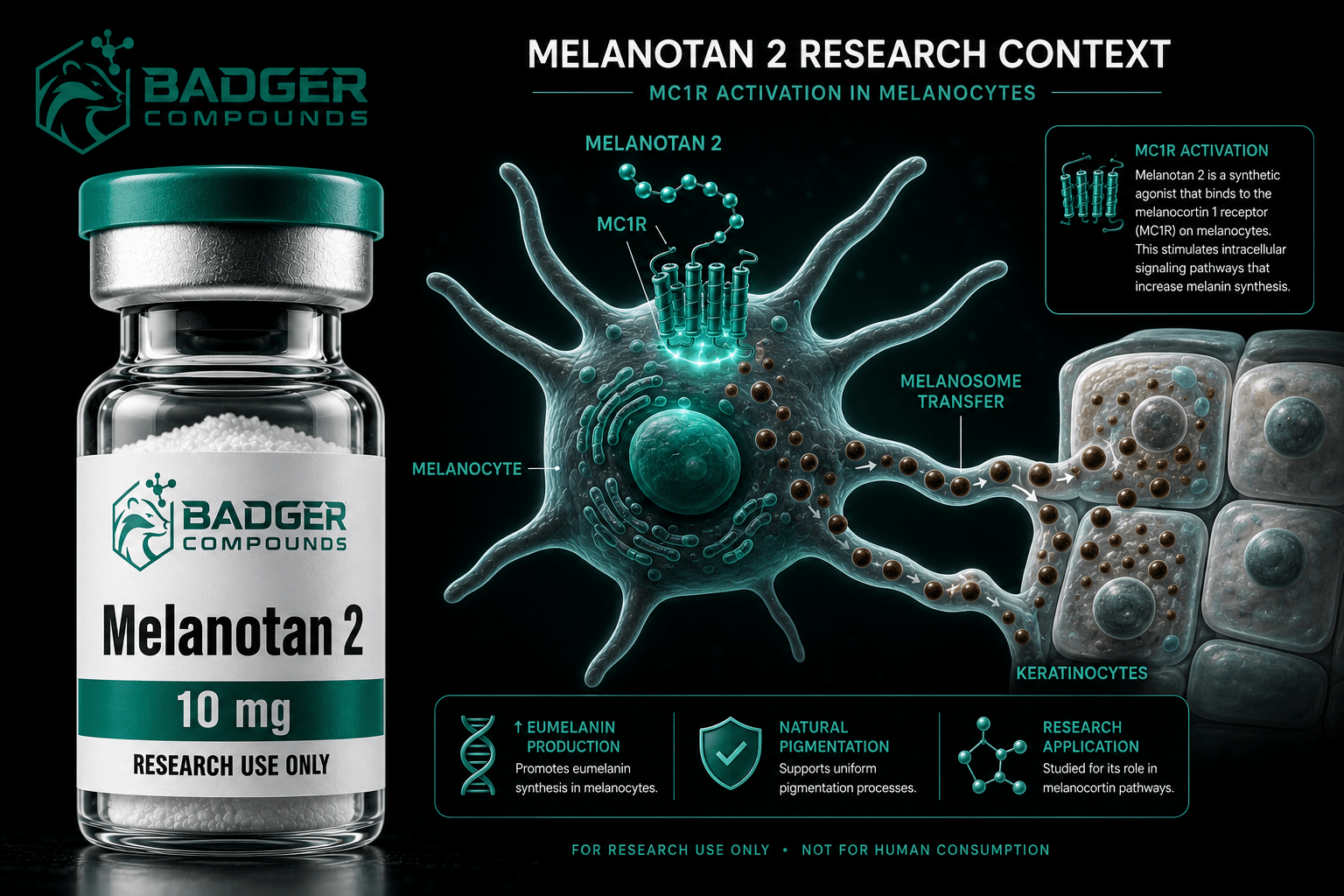
Melanogenesis is the biological process by which melanocytes synthesize melanin, the pigment responsible for skin, hair, and eye color. The melanocortin 1 receptor (MC1R) sits at the top of this pathway. When an agonist such as alpha-MSH or MT-II binds MC1R on the melanocyte surface, the receptor couples to adenylyl cyclase and elevates intracellular cyclic AMP. This activates protein kinase A and drives expression of microphthalmia-associated transcription factor (MITF), the master regulator of melanocyte biology.
MITF in turn upregulates the enzymes of pigment synthesis, principally tyrosinase, which catalyzes the rate-limiting steps of melanin production. The result is a shift toward eumelanin, the brown-black pigment that provides the greatest photoprotective capacity. Because MT-II is described in the research literature as substantially more potent than native alpha-MSH at driving this cascade, it has served as a research tool for studying melanocyte biology and MC1R signaling.
MC1R Activation
MT-II binds MC1R on melanocytes, coupling to adenylyl cyclase and elevating cyclic AMP, the initiating step of the pigmentation cascade.
MITF and Tyrosinase
Downstream signaling upregulates MITF and tyrosinase, the transcription factor and enzyme central to melanin synthesis in research models.
Eumelanin Shift
The pathway favors eumelanin, the brown-black pigment associated with greater photoprotective capacity than red-yellow pheomelanin.
Research framing: All findings referenced in this post derive from preclinical models and early clinical research conducted by third parties. Melanotan II is supplied by Badger Compounds for laboratory research use only and is not intended for human or veterinary use. It is not approved by any regulatory agency for any use. No therapeutic or cosmetic conclusions should be drawn from the research discussed here.
Early Human Pigmentation Research
The foundational human study of MT-II pigmentation was a small pilot phase-I trial by Dorr and colleagues (1996), published in Life Sciences. Working with only three male volunteers in a placebo-controlled design, the researchers administered low subcutaneous doses every other day over two weeks. Two of the subjects showed increased pigmentation in the face, upper body, and other regions, as measured by quantitative reflectance and visual assessment, demonstrating that MT-II had tanning activity in humans at low doses.
Honesty about this study requires noting its scope and its adverse-effect profile. The trial was very small, and the same report documented dose-dependent side effects including nausea, a stretching and yawning complex, spontaneous erections, and Grade II somnolence and fatigue at the higher dose. This early trial should be read as a preliminary signal from a handful of subjects, not as robust evidence of safety or efficacy. The broader tanning-melanotropin concept had been established earlier by Levine and colleagues (1991) in JAMA using the related linear analog NDP-alpha-MSH, which produced measurable skin darkening without ultraviolet exposure.
Non-Selectivity and the Path to PT-141
MT-II’s non-selective receptor profile is the reason its research history branches beyond pigmentation. Because the peptide also activates MC4R in the central nervous system, early trials observed effects on sexual function, and this unexpected finding led directly to the development of a more receptor-focused analog. As documented by Hadley and Dorr (2006), the developers of both compounds, the MC4R activity of MT-II prompted the design of PT-141 (bremelanotide) as a distinct analog aimed at that pathway.
For that separate line of melanocortin research, see our overview of PT-141 melanocortin receptor research, which examines the MC4R and central-nervous-system pharmacology in detail. The relationship between the two compounds is a useful illustration of how a non-selective research peptide can seed the development of a more targeted one.
Melanoma Models: A Genuinely Unresolved Question
The relationship between MT-II and melanoma is one of the more scientifically interesting and unresolved areas in the literature, and it runs in two directions. On one hand, a 2020 study by Wu and colleagues in the International Journal of Molecular Sciences reported that, in a B16-F10 melanoma model, topical MT-II actually suppressed tumor progression. The research described MC1R-mediated upregulation of the tumor suppressor PTEN and inhibition of COX-2 signaling, with MT-II reducing melanoma cell migration, invasion, and colony formation in that model.
On the other hand, the clinical case-report literature raises the opposite concern. Hjuler and Lorentzen (2014), publishing in Dermatology, reported cutaneous melanoma in a young woman who had self-injected MT-II in combination with sunbed use. As the authors emphasized, because MT-II is unlicensed and incompletely tested, the extent and types of adverse effects remain unknown. The primary paper on the melanoma model itself described the carcinogenic consequence of MT-II as equivocal. These findings are not contradictory so much as incomplete: preclinical mechanistic models and observational human reports are examining different questions, and the honest conclusion is that the relationship is unresolved.
| Research Model | System | Reported Observation |
|---|---|---|
| Human pilot trial | 3 male volunteers, subcutaneous (Dorr 1996) | Increased pigmentation in 2 of 3; dose-dependent adverse effects |
| Melanocortin pharmacology | Receptor binding characterization | Non-selective agonism at MC1R, MC3R, MC4R, MC5R |
| Melanoma suppression | B16-F10 in vitro and in vivo (Wu 2020) | MC1R-mediated PTEN upregulation; reduced tumor progression |
| Clinical case report | Self-injection plus sunbed (Hjuler 2014) | Cutaneous melanoma; causation not established |
| Mucosal case report | Nasal spray use (Alsabbagh 2025) | Oral mucosal melanoma reported following use |
Melanotan II is a research-use-only compound and is not approved for human use by any regulatory agency. Badger Compounds supplies MT-II exclusively for qualified research applications in controlled laboratory settings. The research summarized here does not establish safety or efficacy in any human population.
Regulatory Status and the Illicit-Product Problem
Melanotan II occupies an unusual position: it is widely discussed yet approved nowhere. Evans-Brown and colleagues (2009), writing in the BMJ, documented the use of unlicensed Melanotan I and II in the general population and the public health questions this raises. Multiple national regulators, including agencies in the United Kingdom, the United States, and Denmark, have issued warnings against products marketed as Melanotan.
This regulatory gap has a direct consequence for research integrity. Because MT-II has circulated heavily through unregulated channels, product identity and purity are legitimate concerns for any laboratory sourcing the compound. Analytical studies of illicitly sold Melanotan II products have documented variability in identity and content. For research applications, provenance and verified purity are not incidental details but prerequisites for reproducible work, which is why Badger Compounds supplies MT-II with batch-level third-party analysis and publicly viewable certificates of analysis.
Research Pathways Associated with Melanotan II
Preclinical and early clinical literature has examined Melanotan II across several interconnected research contexts:
MC1R agonism Eumelanin synthesis MITF and tyrosinase signaling cAMP / adenylyl cyclase pathway Non-selective melanocortin activity Photoprotection models Melanoma and melanocyte biology MC4R-linked systemic effectsMelanotan II – Research Grade, ≥99% (HPLC)
Badger Compounds supplies Melanotan II as a lyophilized research compound, six-round independently tested per batch with publicly viewable COAs. For qualified laboratory research use only.
View Melanotan II- Dorr RT, Lines R, Levine N, Brooks C, Xiang L, Hruby VJ, Hadley ME. Evaluation of melanotan-II, a superpotent cyclic melanotropic peptide in a pilot phase-I clinical study. Life Sci. 1996;58(20):1777-1784. PMID 8637402
- Levine N, Sheftel SN, Eytan T, et al. Induction of skin tanning by subcutaneous administration of a potent synthetic melanotropin. JAMA. 1991;266(19):2730-2736. PMID 1658407
- Hadley ME, Dorr RT. Melanocortin peptide therapeutics: historical milestones, clinical studies and commercialization. Peptides. 2006;27(4):921-930. PMID 16412534
- Wu JC, Tsai HE, Hsiao YH, Wu JS, Wu CS, Tai MH. Topical MTII therapy suppresses melanoma through PTEN upregulation and cyclooxygenase II inhibition. Int J Mol Sci. 2020;21(2):681. PMID 31968661
- Hjuler KF, Lorentzen HF. Melanoma associated with the use of melanotan-II. Dermatology. 2014;228(1):34-36. PMID 24355990
- Evans-Brown M, Dawson RT, Chandler M, McVeigh J. Use of melanotan I and II in the general population. BMJ. 2009;338:b566. PMID 19224885
- Yassin Alsabbagh A, Bhujel N, Singh RP. Melanotan II nasal spray: a possible risk factor for oral mucosal malignant melanoma? Int J Oral Maxillofac Surg. 2025;54(9):806-808. PMID 40210573
Disclaimer: Melanotan II is supplied by Badger Compounds for laboratory and in vitro research use only. It is not intended for human or veterinary use, is not approved by any regulatory agency, and no product sold by Badger Compounds is approved for therapeutic, diagnostic, or cosmetic application. All research findings referenced in this post are derived from preclinical and third-party clinical studies. No clinical efficacy or safety conclusions should be drawn from the data summarized here.