No products in the cart.
U.S. FILLED & FINISHED | ≥99% COA-VERIFIED PURITY
LC-MS VERIFIED IDENTITY | INDEPENDENTLY TESTED
PT-141 melanocortin receptor research centers on a synthetic analog of alpha-melanocyte-stimulating hormone that acts as an agonist at central melanocortin receptors, where preclinical investigations have examined its activation of MC3R and MC4R signaling in neural circuits associated with sexual function.
PT-141 Melanocortin Receptor Research: A Central Melanocortin Agonist
PT-141 (bremelanotide) is a synthetic cyclic peptide analog of alpha-melanocyte-stimulating hormone that acts as an agonist at central melanocortin receptors, principally MC3R and MC4R. Preclinical investigations have characterized its activation of hypothalamic neural circuits, distinguishing it mechanistically from peripherally acting compounds.
What Is PT-141?
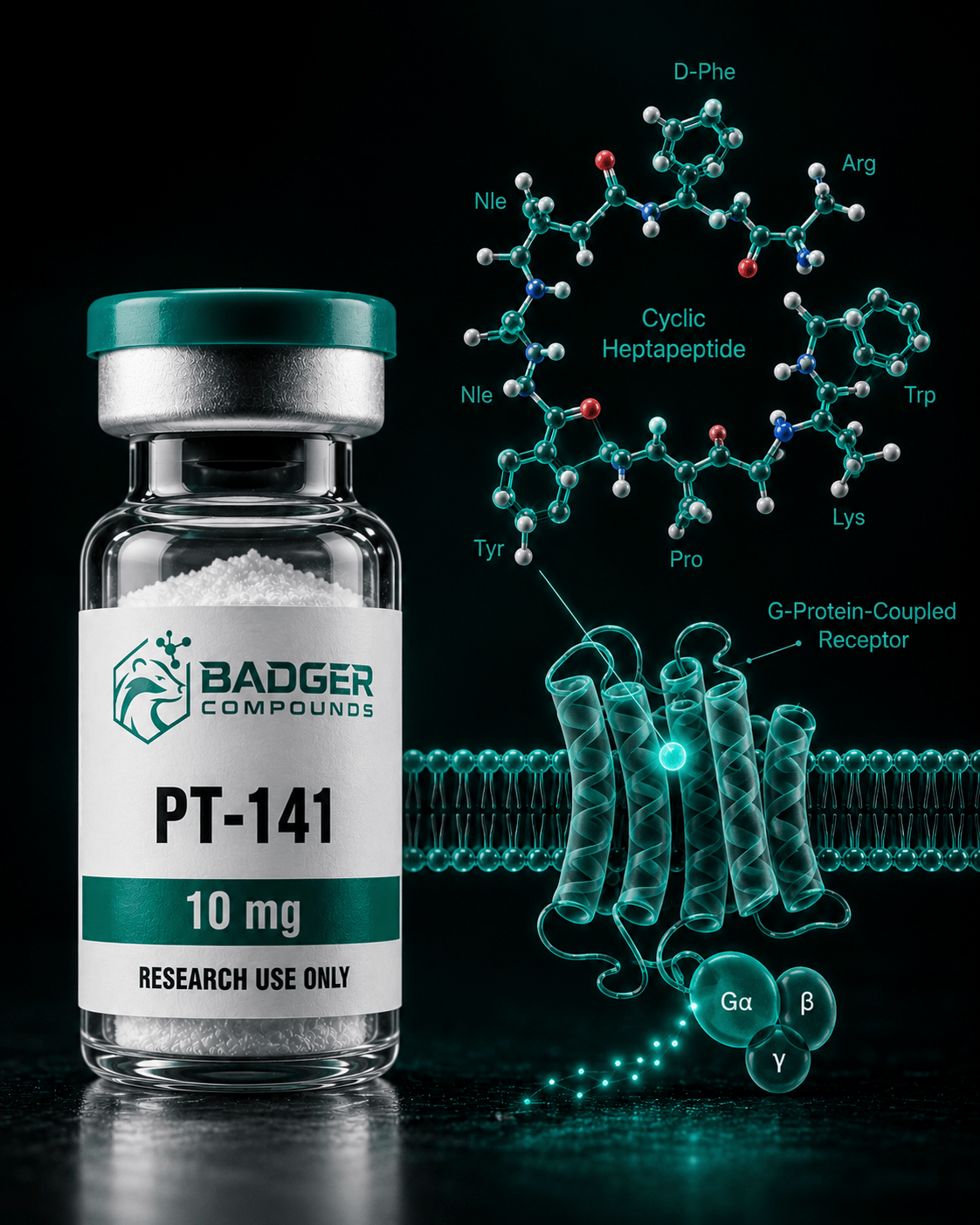
PT-141, known in scientific literature as bremelanotide, is a synthetic cyclic heptapeptide with the structure Ac-Nle-cyclo[Asp-His-D-Phe-Arg-Trp-Lys]-OH and a molecular weight of approximately 1025 Da. It retains the His-Phe-Arg-Trp core sequence of alpha-melanocyte-stimulating hormone (alpha-MSH), which represents the minimal pharmacophore required for melanocortin receptor binding. The cyclic conformation confers resistance to enzymatic degradation and contributes to its binding profile at melanocortin receptor subtypes.
The peptide emerged from melanocortin pharmacology programs originating at the University of Arizona and was subsequently developed as a research analog optimized for central melanocortin receptor activity. Because it shares the alpha-MSH core pharmacophore, PT-141 sits within the same peptide family as other melanocortin-derived research peptides, including the C-terminal tripeptide discussed in our KPV peptide anti-inflammatory research overview, though the two engage the melanocortin system through markedly different mechanisms.
The Melanocortin Receptor System
The melanocortin system comprises five G-protein-coupled receptor subtypes, MC1R through MC5R, each with distinct tissue distribution and function. MC1R is associated with pigmentation in melanocytes, MC2R with adrenal steroidogenesis, and MC5R with exocrine gland function. The MC3R and MC4R subtypes are expressed predominantly in the central nervous system, where they participate in the regulation of energy balance, autonomic tone, and sexual function.
PT-141 acts as an agonist across several melanocortin receptors, with research characterizing meaningful activity at MC3R and MC4R and comparatively lower activity at MC1R. This relative selectivity away from MC1R is of research interest because MC1R activation drives melanogenesis, and reduced MC1R engagement corresponds to a distinct profile relative to less selective melanocortin agonists. Receptor binding couples to adenylyl cyclase through stimulatory G proteins, elevating intracellular cyclic AMP in target neurons.
Research framing: All findings referenced in this post derive from preclinical cell-based and animal research models, alongside receptor pharmacology characterization. PT-141 is supplied by Badger Compounds for laboratory research use only and is not intended for human or veterinary use. No therapeutic or clinical conclusions should be drawn from the preclinical data discussed here.
MC4R and Sexual Function Research
A foundational study by Van der Ploeg and colleagues, published in PNAS (2002), used combined genetic, pharmacological, and anatomical approaches to establish the melanocortin 4 receptor as a mediator of erectile function and sexual behavior in animal models. The research reported that a highly selective non-peptide MC4R agonist augmented erectile activity initiated by cavernous nerve stimulation in wild-type mice but not in Mc4r-null mice, and that copulatory behavior was enhanced by a selective MC4R agonist while diminished in mice lacking the receptor. The study also documented MC4R expression across spinal cord, hypothalamus, brainstem, and pelvic ganglion tissue.
Complementary work by Martin and colleagues (2002) demonstrated in an ex copula rat model that melanocortin-induced erectile activity is mediated by MC4 receptors, helping to resolve which subtype carries the pro-erectile signal given that endogenous melanocortin peptides do not discriminate between receptors.
MC4R Dependency
Preclinical investigations report that selective MC4R agonists augment erectile activity in wild-type animals but not in Mc4r-null models, indicating receptor dependency.
Central Expression
Research localizes MC4R across hypothalamus, brainstem, spinal cord, and pelvic autonomic relay centers relevant to the studied responses.
Copulatory Behavior
Animal-model research associates MC4R activation with enhanced copulatory behavior, with diminished responses in receptor-null models.
Central Mechanism: Neural Circuit Research
PT-141-specific pharmacology was characterized by Molinoff and colleagues (2003), who reported that systemic administration of the peptide to rats and nonhuman primates was associated with penile erections and activated hypothalamic neurons, evidenced by increased c-Fos immunoreactivity. The same research noted that neurons in this central region take up pseudorabies virus injected into the corpus cavernosum, anatomical evidence linking the activated hypothalamic circuits to peripheral effector tissue. This central mode of action distinguishes melanocortin agonists from peripherally acting vasodilator compounds studied in the same domain.
More recent circuit-level research by Semple and colleagues (2017) narrowed the relevant neural substrate, reporting that MC4R expression restricted to single-minded homolog 1 (Sim1) neurons was sufficient to support MC4R-mediated male sexual function in a conditional mouse model. This work advanced the field from receptor-level to circuit-level resolution of the melanocortin sexual-function pathway.
| Research Model | System | Melanocortin Receptor Observation |
|---|---|---|
| Mc4r knockout mice | Cavernous nerve stimulation (Van der Ploeg 2002) | Selective MC4R agonist augments erectile activity in wild-type but not Mc4r-null mice |
| Rat ex copula | Erectile activity assay (Martin 2002) | MC4 receptor activation increases erectile activity |
| Rats and nonhuman primates | c-Fos mapping and pseudorabies tracing (Molinoff 2003) | PT-141 activates hypothalamic neurons linked to peripheral effector tissue |
| Sim1-neuron conditional mice | Genetic circuit mapping (Semple 2017) | MC4R on Sim1 neurons sufficient for male sexual function |
| CNS receptor distribution | Expression mapping (review literature) | MC3R and MC4R predominate in hypothalamic and limbic regions |
PT-141 is a research-use-only peptide. Badger Compounds supplies PT-141 exclusively for qualified research applications in controlled laboratory settings. The preclinical data summarized here does not establish safety or efficacy in any human population.
MC3R Versus MC4R: An Ongoing Research Question
While MC4R has emerged as the principal effector in melanocortin-induced erectile research, the relative contribution of MC3R remains an active question. A review of melanocortin receptors and melanotropic peptides noted conflicting data across studies, with some laboratories suggesting that antagonism of forebrain MC3R may actually enhance melanocortin-induced erections. Because PT-141 engages both subtypes, it has served as a pharmacological tool for probing this distinction rather than a purely MC4R-selective probe.
A broader review by Shadiack and colleagues surveyed melanocortinergic agents in sexual-function research, situating PT-141 alongside related compounds such as MT-II and THIQ and attributing their shared erectogenic properties to central melanocortin receptor binding, particularly within the hypothalamus. Together these reviews frame PT-141 as a central-acting melanocortin agonist whose subtype pharmacology continues to be refined.
Research Pathways Associated with PT-141
Preclinical literature has examined PT-141 across several interconnected research contexts:
MC4R agonism MC3R agonism alpha-MSH core pharmacophore cAMP / adenylyl cyclase signaling Hypothalamic c-Fos activation Sim1 neuron circuitry Central versus peripheral mechanisms Copulatory and erectile behavior modelsPT-141 Peptide – Research Grade, ≥99% (HPLC)
Badger Compounds supplies PT-141 as a lyophilized research peptide, six-round independently tested per batch with publicly viewable COAs. For qualified laboratory research use only.
View PT-141- Molinoff PB, Shadiack AM, Earle D, Diamond LE, Quon CY. PT-141: a melanocortin agonist for the treatment of sexual dysfunction. Ann N Y Acad Sci. 2003;994:96-102. PMID 12851303
- Van der Ploeg LH, Martin WJ, Howard AD, et al. A role for the melanocortin 4 receptor in sexual function. Proc Natl Acad Sci U S A. 2002;99(17):11381-11386. PMID 12172010
- Martin WJ, McGowan E, Cashen DE, et al. Activation of melanocortin MC(4) receptors increases erectile activity in rats ex copula. Eur J Pharmacol. 2002;454(1):71-79. PMID 12409007
- Semple E, Shalabi F, Hill JW. Sim1 neurons are sufficient for MC4R-mediated sexual function in male mice. Endocrinology. 2017;158(4):987-999. PMID 29059347
- Hellstrom WJG, Kendirci M. Melanocortin receptors, melanotropic peptides and penile erection. Curr Top Med Chem. 2007. PMID 17584130
- Shadiack AM, Sharma SD, Earle DC, Spana C, Hallam TJ. Melanocortins in the treatment of male and female sexual dysfunction. Curr Top Med Chem. 2007;7(11):1137-1144. PMID 17584134
Disclaimer: PT-141 is supplied by Badger Compounds for laboratory and in vitro research use only. It is not intended for human or veterinary use, and no product sold by Badger Compounds is approved for therapeutic, diagnostic, or clinical application. All research findings referenced in this post are derived from preclinical cell-based and animal model studies. No clinical efficacy or safety conclusions should be drawn from the data summarized here.