No products in the cart.
U.S. FILLED & FINISHED | ≥99% COA-VERIFIED PURITY
LC-MS VERIFIED IDENTITY | INDEPENDENTLY TESTED
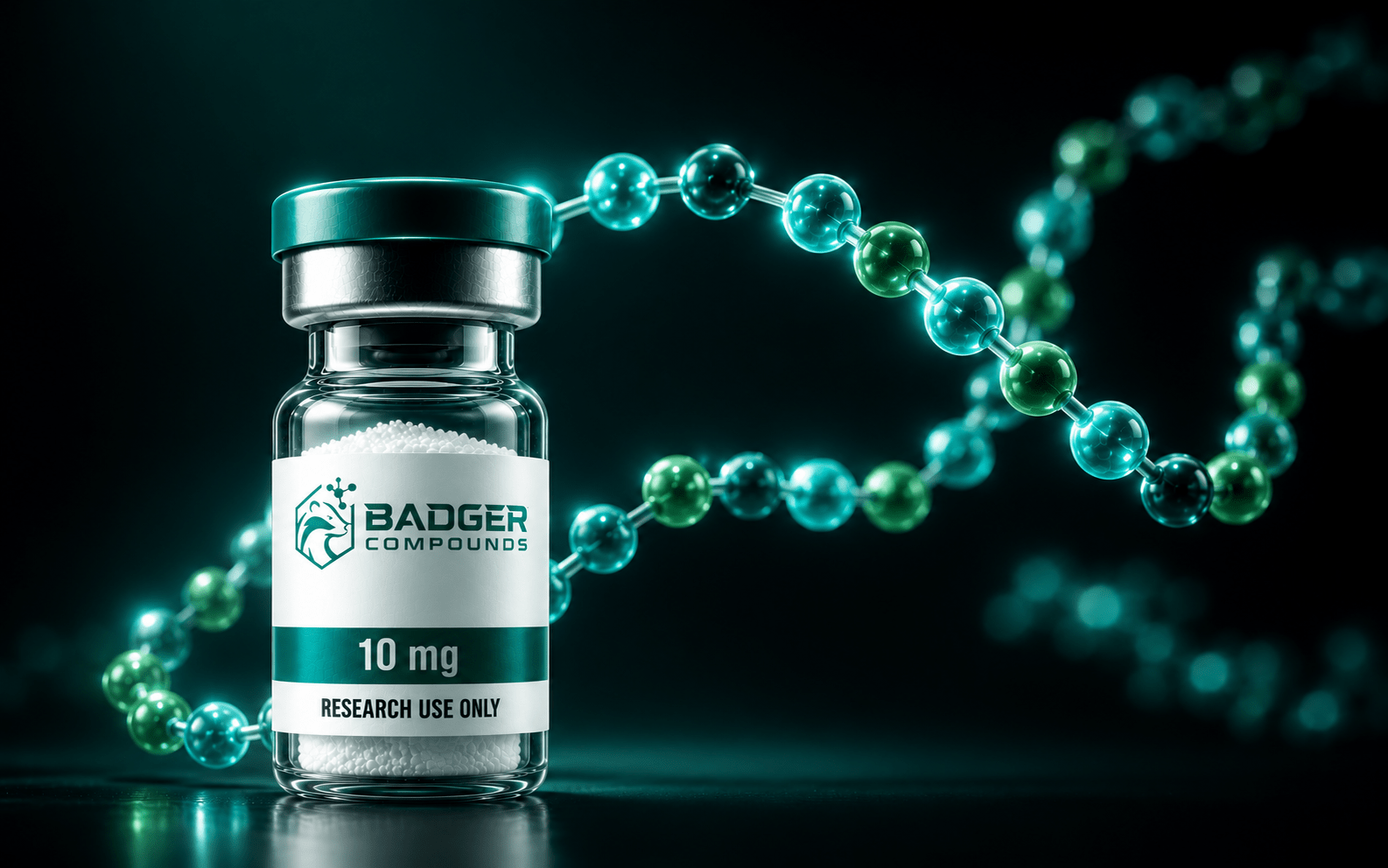
Peptide synthesis is the chemistry behind every research peptide in our catalog: the stepwise process of building a defined amino acid sequence, cleaving it, purifying it, and verifying it. This overview explains what a peptide is, how solid-phase peptide synthesis works, and why we synthesize and test domestically in the United States.
What Is Peptide Synthesis? How Research Peptides Are Made
Peptide synthesis is the chemistry behind every research peptide in our catalog. It is the stepwise process of building a defined amino acid sequence, cleaving it, purifying it, and verifying it before it is ever labeled and shipped. This overview covers what a peptide is, how solid-phase peptide synthesis works step by step, and why we synthesize and test domestically in the United States.
What Is a Peptide?
A peptide is a short chain of amino acids joined together by peptide bonds, the amide linkages that form between the carboxyl group of one amino acid and the amino group of the next. Twenty standard amino acids, arranged in different orders, make up the sequences studied across biology. The order of those amino acids is what gives each peptide its identity and its behavior in research models.
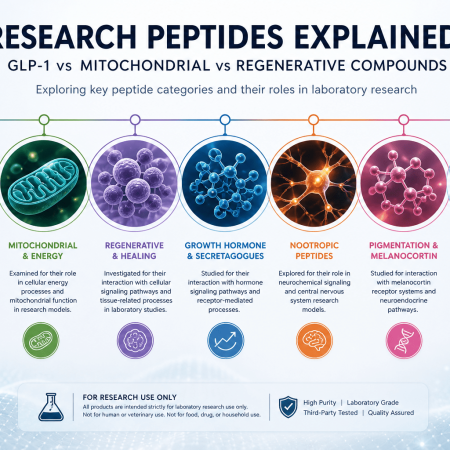
The line between a peptide and a protein is one of size and convention. Chains of roughly 50 amino acids or fewer are generally called peptides, while longer folded chains are called proteins. Most of the compounds studied in metabolic, regenerative, and signaling research fall on the peptide side of that line. For how these compounds group into research categories, see our overview of research peptides explained.
Research framing: All content in this post is for educational and research-context discussion only. Compounds referenced are supplied by Badger Compounds for laboratory research use only and are not intended for human or veterinary use. Nothing here is medical advice or a description of any approved product.
What Is Peptide Synthesis?
Peptide synthesis is the controlled chemical assembly of a specific amino acid sequence. There are two broad routes to making a peptide: recombinant expression, where engineered cells produce the sequence biologically, and chemical synthesis, where the chain is built one amino acid at a time in a reactor. For the defined, high-purity research peptides studied in most laboratory settings, chemical synthesis is the dominant approach.
The method that made modern chemical peptide synthesis practical is solid-phase peptide synthesis, or SPPS, introduced by Bruce Merrifield in 1963. Instead of building the chain in free solution, SPPS anchors the growing peptide to an insoluble resin bead, which allows excess reagents and byproducts to be washed away by simple filtration after each step. That single idea, building on a solid support, is what turned peptide synthesis into a fast, repeatable, and automatable process [1].
How Solid-Phase Peptide Synthesis Works
SPPS builds a peptide from the C-terminus toward the N-terminus through a repeating cycle. Each amino acid is added with its reactive groups temporarily masked by protecting groups, so that only the intended bond forms at each step. The modern standard uses Fmoc/tBu chemistry, where a base-labile Fmoc group protects the growing chain end and acid-labile groups protect the amino acid side chains [2,3].
1. Anchor
The first protected amino acid is attached to the resin through a linker, fixing the future C-terminus of the peptide to the solid support.
2. Deprotect
The temporary Fmoc group on the chain end is removed, exposing a free amino group ready to react with the next residue.
3. Couple
The next protected amino acid is activated and coupled to the exposed end, extending the chain by one residue. Deprotect and couple then repeat for every amino acid in the sequence.
4. Cleave
Once the full sequence is assembled, the peptide is cleaved from the resin and its side-chain protecting groups are removed, yielding the crude peptide.
The deprotect and couple steps are what repeat, once for each amino acid in the target sequence, which is why a longer peptide takes proportionally more cycles. Difficult sequences, where the growing chain tends to fold or aggregate on the resin, call for adapted resins, coupling reagents, and additives to keep each step efficient [2].
Chemical Synthesis Versus Recombinant Expression
Both routes produce peptides, but they answer different needs. The table below summarizes where each approach fits in a research context.
| Feature | Solid-phase chemical synthesis | Recombinant expression |
|---|---|---|
| How it is made | Stepwise assembly on a resin in a reactor | Produced biologically by engineered cells |
| Best suited to | Short to mid-length peptides | Longer peptides and full proteins |
| Sequence control | High, including non-natural amino acids and modifications such as lipidation | Limited to what the biological system encodes |
| Typical research use | Most defined research peptides | Larger recombinant proteins |
From Crude Peptide to Research-Grade Material
A freshly cleaved peptide is not finished. The crude product contains the target sequence alongside truncated chains, deletion sequences, and other byproducts of synthesis, so purification and verification are essential steps, not optional ones [4].
The crude peptide is typically purified by reverse-phase high-performance liquid chromatography (RP-HPLC), which separates the target sequence from closely related impurities. The purified peptide is then lyophilized, or freeze-dried, into a stable powder, and characterized to confirm both identity and purity. For a closer look at each of these stages, see our articles on what ≥99% purity actually means, lyophilized peptides in the laboratory, and third-party testing for research compounds.
Every batch we supply is independently verified before release. Synthesis is only the first step; purification, characterization, and third-party testing are what turn a crude product into research-grade material with documented identity and purity.
Why We Synthesize and Test in the United States
Where and how a peptide is made shapes how confident a researcher can be in what is actually in the vial. We synthesize domestically at a Midwest facility because keeping synthesis, purification, and quality control within a controlled domestic supply chain gives us direct oversight of the full process, from raw amino acids to the finished, labeled vial.
Supply-Chain Traceability
Domestic synthesis keeps the process under direct oversight and shortens the chain between production and release, so each batch can be traced end to end.
Independent Verification
Every batch is tested six ways by third-party laboratories, including identity, purity, and heavy-metal analysis, with batch-level Certificates of Analysis published for review.
That combination, domestic synthesis plus independent testing and published batch-level documentation, is the basis for our purity standard. It is why researchers can match a specific vial to a specific Certificate of Analysis rather than relying on a generic claim.
Final Thoughts
Peptide synthesis is a defined, repeatable chemistry: assemble the sequence on a resin one amino acid at a time, cleave it, purify it, and verify it. Understanding those steps makes the difference between treating a research peptide as a black box and understanding exactly what stands behind the label. The care taken at each stage, and the transparency of the documentation that follows, is what separates research-grade material from an unverified product.
Explore Research-Grade Peptides – ≥99% (HPLC)
Every compound in our catalog is synthesized domestically, six-round independently tested per batch, and supported by publicly viewable COAs. For qualified laboratory research use only.
Browse the Catalog- Amblard M, Fehrentz JA, Martinez J, Subra G. Fundamentals of modern peptide synthesis. Methods Mol Biol. 2005;298:3-24. PMID 15897611
- Coin I, Beyermann M, Bienert M. Solid-phase peptide synthesis: from standard procedures to the synthesis of difficult sequences. Nat Protoc. 2007;2(12):3247-3256. PMID 18079725
- Behrendt R, White P, Offer J. Advances in Fmoc solid-phase peptide synthesis. J Pept Sci. 2016;22(1):4-27. PMID 26785684
- Mäde V, Els-Heindl S, Beck-Sickinger AG. Automated solid-phase peptide synthesis to obtain therapeutic peptides. Beilstein J Org Chem. 2014;10:1197-1212. PMID 24991269
Disclaimer: This article is for informational and educational purposes only. Products and compounds discussed are intended for research use only and are not for human consumption, veterinary use, clinical use, diagnostic use, food use, supplement use, pharmaceutical use, cosmetic use, or any consumer application. Statements have not been evaluated by the FDA. This content does not provide medical advice, treatment guidance, dosing information, or recommendations for personal use.