No products in the cart.
U.S. FILLED & FINISHED | ≥99% COA-VERIFIED PURITY
LC-MS VERIFIED IDENTITY | INDEPENDENTLY TESTED
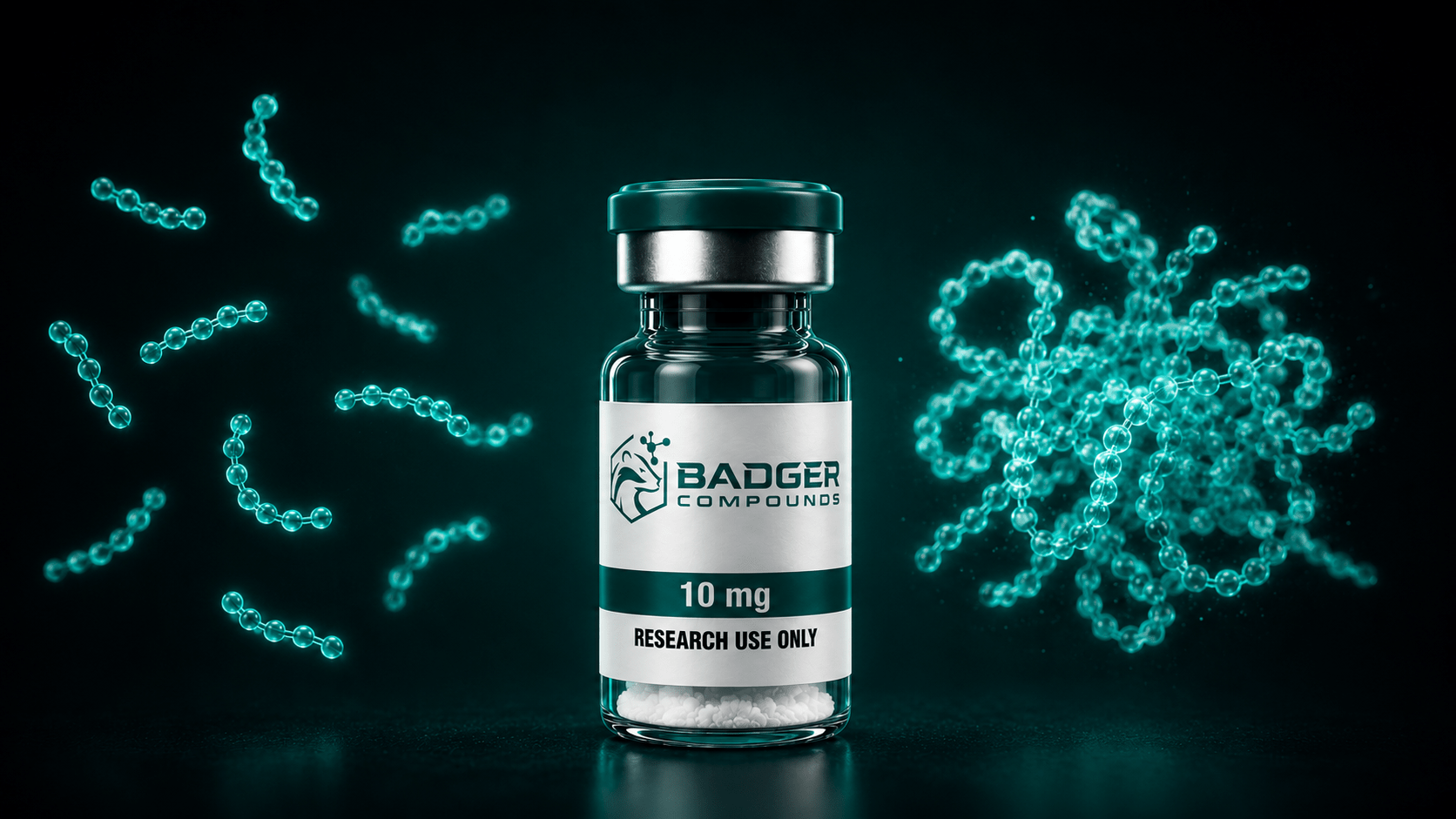
Peptide aggregation is what happens when individual peptide molecules stop behaving as separate units and start clumping together into larger structures. It is a real, well-documented physical process, not a synonym for contamination or chemical degradation, and it is one of the main reasons storage conditions matter so much for peptide research. This guide explains what actually drives peptides to aggregate and why some sequences are far more prone to it than others.
Peptide Aggregation: Why Some Peptides Clump Together
Left in solution, some peptides quietly stay as separate, individual molecules indefinitely. Others begin clumping into larger and larger structures within hours. This difference is not random. Peptide aggregation follows well-understood physical rules, and knowing what drives it explains why certain peptides need far more careful handling than others.
What Is Peptide Aggregation?
Aggregation is a physical process in which individual peptide or protein molecules self-associate into larger multi-molecule structures, ranging from small soluble clusters to large, insoluble fibrils. It is fundamentally different from chemical degradation: the peptide bonds and amino acid sequence usually remain fully intact during aggregation. What changes is how the molecules are arranged relative to each other, not their underlying chemistry [1].
Research framing: This article explains peptide biophysics in an educational, research context. Compounds referenced are supplied by Badger Compounds for laboratory research use only and are not intended for human or veterinary use. Nothing here is medical advice.
What Drives Peptides to Aggregate
Aggregation happens when a peptide’s structure exposes regions that would rather interact with a neighboring peptide molecule than sit alone in solution. Several sequence properties make that more likely [1].
Hydrophobic Patches
Stretches of hydrophobic amino acids prefer to associate with each other rather than remain exposed to water, pulling peptide molecules together.
Beta-Sheet Propensity
Sequences prone to forming extended beta-strand structures can stack with identical strands on neighboring molecules, the structural basis of amyloid fibrils.
Charge Balance
A peptide’s net charge and its distribution along the sequence influence how strongly molecules repel or attract one another in solution.
How Aggregation Actually Proceeds
Peptide aggregation is not an all-or-nothing event. It typically unfolds as a multi-step process, beginning slowly and then accelerating once a critical structure forms.
| Stage | What happens |
|---|---|
| Lag phase (nucleation) | Individual molecules remain mostly separate while a small number of ordered “seed” structures slowly form |
| Growth phase (elongation) | Once a seed forms, additional molecules add onto it rapidly, and aggregate size increases quickly |
| Plateau | Growth levels off as the readily available peptide is consumed into aggregated structures |
This lag-then-rapid-growth pattern is why aggregation can seem to appear suddenly: a solution can look stable for a long stretch of time and then aggregate quickly once nucleation is complete [1].
Aggregation is a structural event, not a chemical one. The amino acid sequence usually stays intact; what changes is whether the molecule stays folded and separate, or reorganizes into a shared structure with its neighbors.
Why This Matters for Handling Research Peptides
Aggregation is one of the two major categories of peptide degradation, alongside the chemical reactions covered in our guide on how to store research peptides. The practical triggers are largely the same ones that drive chemical degradation: warmth, time spent in solution, agitation, and repeated freeze-thaw cycling all increase the chance that a susceptible peptide finds its way into an aggregated state.
Some compounds are well known for this tendency specifically because of their amino acid sequence. Native amylin, the hormone that cagrilintide was engineered from, is a well-documented example of a peptide with a strong tendency to form amyloid fibrils, which is part of why the stabilized analog was developed in the first place. For more on that engineering, see our overview of cagrilintide research.
Research Concepts Related to Peptide Aggregation
Hydrophobic interactions Beta-sheet formation Amyloid fibrils Nucleation and elongation Solid-state peptide stability Physical vs chemical degradationExplore Research-Grade Peptides – ≥99% (HPLC)
Every compound in our catalog is synthesized domestically, six-round independently tested per batch, and supported by publicly viewable COAs. For qualified laboratory research use only.
Browse the Catalog- Chiti F, Dobson CM. Protein misfolding, functional amyloid, and human disease. Annu Rev Biochem. 2006;75:333-366. PMID 16756495
- Lai MC, Topp EM. Solid-state chemical stability of proteins and peptides. J Pharm Sci. 1999;88(5):489-500. PMID 10229638
Disclaimer: This article is for informational and educational purposes only. Products discussed are research use only, not for human consumption, veterinary use, clinical use, or any consumer application. Statements have not been evaluated by the FDA. This content does not provide medical advice.