
No products in the cart.
Cagrilintide research centers on a long-acting amylin analog that sits in a different pharmacological family from the GLP-1 receptor agonists that dominate current metabolic peptide science, where preclinical and clinical investigations have examined how its amylin and calcitonin receptor mechanism behaves both on its own and alongside GLP-1 receptor agonism.
Cagrilintide Research: The Long-Acting Amylin Analog
Cagrilintide research centers on a long-acting amylin analog that sits in a different pharmacological family from the GLP-1 receptor agonists that dominate current metabolic peptide science. Rather than engaging the incretin system, cagrilintide acts on the amylin and calcitonin receptor pathways, and preclinical and clinical investigations have examined how this complementary, non-incretin mechanism behaves both on its own and alongside GLP-1 receptor agonism.
What Is Cagrilintide?
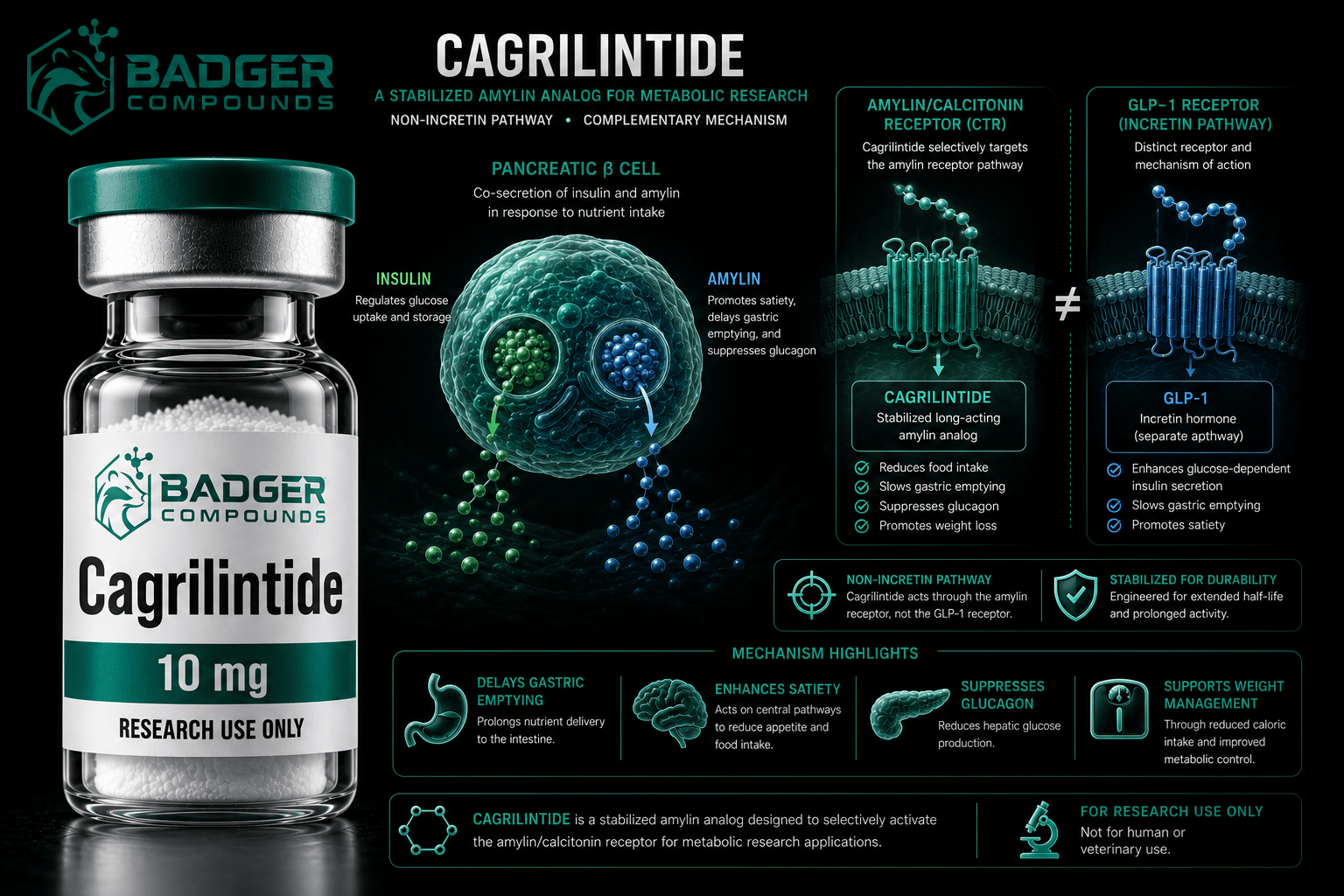
Cagrilintide is a synthetic, long-acting analog of amylin, a pancreatic hormone co-secreted with insulin. It was engineered to overcome the two properties that make native amylin difficult to study directly: a very short circulating half-life and a strong tendency to form amyloid fibrils. Because it engages the amylin and calcitonin receptor family rather than the GLP-1 receptor, cagrilintide gives researchers a distinct, non-incretin route into appetite and body-weight signaling.
This is what separates it from the compounds that surround it in the metabolic catalog. For the broader incretin landscape, from single agonists through dual and triple agonists, see our overview of the evolution of GLP-1 research compounds. This post focuses specifically on the amylin pathway that cagrilintide represents.
What Is Amylin and Why Does It Matter in Research?
Amylin, also called islet amyloid polypeptide, is a 37-amino-acid hormone released from pancreatic beta cells alongside insulin in response to nutrient intake. In physiological research models it is studied as a satiety and glucose-regulation signal that operates on a receptor system separate from the incretins. Because it is co-secreted with insulin, amylin is often framed as a complementary signal that works in parallel with, rather than in place of, the incretin pathway.
Co-Secreted With Insulin
Amylin is released from pancreatic beta cells together with insulin after nutrient intake, positioning it as a parallel metabolic signal in research models.
Satiety and Gastric Emptying
Native amylin is studied for its role in slowing gastric emptying, suppressing post-meal glucagon, and signaling satiety through hindbrain pathways.
The Fibrillation Problem
Amylin readily aggregates into amyloid fibrils and clears quickly. The short-acting analog pramlintide addressed the pharmacology but still required multiple daily injections.
Research framing: All findings referenced in this post derive from preclinical and clinical research conducted by third parties. Cagrilintide is supplied by Badger Compounds for laboratory research use only and is not intended for human or veterinary use. No therapeutic conclusions should be drawn from the research discussed here.
How Cagrilintide Was Engineered
Reported design work describes cagrilintide as a lipidated, long-acting amylin analog built on the human amylin backbone with structural inspiration from calcitonin. Amino acid substitutions were introduced to reduce the fibril-forming tendency of the peptide, and a fatty acid attachment promotes reversible albumin binding. That albumin-binding strategy is the same broad approach used to extend the half-life of second-generation GLP-1 analogs, and it is what shifts cagrilintide from a multiple-daily-dose profile toward a once-weekly research profile. Pharmacologically, cagrilintide is characterized as a non-selective agonist across the calcitonin receptor family, engaging both amylin receptors and the calcitonin receptor [1].
Stabilized Backbone
Substitutions on the human amylin sequence are intended to reduce amyloid fibril formation, one of the central obstacles to working with amylin as a stable molecule.
Albumin-Bound Long Action
A fatty acid attachment supports reversible albumin binding, extending duration of action and enabling a once-weekly research profile.
Amylin Pathway Versus Incretin Pathway
Understanding cagrilintide means seeing how the amylin system relates to, but stands apart from, the GLP-1 incretin system that most metabolic peptide research centers on. The two pathways converge on overlapping outcomes such as satiety and reduced food intake, but they act through distinct receptors and distinct signaling routes. That separation is exactly why researchers investigate them side by side.
| Feature | Amylin pathway (cagrilintide) | Incretin pathway (GLP-1 agonists) |
|---|---|---|
| Native hormone | Amylin (islet amyloid polypeptide) | Glucagon-like peptide-1 |
| Source | Co-secreted with insulin from beta cells | Secreted by intestinal L-cells |
| Receptor target | Amylin and calcitonin receptor family | GLP-1 receptor (class B GPCR) |
| Primary research signals | Satiety, gastric emptying, glucagon suppression | Glucose-dependent insulin secretion, satiety, gastric emptying |
| Research role | Complementary, non-incretin mechanism | Core incretin mechanism |
What the Cagrilintide Research Literature Shows
Cagrilintide has been examined both on its own and in combination with the GLP-1 receptor agonist semaglutide across a set of controlled studies.
A multicenter, randomized, double-blind, placebo-controlled and active-controlled phase 2 study evaluated once-weekly cagrilintide across an ascending dose range in participants with overweight and obesity. It was the first study to characterize the dose-response relationship of cagrilintide for body weight, reporting dose-dependent reductions with a tolerability profile dominated by transient gastrointestinal effects during dose escalation [2].
A separate randomized, placebo-controlled phase 1b trial studied multiple ascending doses of cagrilintide given together with semaglutide 2.4 mg. This pairing, referred to in the literature as CagriSema, was designed to probe whether combining an amylin analog with a GLP-1 receptor agonist produces effects beyond either mechanism alone [3]. A later phase 2 trial extended this combination research into a type 2 diabetes research population, comparing the combination against each component individually and reporting greater body-weight reduction with the combination alongside changes in glycemic research parameters [4].
One caveat runs through this literature and is worth stating plainly: much of the pivotal cagrilintide work originates from a single sponsor, and the tolerability signal most consistently reported is gastrointestinal, particularly nausea during dose escalation. Cagrilintide remains an investigational compound, and its long-term profile continues to be studied. These findings should be read as active research rather than settled conclusions.
Cagrilintide is a research-use-only peptide. Badger Compounds supplies cagrilintide exclusively for qualified research applications in controlled laboratory settings. The research summarized here does not establish safety or efficacy in any human population.
Why Combination Research Draws Interest
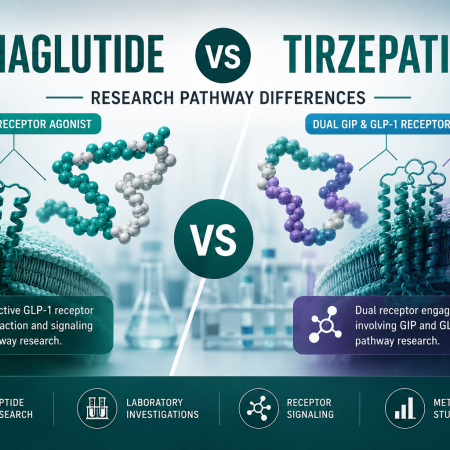
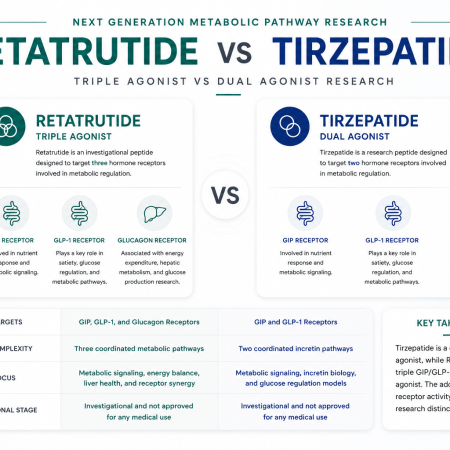
The scientific appeal of cagrilintide is that it lets researchers ask whether two separate satiety systems, the amylin pathway and the incretin pathway, can be engaged in parallel. Because the two systems act through different receptors, combining them is a way to study whether complementary, non-overlapping mechanisms produce distinct research outcomes compared with maximizing a single pathway. This positions cagrilintide alongside, rather than inside, the dual and triple agonist frameworks. For how those multi-receptor incretin strategies compare, see our discussion of what makes triple agonist research different, and our side-by-side overviews of semaglutide versus tirzepatide and retatrutide versus tirzepatide.
Research Pathways Associated with Cagrilintide
Preclinical and clinical literature has examined this amylin analog and its research context across several interconnected themes:
Amylin receptor agonism Calcitonin receptor family signaling Satiety and food intake Gastric emptying Glucagon suppression Amyloid fibrillation resistance Albumin-binding half-life extension GLP-1 plus amylin combination researchCagrilintide – Research Grade, ≥99% (HPLC)
Badger Compounds supplies cagrilintide as a lyophilized research peptide, six-round independently tested per batch with publicly viewable COAs. For qualified laboratory research use only.
View Cagrilintide- Kruse T, Hansen JL, Dahl K, et al. Development of cagrilintide, a long-acting amylin analogue. J Med Chem. 2021;64(15):11183-11194. PMID 34288673
- Lau DCW, Erichsen L, Francisco AM, et al. Once-weekly cagrilintide for weight management in people with overweight and obesity: a multicentre, randomised, double-blind, placebo-controlled and active-controlled, dose-finding phase 2 trial. Lancet. 2021;398(10317):2160-2172. PMID 34798060
- Enebo LB, Berthelsen KK, Kankam M, et al. Safety, tolerability, pharmacokinetics, and pharmacodynamics of concomitant administration of multiple doses of cagrilintide with semaglutide 2.4 mg for weight management: a randomised, controlled, phase 1b trial. Lancet. 2021;397(10286):1736-1748. PMID 33894838
- Frias JP, Deenadayalan S, Erichsen L, et al. Efficacy and safety of co-administered once-weekly cagrilintide 2.4 mg with once-weekly semaglutide 2.4 mg in type 2 diabetes: a multicentre, randomised, double-blind, active-controlled, phase 2 trial. Lancet. 2023;402(10403):720-730. PMID 37364590
Disclaimer: Cagrilintide is supplied by Badger Compounds for laboratory and in vitro research use only. It is not intended for human or veterinary use, and no product sold by Badger Compounds is approved for therapeutic, diagnostic, or clinical application. All research findings referenced in this post are derived from preclinical and clinical studies conducted by third parties. No clinical efficacy or safety conclusions should be drawn from the data summarized here.
Cagrilintide Research: The Long-Acting Amylin Analog
Cagrilintide research centers on a long-acting amylin analog that sits in a different pharmacological family from the GLP-1 receptor agonists that dominate current metabolic peptide science. Rather than engaging the incretin system, cagrilintide acts on the amylin and calcitonin receptor pathways, and preclinical and clinical investigations have examined how this complementary, non-incretin mechanism behaves both on its own and alongside GLP-1 receptor agonism.
What Is Cagrilintide?
Cagrilintide is a synthetic, long-acting analog of amylin, a pancreatic hormone co-secreted with insulin. It was engineered to overcome the two properties that make native amylin difficult to study directly: a very short circulating half-life and a strong tendency to form amyloid fibrils. Because it engages the amylin and calcitonin receptor family rather than the GLP-1 receptor, cagrilintide gives researchers a distinct, non-incretin route into appetite and body-weight signaling.
This is what separates it from the compounds that surround it in the metabolic catalog. For the broader incretin landscape, from single agonists through dual and triple agonists, see our overview of the evolution of GLP-1 research compounds. This post focuses specifically on the amylin pathway that cagrilintide represents.
What Is Amylin and Why Does It Matter in Research?
Amylin, also called islet amyloid polypeptide, is a 37-amino-acid hormone released from pancreatic beta cells alongside insulin in response to nutrient intake. In physiological research models it is studied as a satiety and glucose-regulation signal that operates on a receptor system separate from the incretins. Because it is co-secreted with insulin, amylin is often framed as a complementary signal that works in parallel with, rather than in place of, the incretin pathway.
Co-Secreted With Insulin
Amylin is released from pancreatic beta cells together with insulin after nutrient intake, positioning it as a parallel metabolic signal in research models.
Satiety and Gastric Emptying
Native amylin is studied for its role in slowing gastric emptying, suppressing post-meal glucagon, and signaling satiety through hindbrain pathways.
The Fibrillation Problem
Amylin readily aggregates into amyloid fibrils and clears quickly. The short-acting analog pramlintide addressed the pharmacology but still required multiple daily injections.
Research framing: All findings referenced in this post derive from preclinical and clinical research conducted by third parties. Cagrilintide is supplied by Badger Compounds for laboratory research use only and is not intended for human or veterinary use. No therapeutic conclusions should be drawn from the research discussed here.
How Cagrilintide Was Engineered
Reported design work describes cagrilintide as a lipidated, long-acting amylin analog built on the human amylin backbone with structural inspiration from calcitonin. Amino acid substitutions were introduced to reduce the fibril-forming tendency of the peptide, and a fatty acid attachment promotes reversible albumin binding. That albumin-binding strategy is the same broad approach used to extend the half-life of second-generation GLP-1 analogs, and it is what shifts cagrilintide from a multiple-daily-dose profile toward a once-weekly research profile. Pharmacologically, cagrilintide is characterized as a non-selective agonist across the calcitonin receptor family, engaging both amylin receptors and the calcitonin receptor [1].
Stabilized Backbone
Substitutions on the human amylin sequence are intended to reduce amyloid fibril formation, one of the central obstacles to working with amylin as a stable molecule.
Albumin-Bound Long Action
A fatty acid attachment supports reversible albumin binding, extending duration of action and enabling a once-weekly research profile.
Amylin Pathway Versus Incretin Pathway
Understanding cagrilintide means seeing how the amylin system relates to, but stands apart from, the GLP-1 incretin system that most metabolic peptide research centers on. The two pathways converge on overlapping outcomes such as satiety and reduced food intake, but they act through distinct receptors and distinct signaling routes. That separation is exactly why researchers investigate them side by side.
| Feature | Amylin pathway (cagrilintide) | Incretin pathway (GLP-1 agonists) |
|---|---|---|
| Native hormone | Amylin (islet amyloid polypeptide) | Glucagon-like peptide-1 |
| Source | Co-secreted with insulin from beta cells | Secreted by intestinal L-cells |
| Receptor target | Amylin and calcitonin receptor family | GLP-1 receptor (class B GPCR) |
| Primary research signals | Satiety, gastric emptying, glucagon suppression | Glucose-dependent insulin secretion, satiety, gastric emptying |
| Research role | Complementary, non-incretin mechanism | Core incretin mechanism |
What the Cagrilintide Research Literature Shows
Cagrilintide has been examined both on its own and in combination with the GLP-1 receptor agonist semaglutide across a set of controlled studies.
A multicenter, randomized, double-blind, placebo-controlled and active-controlled phase 2 study evaluated once-weekly cagrilintide across an ascending dose range in participants with overweight and obesity. It was the first study to characterize the dose-response relationship of cagrilintide for body weight, reporting dose-dependent reductions with a tolerability profile dominated by transient gastrointestinal effects during dose escalation [2].
A separate randomized, placebo-controlled phase 1b trial studied multiple ascending doses of cagrilintide given together with semaglutide 2.4 mg. This pairing, referred to in the literature as CagriSema, was designed to probe whether combining an amylin analog with a GLP-1 receptor agonist produces effects beyond either mechanism alone [3]. A later phase 2 trial extended this combination research into a type 2 diabetes research population, comparing the combination against each component individually and reporting greater body-weight reduction with the combination alongside changes in glycemic research parameters [4].
One caveat runs through this literature and is worth stating plainly: much of the pivotal cagrilintide work originates from a single sponsor, and the tolerability signal most consistently reported is gastrointestinal, particularly nausea during dose escalation. Cagrilintide remains an investigational compound, and its long-term profile continues to be studied. These findings should be read as active research rather than settled conclusions.
Cagrilintide is a research-use-only peptide. Badger Compounds supplies cagrilintide exclusively for qualified research applications in controlled laboratory settings. The research summarized here does not establish safety or efficacy in any human population.
Why Combination Cagrilintide Research Draws Interest
The scientific appeal of cagrilintide is that it lets researchers ask whether two separate satiety systems, the amylin pathway and the incretin pathway, can be engaged in parallel. Because the two systems act through different receptors, combining them is a way to study whether complementary, non-overlapping mechanisms produce distinct research outcomes compared with maximizing a single pathway. This positions cagrilintide alongside, rather than inside, the dual and triple agonist frameworks. For how those multi-receptor incretin strategies compare, see our discussion of what makes triple agonist research different, and our side-by-side overviews of semaglutide versus tirzepatide and retatrutide versus tirzepatide.
Research Pathways Associated with Cagrilintide
Preclinical and clinical literature has examined this amylin analog and its research context across several interconnected themes:
Amylin receptor agonism Calcitonin receptor family signaling Satiety and food intake Gastric emptying Glucagon suppression Amyloid fibrillation resistance Albumin-binding half-life extension GLP-1 plus amylin combination researchCagrilintide – Research Grade, ≥99% (HPLC)
Badger Compounds supplies cagrilintide as a lyophilized research peptide, six-round independently tested per batch with publicly viewable COAs. For qualified laboratory research use only.
View Cagrilintide- Kruse T, Hansen JL, Dahl K, et al. Development of cagrilintide, a long-acting amylin analogue. J Med Chem. 2021;64(15):11183-11194. PMID 34288673
- Lau DCW, Erichsen L, Francisco AM, et al. Once-weekly cagrilintide for weight management in people with overweight and obesity: a multicentre, randomised, double-blind, placebo-controlled and active-controlled, dose-finding phase 2 trial. Lancet. 2021;398(10317):2160-2172. PMID 34798060
- Enebo LB, Berthelsen KK, Kankam M, et al. Safety, tolerability, pharmacokinetics, and pharmacodynamics of concomitant administration of multiple doses of cagrilintide with semaglutide 2.4 mg for weight management: a randomised, controlled, phase 1b trial. Lancet. 2021;397(10286):1736-1748. PMID 33894838
- Frias JP, Deenadayalan S, Erichsen L, et al. Efficacy and safety of co-administered once-weekly cagrilintide 2.4 mg with once-weekly semaglutide 2.4 mg in type 2 diabetes: a multicentre, randomised, double-blind, active-controlled, phase 2 trial. Lancet. 2023;402(10403):720-730. PMID 37364590
Disclaimer: Cagrilintide is supplied by Badger Compounds for laboratory and in vitro research use only. It is not intended for human or veterinary use, and no product sold by Badger Compounds is approved for therapeutic, diagnostic, or clinical application. All research findings referenced in this post are derived from preclinical and clinical studies conducted by third parties. No clinical efficacy or safety conclusions should be drawn from the data summarized here.
Badger Compounds Research Access
Verify to Continue
This catalog is reserved for qualified research use. Confirm below to continue.
Please confirm both statements and select a research type.