No products in the cart.
U.S. FILLED & FINISHED | ≥99% COA-VERIFIED PURITY
LC-MS VERIFIED IDENTITY | INDEPENDENTLY TESTED
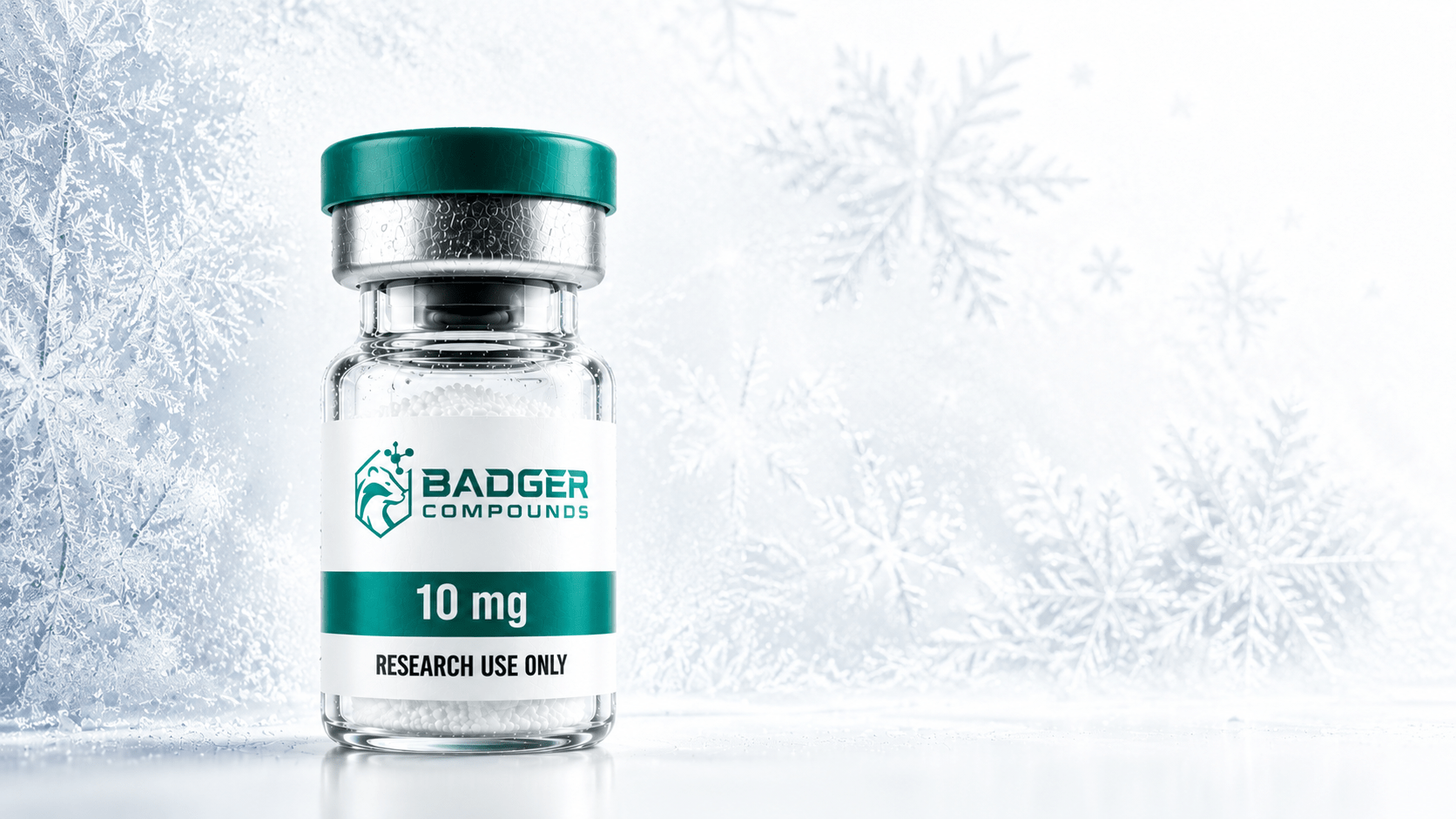
How to store peptides correctly is one of the most practical questions in research handling, because a peptide is only as good as its condition when it reaches the bench. This guide covers what actually degrades a peptide, how to store lyophilized and reconstituted material, why freeze-thaw cycles matter, and how to recognize when a research peptide may no longer be intact.
How to Store Research Peptides: Stability, Shelf Life, and Handling
How to store peptides correctly is one of the most practical questions in research handling, because a peptide is only as good as its condition when it reaches the bench. Peptides are sensitive molecules, and the way they are stored determines whether they stay intact or slowly break down. This guide covers what actually degrades a peptide, how to store lyophilized and reconstituted material, why freeze-thaw cycles matter, and how to recognize when a research peptide may no longer be intact.
Why Peptide Storage Matters
Peptides are chains of amino acids held together by peptide bonds, and those bonds and side chains are chemically reactive under the right conditions. Left in a warm, humid, or dissolved environment, a peptide can slowly undergo chemical and physical changes that alter its structure. Because research depends on knowing exactly what is in the vial, storage is not an afterthought; it is part of keeping the material fit for its intended use [1].
The good news is that the same molecule can be remarkably stable or surprisingly fragile depending entirely on how it is kept. Understanding the handful of factors that drive degradation makes correct storage straightforward.
Research framing: This article covers laboratory handling and storage of research materials only. Peptides discussed are supplied by Badger Compounds for research use only and are not intended for human or veterinary use. Always follow the storage guidance on the product Certificate of Analysis and label. Nothing here is medical advice.
What Actually Degrades a Peptide?
Peptide degradation falls into two broad categories. Chemical degradation changes the molecule itself through reactions such as deamidation, oxidation, and cleavage of the peptide bond. Physical degradation changes its state without breaking bonds, most importantly through aggregation, where molecules clump together. Both are driven by a small set of environmental factors [1,2].
Temperature
Heat accelerates nearly every degradation reaction. Lower temperatures slow them dramatically, which is why cold storage is the single most important control.
Moisture
Water enables and speeds chemical reactions such as deamidation and hydrolysis. Keeping a lyophilized peptide dry is central to its stability.
Light and Oxygen
Exposure to light and air can drive oxidation, particularly at sensitive residues such as methionine, cysteine, and tryptophan.
Physical Stress
Repeated freezing and thawing, agitation, and time in solution promote aggregation and structural change.
How to Store Lyophilized Peptides
Most research peptides are supplied as a lyophilized, or freeze-dried, powder for exactly this reason: removing water puts the molecule into its most stable state and slows the reactions that degrade it [3]. For why this form is used, see our overview of lyophilized peptides in the laboratory.
To keep a lyophilized peptide stable, store it cold, dry, dark, and sealed. Keep the vial in its original sealed container at −20 °C or colder for long-term storage, protect it from light, and avoid letting it warm and cool repeatedly. Because moisture is a primary driver of degradation, let a cold vial return to room temperature before opening it, so that condensation does not form inside. In a properly frozen, dry state, many lyophilized peptides remain stable for long periods, but the specific window depends on the peptide and should follow the product documentation [2].
Lyophilized Versus Reconstituted Storage
Once a lyophilized peptide is dissolved into solution for laboratory work, it enters its least stable state, because water reintroduces the very conditions that drive chemical degradation [4]. The table below summarizes how the two forms differ in handling.
| Factor | Lyophilized (powder) | Reconstituted (in solution) |
|---|---|---|
| Relative stability | Most stable form | Least stable form |
| Typical storage | Frozen, in the dark, sealed and dry | Refrigerated, protected from light |
| Practical shelf life | Long, when kept frozen and dry | Short, use within a limited window |
| Main risks | Moisture ingress, warming | Hydrolysis, oxidation, aggregation |
The practical takeaway is to keep material lyophilized until it is needed, and to treat any solution as a shorter-lived working form rather than a storage form.
Cold, dark, dry, and sealed is the short version. The powder form is stable; a peptide in solution is on a clock. Always defer to the storage conditions listed on the product Certificate of Analysis for the specific compound.
The Freeze-Thaw Problem
One of the most common and avoidable causes of peptide degradation is repeated freeze-thaw cycling. Each time a solution freezes and thaws, the peptide is subjected to physical stress and to local concentration and pH shifts at the ice interface, which promote aggregation and structural change [1,2]. A peptide that is frozen and thawed many times can degrade far faster than one held at a steady temperature.
The standard way to avoid this is to divide a reconstituted peptide into single-use aliquots before freezing, so that each portion is thawed only once. That way the rest of the material is never disturbed by repeated cycling.
Signs a Peptide May Have Degraded
Some changes are visible. Cloudiness or visible particles in what should be a clear solution can indicate aggregation, discoloration can indicate oxidation or other reactions, and a powder that will not fully dissolve may have changed. These visual cues are useful warnings, but they are not definitive, since significant degradation can occur with no obvious appearance change at all.
The only reliable way to confirm identity and purity is analytical testing, which is why batch-level documentation matters. For what purity figures actually describe and how material is verified, see our articles on what ≥99% purity means and third-party testing for research compounds. For background on how the material is made in the first place, see our overview of how research peptides are made.
Peptide Storage Best Practices
The full answer to how to store peptides comes down to a short, repeatable set of habits:
Keep lyophilized until needed Store frozen at −20 °C or colder Protect from light Keep sealed and dry Warm to room temperature before opening Aliquot before freezing Avoid repeated freeze-thaw Label aliquots with the date Follow the product COAExplore Research-Grade Peptides – ≥99% (HPLC)
Every compound in our catalog ships lyophilized for stability, is six-round independently tested per batch, and is supported by publicly viewable COAs with storage guidance. For qualified laboratory research use only.
Browse the Catalog- Lai MC, Topp EM. Solid-state chemical stability of proteins and peptides. J Pharm Sci. 1999;88(5):489-500. PMID 10229638
- Manning MC, Chou DK, Murphy BM, Payne RW, Katayama DS. Stability of protein pharmaceuticals: an update. Pharm Res. 2010;27(4):544-575. PMID 20143256
- Wang W. Instability, stabilization, and formulation of liquid protein pharmaceuticals. Int J Pharm. 1999;185(2):129-188. PMID 10460913
- Frokjaer S, Otzen DE. Protein drug stability: a formulation challenge. Nat Rev Drug Discov. 2005;4(4):298-306. PMID 15803194
Disclaimer: This article is for informational and educational purposes only. Products and compounds discussed are intended for research use only and are not for human consumption, veterinary use, clinical use, diagnostic use, food use, supplement use, pharmaceutical use, cosmetic use, or any consumer application. Statements have not been evaluated by the FDA. This content does not provide medical advice, treatment guidance, dosing information, or recommendations for personal use.