No products in the cart.
U.S. FILLED & FINISHED | ≥99% COA-VERIFIED PURITY
LC-MS VERIFIED IDENTITY | INDEPENDENTLY TESTED
Melting point and peptide purity are connected in a way that a chemical purity figure alone does not capture. Differential scanning calorimetry, or DSC, measures how a peptide physically behaves as it is heated, and that physical behavior is a genuine, independent characterization tool, distinct from the chemical purity reported by HPLC. This guide explains what DSC actually measures and why appearance and thermal behavior belong in a complete characterization picture.
Melting Point and Peptide Purity: What DSC and Appearance Testing Reveal
HPLC purity tells you how much of a sample is the target sequence relative to related chemical impurities. It does not tell you how that peptide physically behaves as a solid or how it responds to heat. Differential scanning calorimetry closes that gap, adding a physical characterization dimension that chemical purity testing was never designed to cover.
What Is Differential Scanning Calorimetry?
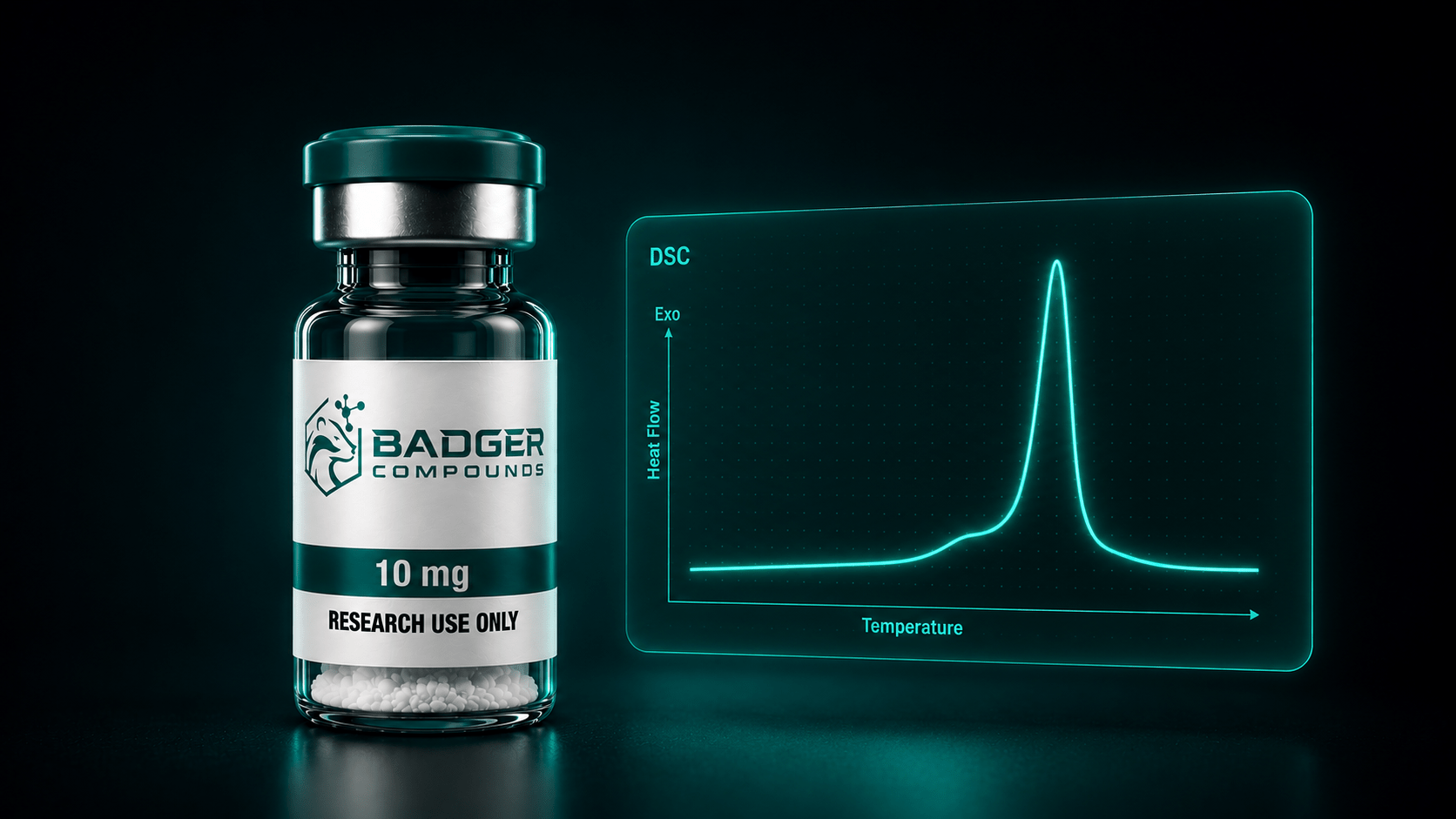
Differential scanning calorimetry (DSC) is an analytical technique that measures the heat a sample absorbs or releases as its temperature is raised at a controlled rate. For peptides and proteins, this heat flow reveals thermal transitions, most importantly the temperature at which the molecule’s higher-order structure unfolds, known as the melting temperature or Tm [1]. The resulting DSC profile behaves like a thermal fingerprint of the sample, and comparing that fingerprint between production lots or formulations is a standard way to detect meaningful differences in structural conformation [2].
Research framing: This article explains analytical characterization methods in an educational, research context. Compounds referenced are supplied by Badger Compounds for laboratory research use only and are not intended for human or veterinary use. Nothing here is medical advice.
What DSC Actually Measures
Melting Temperature (Tm)
The temperature at which the molecule’s folded structure transitions to an unfolded state, a direct measure of thermal stability.
Enthalpy (ΔH)
The amount of heat absorbed during that transition, reflecting the energy holding the folded structure together.
Thermal Profile Shape
The overall shape of the heat-flow curve, which can reveal multiple domains or structural populations within a sample.
These parameters give researchers a way to compare thermal stability across batches, formulations, or structural variants, using differences in Tm and enthalpy as a sensitive indicator of whether two samples are behaving identically [1,2].
DSC vs HPLC Purity: Two Different Questions
| Method | What it measures | Question it answers |
|---|---|---|
| HPLC purity | Ratio of target peptide to related chemical impurities | How chemically pure is the sample? |
| DSC | Heat flow associated with structural transitions | How does the sample behave thermally, and is its structure consistent? |
Neither method substitutes for the other. A sample can report excellent HPLC purity while still showing an unexpected DSC thermal profile if something about its physical state, such as aggregation or a structural variant, differs from the reference material. This is why DSC is used as an additional, physical layer of characterization in biopharmaceutical development, alongside chemical purity testing rather than instead of it [1].
A purity percentage describes chemistry. A thermal profile describes physical behavior. A complete characterization picture uses both, because a sample can pass one check and still show something worth investigating on the other.
Appearance as a Simple, Real Check
Alongside instrumental methods like DSC, visual appearance remains a genuinely useful, low-cost check. A lyophilized peptide is expected to be a uniform white to off-white powder or cake; discoloration, unexpected clumping, or visible moisture can be an early sign that something about a batch is not as expected, even before any instrumental test is run. Appearance does not replace analytical testing, but it is often the first and simplest indicator that a batch merits closer investigation, which is why it appears as a distinct entry on a properly documented spec sheet.
Where This Fits in a Complete Characterization Panel
DSC and appearance sit alongside, rather than replace, the core identity, purity, and contaminant panels covered elsewhere in our research library. For the chemical side of the picture, see our guides on how to read a Certificate of Analysis and what ≥99% purity actually means. Physical characterization methods like DSC are a further layer, used to confirm that a peptide’s structural behavior is consistent from batch to batch, not only that its chemical composition matches specification.
Research Concepts Related to DSC and Physical Characterization
Melting temperature (Tm) Thermal unfolding Enthalpy of transition Structural conformation Batch-to-batch consistency Physical vs chemical characterizationExplore Research-Grade Peptides – ≥99% (HPLC)
Every compound in our catalog is synthesized domestically, six-round independently tested per batch, and supported by publicly viewable COAs. For qualified laboratory research use only.
Browse the Catalog- Johnson CM. Differential scanning calorimetry as a tool for protein folding and stability. Arch Biochem Biophys. 2013;531(1-2):100-109. PMID 23022410
- Durowoju IB, Bhandal KS, Hu J, Carpick B, Kirkitadze M. Differential scanning calorimetry — a method for assessing the thermal stability and conformation of protein antigen. J Vis Exp. 2017;(121):55262. PMID 28287565
Disclaimer: This article is for informational and educational purposes only. Products discussed are research use only, not for human consumption, veterinary use, clinical use, or any consumer application. Statements have not been evaluated by the FDA. This content does not provide medical advice.
Melting Point and Peptide Purity: What DSC and Appearance Testing Reveal
HPLC purity tells you how much of a sample is the target sequence relative to related chemical impurities. It does not tell you how that peptide physically behaves as a solid or how it responds to heat. Differential scanning calorimetry closes that gap, adding a physical characterization dimension that chemical purity testing was never designed to cover.
What Is Differential Scanning Calorimetry?
Differential scanning calorimetry (DSC) is an analytical technique that measures the heat a sample absorbs or releases as its temperature is raised at a controlled rate. For peptides and proteins, this heat flow reveals thermal transitions, most importantly the temperature at which the molecule’s higher-order structure unfolds, known as the melting temperature or Tm [1]. The resulting DSC profile behaves like a thermal fingerprint of the sample, and comparing that fingerprint between production lots or formulations is a standard way to detect meaningful differences in structural conformation [2].
Research framing: This article explains analytical characterization methods in an educational, research context. Compounds referenced are supplied by Badger Compounds for laboratory research use only and are not intended for human or veterinary use. Nothing here is medical advice.
What DSC Actually Measures
Melting Temperature (Tm)
The temperature at which the molecule’s folded structure transitions to an unfolded state, a direct measure of thermal stability.
Enthalpy (ΔH)
The amount of heat absorbed during that transition, reflecting the energy holding the folded structure together.
Thermal Profile Shape
The overall shape of the heat-flow curve, which can reveal multiple domains or structural populations within a sample.
These parameters give researchers a way to compare thermal stability across batches, formulations, or structural variants, using differences in Tm and enthalpy as a sensitive indicator of whether two samples are behaving identically [1,2].
DSC vs HPLC Purity: Two Different Questions
| Method | What it measures | Question it answers |
|---|---|---|
| HPLC purity | Ratio of target peptide to related chemical impurities | How chemically pure is the sample? |
| DSC | Heat flow associated with structural transitions | How does the sample behave thermally, and is its structure consistent? |
Neither method substitutes for the other. A sample can report excellent HPLC purity while still showing an unexpected DSC thermal profile if something about its physical state, such as aggregation or a structural variant, differs from the reference material. This is why DSC is used as an additional, physical layer of characterization in biopharmaceutical development, alongside chemical purity testing rather than instead of it [1].
A purity percentage describes chemistry. A thermal profile describes physical behavior. A complete characterization picture uses both, because a sample can pass one check and still show something worth investigating on the other.
Appearance as a Simple, Real Check
Alongside instrumental methods like DSC, visual appearance remains a genuinely useful, low-cost check. A lyophilized peptide is expected to be a uniform white to off-white powder or cake; discoloration, unexpected clumping, or visible moisture can be an early sign that something about a batch is not as expected, even before any instrumental test is run. Appearance does not replace analytical testing, but it is often the first and simplest indicator that a batch merits closer investigation, which is why it appears as a distinct entry on a properly documented spec sheet.
Where This Fits in a Complete Characterization Panel
DSC and appearance sit alongside, rather than replace, the core identity, purity, and contaminant panels covered elsewhere in our research library. For the chemical side of the picture, see our guides on how to read a Certificate of Analysis and what ≥99% purity actually means. Physical characterization methods like DSC are a further layer, used to confirm that a peptide’s structural behavior is consistent from batch to batch, not only that its chemical composition matches specification.
Research Concepts Related to DSC and Physical Characterization
Melting temperature (Tm) Thermal unfolding Enthalpy of transition Structural conformation Batch-to-batch consistency Physical vs chemical characterizationExplore Research-Grade Peptides – ≥99% (HPLC)
Every compound in our catalog is synthesized domestically, six-round independently tested per batch, and supported by publicly viewable COAs. For qualified laboratory research use only.
Browse the Catalog- Johnson CM. Differential scanning calorimetry as a tool for protein folding and stability. Arch Biochem Biophys. 2013;531(1-2):100-109. PMID 23022410
- Durowoju IB, Bhandal KS, Hu J, Carpick B, Kirkitadze M. Differential scanning calorimetry — a method for assessing the thermal stability and conformation of protein antigen. J Vis Exp. 2017;(121):55262. PMID 28287565
Disclaimer: This article is for informational and educational purposes only. Products discussed are research use only, not for human consumption, veterinary use, clinical use, or any consumer application. Statements have not been evaluated by the FDA. This content does not provide medical advice.