No products in the cart.
U.S. FILLED & FINISHED | ≥99% COA-VERIFIED PURITY
LC-MS VERIFIED IDENTITY | INDEPENDENTLY TESTED

Agonist vs antagonist is one of the most fundamental distinctions in pharmacology, and it explains why two compounds can bind the exact same receptor and produce opposite outcomes. An agonist activates a receptor; an antagonist blocks it. That single difference in behavior at the receptor level underlies nearly every mechanism-of-action description in peptide research, from GLP-1 receptor agonists to ghrelin-receptor-targeting growth hormone secretagogues.
Agonist vs Antagonist: How Receptor Binding Actually Works
Every mechanism-of-action section in peptide research eventually comes down to one question: does this compound turn a receptor on, or does it block it? That single distinction, agonist versus antagonist, is the organizing logic behind nearly every receptor-targeted compound. This guide explains what the two terms actually mean at the receptor level, and why the difference matters far beyond the label.
What Is a Receptor?
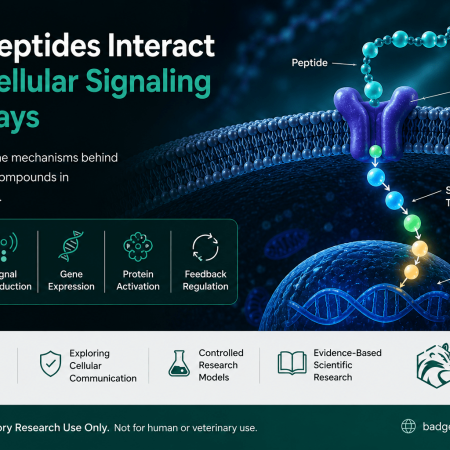
A receptor is a protein, usually embedded in a cell’s membrane, that recognizes a specific signaling molecule and triggers a response inside the cell when that molecule binds. Hormones, neurotransmitters, and many research peptides work by binding receptors rather than by acting directly inside the cell themselves. The receptor is the switch; the binding molecule is what flips it.
G protein-coupled receptors (GPCRs) are the largest and most heavily studied receptor family, and they illustrate the agonist/antagonist distinction especially well. GPCRs are the target of roughly a third of all FDA-approved drugs, and the primary way researchers describe how a compound acts on one is by classifying it as an agonist, an antagonist, or something in between [3].
Research framing: This article explains receptor pharmacology concepts in an educational, research context. Compounds referenced are supplied by Badger Compounds for laboratory research use only and are not intended for human or veterinary use. Nothing here is medical advice.
Agonist vs Antagonist: The Core Definitions
Under the standard nomenclature adopted by the International Union of Basic and Clinical Pharmacology, a receptor ligand’s behavior is described using two separate properties: affinity, how well it binds the receptor, and efficacy, what it does once bound [1].
Agonist
Binds a receptor and activates it, triggering the same kind of downstream response the receptor’s natural signaling molecule would produce.
Antagonist
Binds a receptor but does not activate it. By occupying the binding site, it blocks the receptor’s natural signal or an agonist from acting there.
Partial Agonist
Binds and activates the receptor, but produces a smaller maximal response than a full agonist, even at saturating concentrations.
The key insight is that affinity and efficacy are independent properties. Two compounds can bind a receptor with identical affinity and still behave completely differently, one activating it, the other simply occupying it, depending on their efficacy [2].
Agonists and Antagonists at a Glance
| Property | Agonist | Antagonist |
|---|---|---|
| Binds the receptor | Yes | Yes |
| Activates the receptor | Yes | No |
| Downstream effect | Triggers a response | Blocks a response |
| Analogy | Turns the key and opens the lock | Fills the lock so no key can turn it |
| Peptide example | GLP-1 receptor agonists (semaglutide) | Receptor blockers used to study a pathway’s role |
Affinity is how tightly a compound binds a receptor. Efficacy is what happens once it is bound. Agonists have both; antagonists have affinity without triggering the receptor’s activating efficacy. Confusing the two is the most common source of confusion in reading mechanism-of-action language.
Competitive vs Non-Competitive Antagonism
Not all antagonism works the same way. A competitive antagonist binds the same site as the natural agonist and competes with it directly, so its blocking effect can typically be overcome by adding enough agonist to outcompete it. A non-competitive antagonist binds a different site on the receptor or otherwise prevents activation in a way that adding more agonist cannot reverse [2]. This distinction matters in research design, since it changes how a blocking effect behaves as concentrations shift.
Why This Distinction Is the Basis of Peptide Mechanism
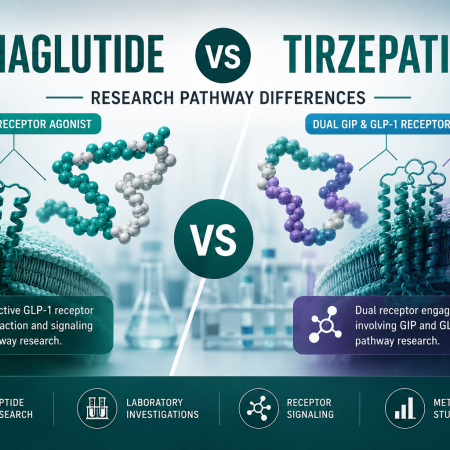
Once you understand agonist versus antagonist, mechanism-of-action descriptions across peptide research become far easier to parse. Semaglutide, for example, is described as a GLP-1 receptor agonist because it binds the GLP-1 receptor and activates the same downstream signaling that native GLP-1 does, just with a much longer duration of action [4]. Growth hormone secretagogues in the ipamorelin and GHRP family are described as ghrelin-receptor agonists for the same reason: they activate a specific receptor rather than blocking it.
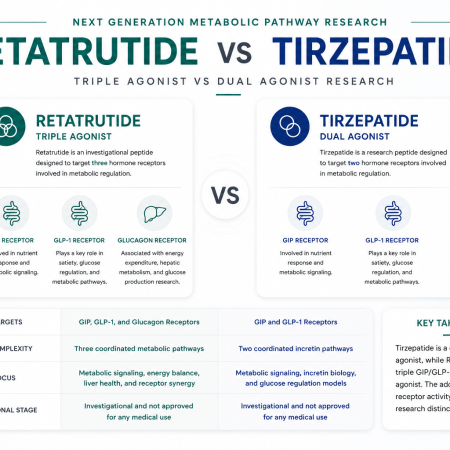
The framing extends further than single compounds. When researchers compare a triple agonist to a dual agonist, the number refers to how many distinct receptors a single compound activates, not whether it is an agonist at all. For that comparison, see our overview of what makes triple agonist research different and our broader look at the evolution of GLP-1 research compounds.
Beyond Agonist and Antagonist
Modern receptor pharmacology recognizes a few additional categories that extend this basic framework.
Inverse Agonists
Some receptors show a small amount of activity even with nothing bound. An inverse agonist reduces that baseline activity below its resting level, producing the opposite effect of an agonist rather than simply blocking one [2].
Allosteric Modulators
Rather than binding the same site as the natural signal, allosteric modulators bind elsewhere on the receptor and adjust how it responds to its natural agonist, either enhancing or dampening the effect [3].
Research Concepts Related to Agonist vs Antagonist
This distinction connects to a set of foundational pharmacology concepts:
Receptor affinity Receptor efficacy G protein-coupled receptors (GPCRs) Competitive antagonism Partial agonism Inverse agonism Allosteric modulation Receptor-mediated signalingExplore Research-Grade Peptides – ≥99% (HPLC)
Every compound in our catalog is synthesized domestically, six-round independently tested per batch, and supported by publicly viewable COAs. For qualified laboratory research use only.
Browse the Catalog- Neubig RR, Spedding M, Kenakin T, Christopoulos A. International Union of Pharmacology Committee on Receptor Nomenclature and Drug Classification. XXXVIII. Update on terms and symbols in quantitative pharmacology. Pharmacol Rev. 2003;55(4):597-606. PMID 14657418
- Kenakin T. Principles: receptor theory in pharmacology. Trends Pharmacol Sci. 2004;25(4):186-192. PMID 15063082
- Hauser AS, Attwood MM, Rask-Andersen M, Schiöth HB, Gloriam DE. Trends in GPCR drug discovery: new agents, targets and indications. Nat Rev Drug Discov. 2017;16(12):829-842. PMID 29075003
- Lau J, Bloch P, Schäffer L, et al. Discovery of the once-weekly glucagon-like peptide-1 (GLP-1) analogue semaglutide. J Med Chem. 2015;58(18):7370-7380. PMID 26308095
Disclaimer: This article is for informational and educational purposes only. Products and compounds discussed are intended for research use only and are not for human consumption, veterinary use, clinical use, diagnostic use, food use, supplement use, pharmaceutical use, cosmetic use, or any consumer application. Statements have not been evaluated by the FDA. This content does not provide medical advice, treatment guidance, dosing information, or recommendations for personal use.