No products in the cart.
U.S. FILLED & FINISHED | ≥99% COA-VERIFIED PURITY
LC-MS VERIFIED IDENTITY | INDEPENDENTLY TESTED
A CAS number shows up on nearly every research compound specification sheet, including ours, but what it actually verifies is often unclear. It is not a chemical name, a molecular formula, or a batch code. It is a unique registry identifier assigned to one specific substance, and understanding what it does and does not confirm is an important part of reading a spec sheet correctly. This guide explains what a CAS number is, how it is structured, and why it matters for compound identification.
What Is a CAS Number, and Why Does It Matter?
Every research compound spec sheet has one: a short string of digits broken up by hyphens, sitting quietly next to the molecular weight and the purity figure. That is the CAS number, and it does a specific, narrow job extremely well: it identifies exactly one substance, unambiguously, regardless of what anyone happens to call it. Here is what it actually is and why it belongs on every spec sheet.
What Is a CAS Number?
A CAS number, formally a CAS Registry Number, is a unique numeric identifier assigned to a specific chemical substance by the Chemical Abstracts Service (CAS), a division of the American Chemical Society. Every substance disclosed in the scientific literature and added to the CAS Registry receives its own number, and that number refers to exactly one substance and nothing else [1].
The system exists because chemical substances can be described in many different ways: a systematic chemical name, a common name, a trade name, a molecular formula, or an internal research code. Those names can vary by language, by industry, or by who is writing them, but a single compound only ever has one CAS number. That is the entire purpose of the system: eliminating ambiguity about which substance is actually being discussed [1].
Scope note: This article explains the CAS Registry Number system in general terms, drawing on the Chemical Abstracts Service’s own published documentation as the authoritative source. It is educational and is not a substitute for verifying a specific compound’s CAS number through an official registry.
How a CAS Number Is Structured
A CAS number contains up to ten digits, split into three parts by hyphens: a first segment of two to seven digits, a second segment of exactly two digits, and a final single check digit [1]. The check digit is calculated from the digits before it using a fixed formula, so a CAS number that fails the check-digit calculation is immediately known to be invalid or mistyped.
First Segment
Two to seven digits, assigned in sequence as new substances are added to the registry.
Second Segment
Always exactly two digits, the middle portion of the identifier.
Check Digit
A single final digit calculated from the rest of the number, used to catch transcription errors.
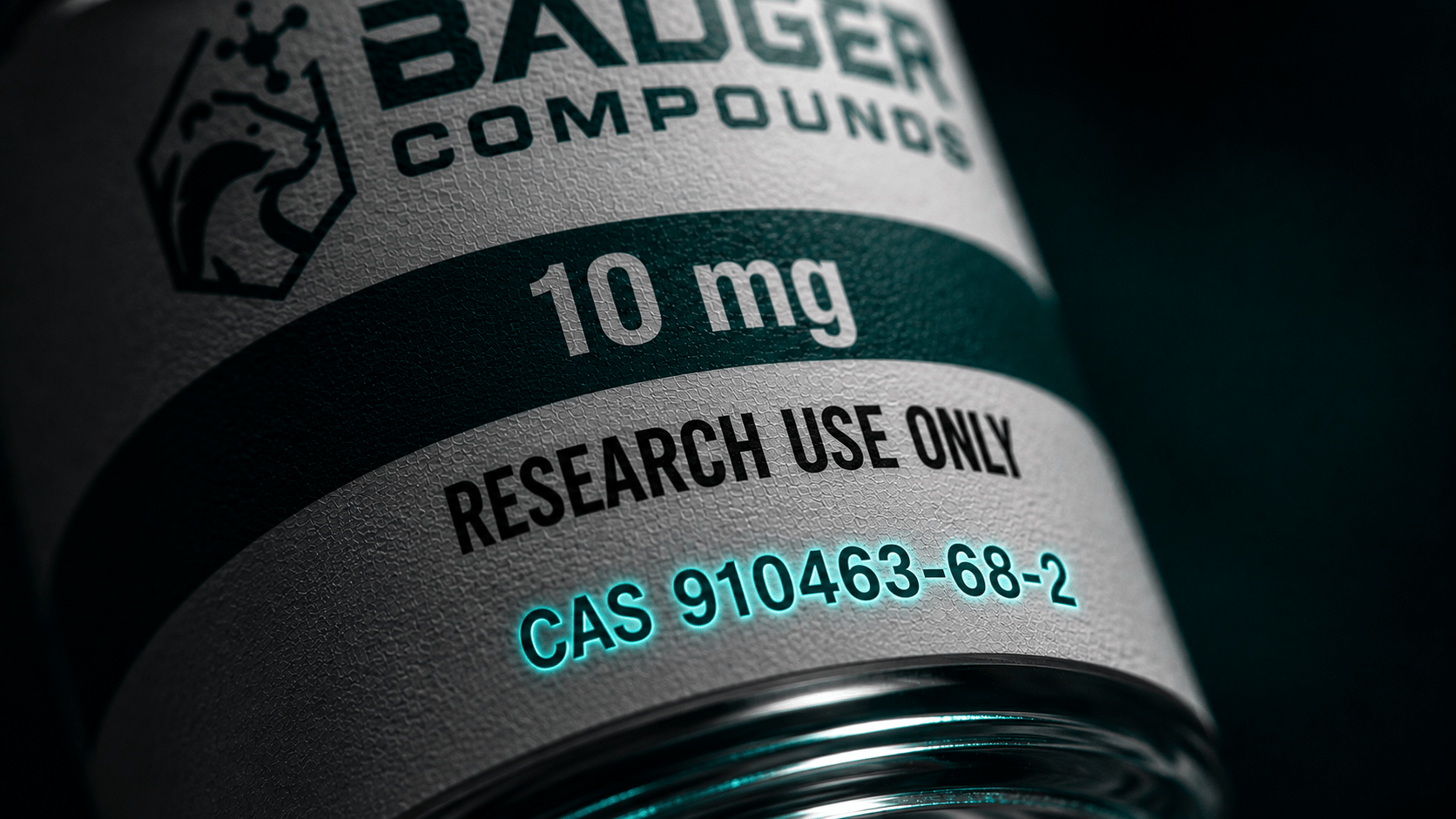
Two examples from our own catalog illustrate the format: semaglutide is registered as CAS 910463-68-2, and tirzepatide is registered as CAS 2023788-19-2. Both follow the same three-part structure, just with different numbers of digits in the first segment.
What a CAS Number Does Not Tell You
This is the detail most often misunderstood: a CAS number carries no chemical information on its own. Numbers are assigned sequentially as substances are registered, not according to structure, molecular weight, or chemical family. Unlike systematic naming systems such as IUPAC nomenclature, or structure-encoding formats such as SMILES or InChI strings, a CAS number cannot be decoded to reveal anything about the substance it refers to [1].
In other words, a CAS number tells you that two documents are talking about the exact same substance. It does not, by itself, tell you what that substance is made of, how pure a given batch is, or what its structure looks like. Those are separate questions answered by separate documentation, which is exactly why a CAS number is only one field on a spec sheet rather than the whole of it. For how identity is verified more completely, see our guide on how to read a Certificate of Analysis.
A CAS number answers one question: is this the same substance as that one? It does not answer whether the substance is pure, what it looks like structurally, or anything about its biological activity. Treat it as a precise label, not a quality claim.
Why CAS Numbers Matter in Regulatory and Research Documentation
Because a CAS number resolves naming ambiguity so reliably, it has become the standard identifier referenced across regulatory frameworks and quality documentation. In the United States, it appears in EPA chemical inventories; internationally, frameworks such as REACH in the European Union and the Globally Harmonized System (GHS) rely on it for substance identification. Pharmacopeial standards including the United States Pharmacopeia reference CAS numbers in their monographs specifically to keep substance identity consistent across sources [1].
In practice, this is why a CAS number sits on a research compound’s spec sheet alongside its purity figure and molecular weight. The CAS number confirms which substance you are looking at; the purity and identity testing confirm what is actually in the vial. Both are necessary, and neither substitutes for the other.
CAS Number vs Other Identifiers
A CAS number is one of several identifiers a compound can carry, and each answers a different question.
| Identifier | What it identifies | Encodes structure? |
|---|---|---|
| CAS Number | A specific registered substance | No, purely a sequential registry number |
| IUPAC Name | A substance, via systematic nomenclature rules | Yes, the name itself describes structure |
| Molecular Formula | Atomic composition only | Partially; shared by many different structures |
| Research or Developer Code | A compound as named by its discoverer | No, an informal internal label |
Research peptide names often add a further layer, since many compounds are known primarily by an informal developer code or acronym rather than a formal name. For how those research names come about, see our overview of peptide nomenclature.
Research Concepts Related to CAS Numbers
Understanding CAS numbers connects to a few related documentation and identification concepts:
Chemical Abstracts Service registry Substance identity verification IUPAC nomenclature Pharmacopeial monographs Regulatory substance tracking Spec sheet documentationDocumented, Verified Research Compounds – ≥99% (HPLC)
Every product page in our catalog lists the correct CAS number alongside full specifications, six-round independent testing, and a publicly viewable COA. For qualified laboratory research use only.
Browse the Catalog- Chemical Abstracts Service (CAS), a division of the American Chemical Society. CAS Registry: the gold standard for chemical substance information. CAS official registry page
Disclaimer: This article is for informational and educational purposes only. Products and compounds discussed are intended for research use only and are not for human consumption, veterinary use, clinical use, diagnostic use, food use, supplement use, pharmaceutical use, cosmetic use, or any consumer application. Statements have not been evaluated by the FDA. This content does not provide medical advice, treatment guidance, dosing information, or recommendations for personal use.