No products in the cart.
U.S. FILLED & FINISHED | ≥99% COA-VERIFIED PURITY
LC-MS VERIFIED IDENTITY | INDEPENDENTLY TESTED
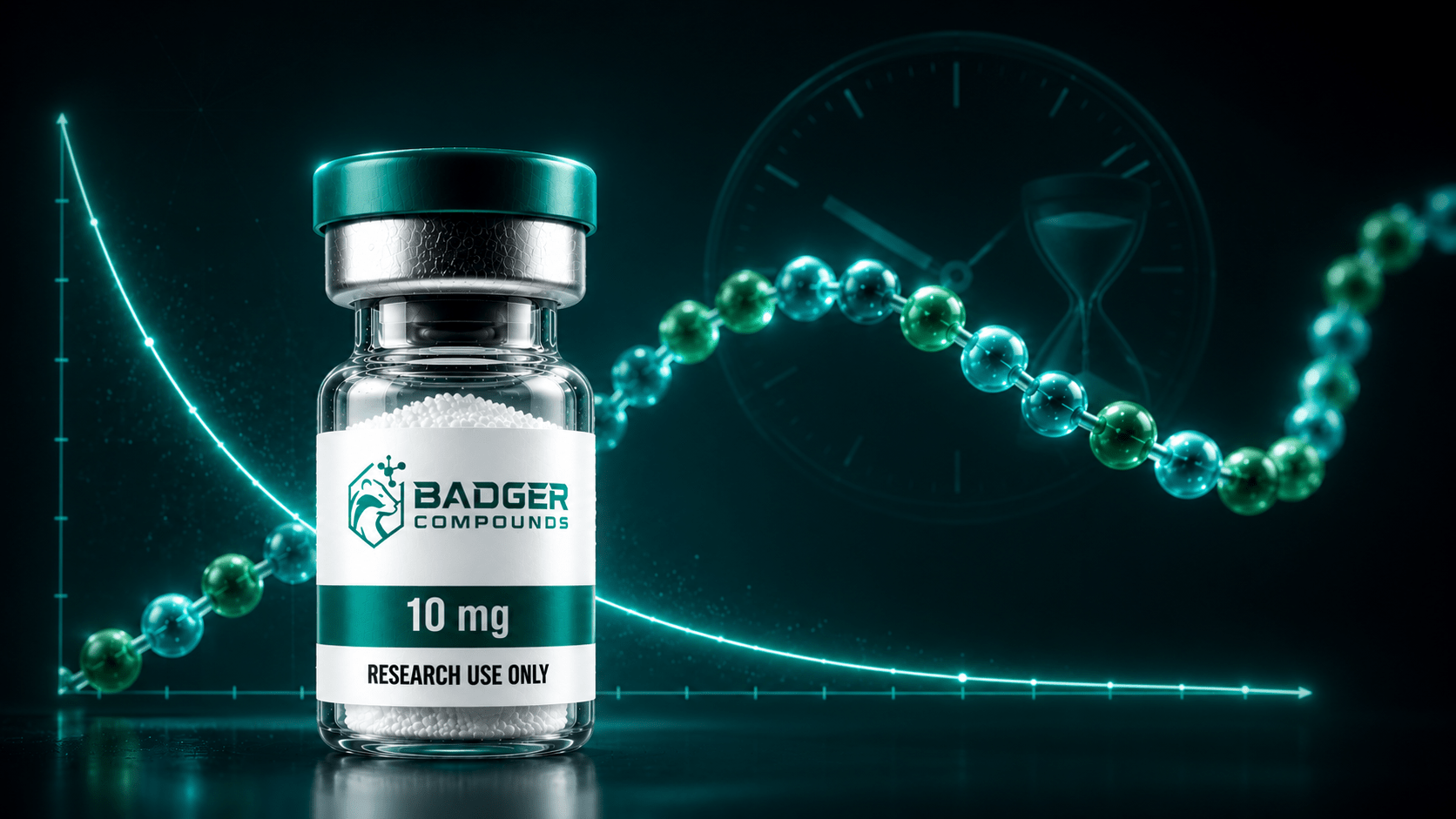
Peptide half-life is one of the most important properties in peptide research, because it determines how long a compound stays active before it is cleared. This overview explains what half-life means, why unmodified peptides break down in minutes, and how modifications such as lipidation, albumin binding, PEGylation, and enzyme resistance are used to make research peptides last far longer.
What Is Peptide Half-Life, and Why Are Peptides Modified to Last Longer?
Peptide half-life is one of the most important properties in peptide research, because it determines how long a compound stays active before it is cleared. This overview explains what half-life means, why unmodified peptides break down in minutes, and how modifications such as lipidation, albumin binding, PEGylation, and enzyme resistance are used to make research peptides last far longer.
What Is Peptide Half-Life?
In pharmacology, half-life is the time it takes for the concentration of a compound in the blood to fall to half of its starting value. It is usually written as t½. A short half-life means the molecule is cleared quickly; a long half-life means it persists. For peptides, half-life is the property that most directly shapes how long a research effect can be observed and how often a compound would need to be administered in a study.
This single number connects chemistry to behavior. Two peptides can act on the same receptor, yet one may be gone in minutes while the other circulates for days, entirely because of how each resists the body’s clearance systems [1].
Research framing: This article discusses pharmacokinetic concepts in an educational, research context only. Compounds referenced are supplied by Badger Compounds for laboratory research use only and are not intended for human or veterinary use. Nothing here is medical advice or dosing guidance.
Why Unmodified Peptides Clear So Fast
Natural peptides are built to be transient signals, not long-lasting drugs. In their unmodified form, most have very short half-lives, often only minutes, because the body has two efficient ways of removing them [2].
Proteolysis
Enzymes throughout the blood and tissues cleave peptide bonds. Specific enzymes such as DPP-4 rapidly inactivate certain peptides at defined sites.
Renal Clearance
Because peptides are small, the kidneys filter them out of circulation quickly, a major route of elimination for low-molecular-weight molecules.
Small Size
The same compact size that lets peptides reach their targets also makes them easy to filter and degrade, working against long circulation.
A well-documented example is native glucagon-like peptide-1 (GLP-1). In its natural form it is cleaved by the enzyme DPP-4 and has a circulating half-life of only about two minutes, far too short to be useful without modification [3]. This is the problem that half-life engineering exists to solve.
How Peptide Half-Life Is Extended
Researchers extend peptide half-life by defeating the two clearance routes above: shielding the molecule from enzymes and making it too large or too tightly bound to be filtered quickly. Several strategies do this, often in combination [1].
| Strategy | How it extends half-life | Example |
|---|---|---|
| Albumin binding (lipidation) | A fatty acid chain is attached so the peptide binds serum albumin, a long-lived blood protein, and rides along with it | Liraglutide, semaglutide |
| PEGylation | Polyethylene glycol chains increase the molecule’s size and shield it from enzymes, slowing renal clearance and proteolysis | Various pegylated therapeutics |
| Backbone modification | Non-natural amino acids at cleavage sites make the peptide resistant to enzymes such as DPP-4 | Aib substitution in semaglutide |
| Fusion and size increase | Fusing to a larger partner raises the effective size above the kidney’s filtration threshold | Fc and albumin fusion constructs |
PEGylation illustrates the size principle directly: by increasing molecular mass and shielding the peptide from proteolytic enzymes, it improves pharmacokinetics and lengthens circulation time [2]. Albumin binding illustrates the piggyback principle: work using site-specific albumin conjugation has produced GLP-1 variants with substantially extended half-lives compared with the unconjugated peptide [4].
A Concrete Example: From Two Minutes to Once Weekly
The GLP-1 line is the clearest illustration of half-life engineering in action. Native GLP-1 lasts about two minutes. Liraglutide added a fatty acid chain to bind albumin, extending action enough for once-daily use. Semaglutide then went further, combining stronger albumin affinity with a backbone amino acid substitution that blocks DPP-4 cleavage, producing a compound stable enough for a once-weekly profile [3]. The receptor target barely changed; what changed was survival in circulation.
The same logic explains other compounds. For how the growth hormone secretagogue CJC-1295 changes dramatically depending on whether it carries the albumin-binding drug affinity complex, see our post on CJC-1295 and peptide half-life, and for the wider metabolic landscape shaped by these design choices, see our overview of the evolution of GLP-1 research compounds.
Half-life is not a fixed property of a peptide; it is engineered. The same sequence can last minutes or days depending on how it is protected from enzymes and filtration. That engineering is why most modern research peptides exist in the form they do.
Why Half-Life Matters Across the Catalog
Once you understand half-life, a lot of the research peptide landscape makes more sense. Many of the compounds studied today are the direct result of extending a short-lived natural peptide into something with a usable duration of action. The amylin analog cagrilintide, for example, was built as a long-acting molecule using the same albumin-binding approach; see our overview of cagrilintide research. Recognizing the strategy behind a compound helps frame what a given experiment is actually testing.
Duration of Action
Half-life sets how long a research effect persists and how frequently a compound would be administered in a study design.
Design Intent
Whether a peptide is short-acting or long-acting is usually a deliberate design choice, not an accident of the sequence.
Comparability
Comparing two related compounds often comes down to comparing their half-life engineering as much as their targets.
Research Concepts Related to Peptide Half-Life
Peptide half-life connects to a cluster of pharmacokinetic concepts studied across the literature:
Proteolytic degradation DPP-4 resistance Renal clearance Albumin binding Fatty acid acylation (lipidation) PEGylation Terminal half-life (t½) Duration of actionExplore Research-Grade Peptides – ≥99% (HPLC)
Every compound in our catalog is synthesized domestically, six-round independently tested per batch, and supported by publicly viewable COAs. For qualified laboratory research use only.
Browse the Catalog- Fosgerau K, Hoffmann T. Peptide therapeutics: current status and future directions. Drug Discov Today. 2015;20(1):122-128. PMID 25450771
- Harris JM, Chess RB. Effect of pegylation on pharmaceuticals. Nat Rev Drug Discov. 2003;2(3):214-221. PMID 12612647
- Lau J, Bloch P, Schäffer L, et al. Discovery of the once-weekly glucagon-like peptide-1 (GLP-1) analogue semaglutide. J Med Chem. 2015;58(18):7370-7380. PMID 26308095
- Bak M, Park J, Min K, et al. Recombinant peptide production platform coupled with site-specific albumin conjugation enables a convenient production of long-acting therapeutic peptide. Pharmaceutics. 2020;12(4):364. PMID 32316169
Disclaimer: This article is for informational and educational purposes only. Products and compounds discussed are intended for research use only and are not for human consumption, veterinary use, clinical use, diagnostic use, food use, supplement use, pharmaceutical use, cosmetic use, or any consumer application. Statements have not been evaluated by the FDA. This content does not provide medical advice, treatment guidance, dosing information, or recommendations for personal use.