No products in the cart.
U.S. FILLED & FINISHED | ≥99% COA-VERIFIED PURITY
LC-MS VERIFIED IDENTITY | INDEPENDENTLY TESTED
Vasoactive intestinal peptide research spans an unusually broad set of biological systems for a single 28-amino-acid neuropeptide, reaching across the gastrointestinal tract, the airways, the immune system, and the brain, where investigations through its VPAC1 and VPAC2 receptors range from immune modulation to circadian timekeeping.
Vasoactive Intestinal Peptide (VIP): A Research Overview
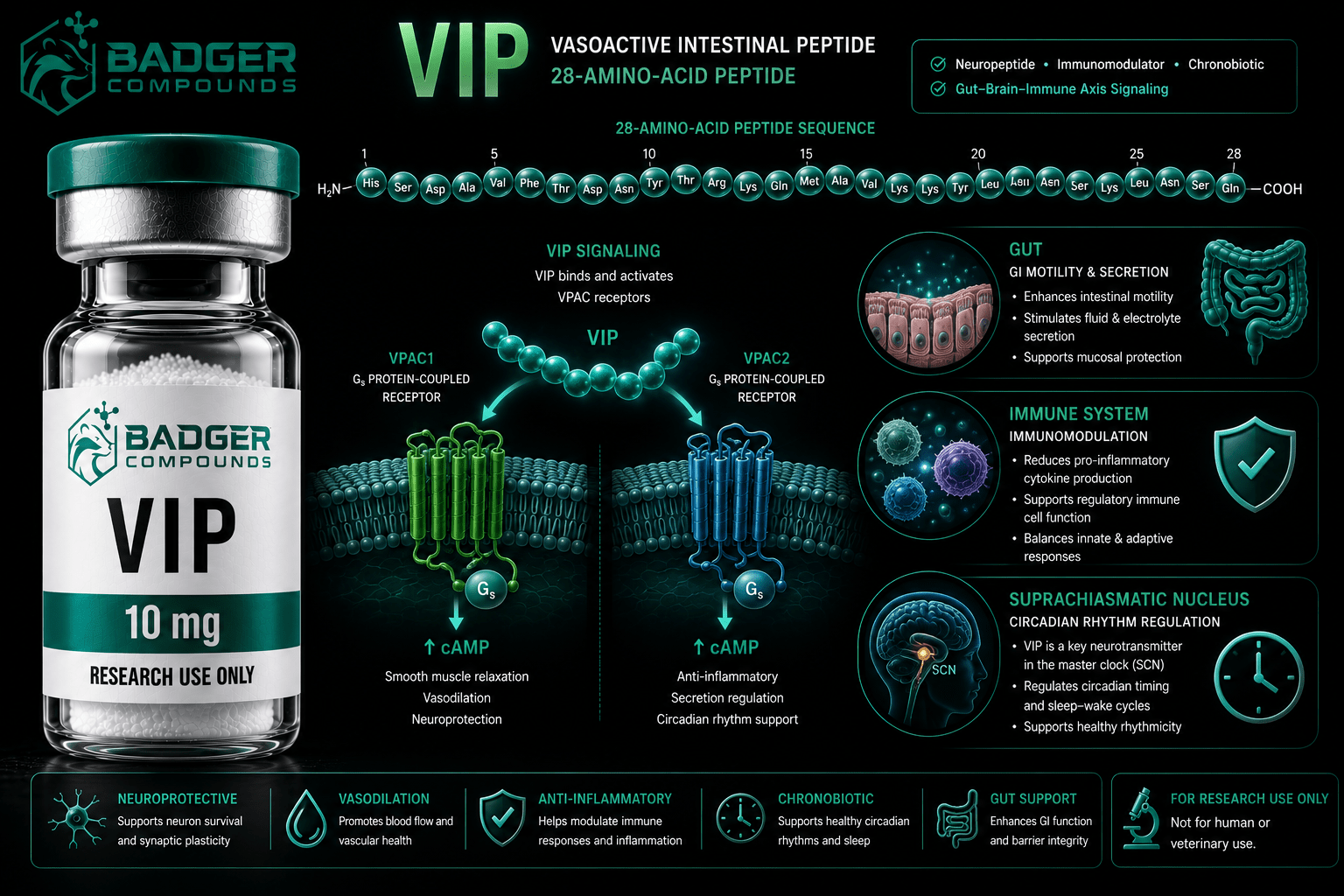
Vasoactive intestinal peptide research spans an unusually broad set of biological systems for a single 28-amino-acid neuropeptide, reaching across the gastrointestinal tract, the airways, the immune system, and the brain. First isolated from gut tissue as a vasodilator, VIP has since been studied through its VPAC1 and VPAC2 receptors in contexts ranging from immune modulation to circadian timekeeping. That breadth makes it a compound of enduring research interest, and it also makes the evidence easy to overstate.
What Is VIP? Structure and Receptors
VIP is a 28-amino-acid peptide belonging to the secretin and glucagon superfamily, which also includes secretin, glucagon, the glucagon-like peptides, and PACAP (pituitary adenylate cyclase-activating polypeptide). It was originally described in 1970 as a peripheral and splanchnic vasodilator, and its biology was mapped progressively over the following decades.
VIP signals through two class B G protein-coupled receptors, VPAC1 and VPAC2. Both respond to VIP and to the closely related PACAP with high affinity, and both generally raise intracellular cyclic AMP when activated. A third related receptor, PAC1, is selective for PACAP. VPAC1 is broadly expressed across the central nervous system and peripheral tissues including lung, liver, and intestine, while VPAC2 has a distribution that includes immune tissue and the master circadian clock [1].
Where VIP Acts: A Broad Distribution
The signature feature of VIP is how many systems it touches. In research models it has been described across the following contexts:
| System | Reported research roles |
|---|---|
| Gastrointestinal | Smooth muscle relaxation, water and electrolyte secretion, blood vessel dilation, modulation of gut motility |
| Respiratory | Airway smooth muscle relaxation and bronchodilation, effects on surfactant-related pathways in preclinical work |
| Immune | Broad immunomodulatory and anti-inflammatory activity, characterized largely in preclinical models |
| Central nervous system | Signaling in the suprachiasmatic nucleus, the mammalian circadian pacemaker |
Research framing: All findings referenced in this post derive from preclinical and clinical research conducted by third parties. VIP is supplied by Badger Compounds for laboratory research use only and is not intended for human or veterinary use. No therapeutic conclusions should be drawn from the research discussed here.
VIP in Immune Research
One of the most studied dimensions of VIP is its role as an immunomodulator. Across preclinical work it has been characterized as an anti-inflammatory mediator that can dampen activation of macrophages and dendritic cells and shift responses toward regulatory and Th2 patterns. It has been examined in a range of inflammatory and autoimmune research models, and this body of work is the basis for describing VIP as a pleiotropic immune signaling molecule rather than a simple gut hormone [2].
An important caveat runs through this literature: the great majority of the immune findings come from cell and animal models. They describe mechanisms and research signals, not established outcomes in people.
VIP and the Circadian Clock
A distinctive and well-supported role for VIP lies in timekeeping. The suprachiasmatic nucleus of the hypothalamus, a small paired structure of roughly 20,000 neurons, functions as the central circadian clock in mammals. VIP and its receptor VPAC2 are concentrated in this circuit, where they help synchronize individual cellular oscillators into a single coherent rhythm. Research using intersectional genetics and live imaging has identified the VIP to VPAC2 axis as a pacemaking hub that sets the period and phase of the whole network, which is why VIP is often described as essential to robust circadian function [3].
VIP in Metabolic Research
Because VIP and its receptors belong to the same secretin and glucagon superfamily as the incretins, there is research interest in its metabolic signaling. Work in this area has examined VPAC2 in the context of insulin secretion and glucose handling, positioning VIP and VPAC2 as a potential research target within type 2 diabetes models [4]. This remains an investigational research direction rather than an established application.
Clinical Investigation: The Aviptadil Evidence Picture
The synthetic form of VIP, known as aviptadil, has been carried into human trials, most prominently for acute respiratory failure. This is where an honest reading of the evidence matters, because the clinical record is more sobering than many summaries imply.
An early randomized, placebo-controlled trial in patients with critical COVID-19 respiratory failure did not meet its primary endpoint, although it reported a signal toward improved survival at day 60 in a secondary analysis [5]. That signal drew considerable attention. It was then tested in a much larger, definitive randomized trial, TESICO, part of the NIH ACTIV program. In that trial intravenous aviptadil did not improve the primary recovery endpoint, did not improve mortality, and did not improve any other measured endpoint compared with placebo [6]. Aviptadil is not an approved therapy, and research-grade VIP is unapproved material for research use only.
VIP has a large and genuinely interesting preclinical literature, especially in immunology and circadian biology, but its clinical translation is limited and its best-powered trial to date was negative. Some claims circulating about VIP, including certain intranasal protocols, rest on limited or single-source evidence and should be treated with caution. VIP is supplied by Badger Compounds for research use only.
Interpreting the VIP Research Landscape
VIP is a compelling research subject precisely because it sits at the intersection of so many systems, gut, lung, immune, and brain, all through a compact 28-amino-acid sequence and a shared VPAC receptor system. The strongest and most reproducible research signals are in receptor pharmacology, immune modulation, and circadian biology. The clinical picture is narrower and, in its largest test to date, negative. VIP also has a very short circulating half-life, which is itself a significant constraint on how it can be studied. Holding both the breadth of the preclinical work and the limits of the clinical record at once is the accurate way to understand where VIP research stands.
Strong Preclinical Base
Receptor pharmacology, immune modulation, and circadian biology are the best-supported and most reproducible areas of VIP research.
Limited Clinical Translation
The largest controlled human trial of synthetic VIP, aviptadil, was negative across all endpoints in acute respiratory failure.
A Short Half-Life
VIP clears rapidly from circulation, a practical constraint that shapes how it can be delivered and studied.
Related Research Reading
VIP research overlaps with several gut, immune, and neurological peptide topics covered in our research library:
KPV Peptide: Anti-Inflammatory Research · Thymosin Alpha-1: Immune Modulation Research · Semax and Selank: Neurological Research
Research Pathways Associated with VIP
Preclinical and clinical literature has examined this neuropeptide and its research context across several interconnected themes:
VPAC1 and VPAC2 receptor signaling cAMP second messenger pathways Immunomodulation and anti-inflammation Circadian pacemaking (SCN) Airway smooth muscle relaxation Gut motility and secretion VPAC2 and metabolic signaling PACAP-related neuropeptide biologyResearch Compounds – Research Grade, ≥99% (HPLC)
Every compound in our catalog is six-round independently tested per batch with publicly viewable COAs. For qualified laboratory research use only.
Browse the Catalog- Delgado M, Pozo D, Ganea D. The significance of vasoactive intestinal peptide in immunomodulation. Pharmacol Rev. 2004;56(2):249-290. PMID 15169929
- Harmar AJ, Fahrenkrug J, Gozes I, et al. Pharmacology and functions of receptors for vasoactive intestinal peptide and pituitary adenylate cyclase-activating polypeptide: IUPHAR Review 1. Br J Pharmacol. 2012;166(1):4-17. PMID 22289055
- Patton AP, Edwards MD, Smyllie NJ, et al. The VIP-VPAC2 neuropeptidergic axis is a cellular pacemaking hub of the suprachiasmatic nucleus circadian circuit. Nat Commun. 2020;11(1):3394. PMID 32636383
- Hou X, Yang D, Yang G, et al. Therapeutic potential of vasoactive intestinal peptide and its receptor VPAC2 in type 2 diabetes. Front Endocrinol (Lausanne). 2022;13:984198. PMID 36204104
- Youssef JG, Lavin P, Schoenfeld DA, et al. The use of IV vasoactive intestinal peptide (aviptadil) in patients with critical COVID-19 respiratory failure: results of a 60-day randomized controlled trial. Crit Care Med. 2022;50(11):1545-1554. PMID 36044317
- Brown SM, Barkauskas CE, Grund B, et al. Intravenous aviptadil and remdesivir for treatment of COVID-19-associated hypoxaemic respiratory failure in the USA (TESICO): a randomised, placebo-controlled trial. Lancet Respir Med. 2023;11(9):791-803. PMID 37348524
Disclaimer: VIP is supplied by Badger Compounds for laboratory and in vitro research use only. It is not intended for human or veterinary use, and no product sold by Badger Compounds is approved for therapeutic, diagnostic, or clinical application. All research findings referenced in this post are derived from preclinical and clinical studies conducted by third parties. No clinical efficacy or safety conclusions should be drawn from the data summarized here.
Vasoactive Intestinal Peptide (VIP): A Research Overview
Vasoactive intestinal peptide research spans an unusually broad set of biological systems for a single 28-amino-acid neuropeptide, reaching across the gastrointestinal tract, the airways, the immune system, and the brain. First isolated from gut tissue as a vasodilator, VIP has since been studied through its VPAC1 and VPAC2 receptors in contexts ranging from immune modulation to circadian timekeeping. That breadth makes it a compound of enduring research interest, and it also makes the evidence easy to overstate.
What Is Vasoactive Intestinal Peptide (VIP)?
VIP is a 28-amino-acid peptide belonging to the secretin and glucagon superfamily, which also includes secretin, glucagon, the glucagon-like peptides, and PACAP (pituitary adenylate cyclase-activating polypeptide). It was originally described in 1970 as a peripheral and splanchnic vasodilator, and its biology was mapped progressively over the following decades.
VIP signals through two class B G protein-coupled receptors, VPAC1 and VPAC2. Both respond to VIP and to the closely related PACAP with high affinity, and both generally raise intracellular cyclic AMP when activated. A third related receptor, PAC1, is selective for PACAP. VPAC1 is broadly expressed across the central nervous system and peripheral tissues including lung, liver, and intestine, while VPAC2 has a distribution that includes immune tissue and the master circadian clock [1].
Where VIP Acts: A Broad Distribution
The signature feature of VIP is how many systems it touches. In research models it has been described across the following contexts:
| System | Reported research roles |
|---|---|
| Gastrointestinal | Smooth muscle relaxation, water and electrolyte secretion, blood vessel dilation, modulation of gut motility |
| Respiratory | Airway smooth muscle relaxation and bronchodilation, effects on surfactant-related pathways in preclinical work |
| Immune | Broad immunomodulatory and anti-inflammatory activity, characterized largely in preclinical models |
| Central nervous system | Signaling in the suprachiasmatic nucleus, the mammalian circadian pacemaker |
Research framing: All findings referenced in this post derive from preclinical and clinical research conducted by third parties. VIP is supplied by Badger Compounds for laboratory research use only and is not intended for human or veterinary use. No therapeutic conclusions should be drawn from the research discussed here.
VIP in Immune Research
One of the most studied dimensions of VIP is its role as an immunomodulator. Across preclinical work it has been characterized as an anti-inflammatory mediator that can dampen activation of macrophages and dendritic cells and shift responses toward regulatory and Th2 patterns. It has been examined in a range of inflammatory and autoimmune research models, and this body of work is the basis for describing VIP as a pleiotropic immune signaling molecule rather than a simple gut hormone [2].
An important caveat runs through this literature: the great majority of the immune findings come from cell and animal models. They describe mechanisms and research signals, not established outcomes in people.
VIP and the Circadian Clock
A distinctive and well-supported role for VIP lies in timekeeping. The suprachiasmatic nucleus of the hypothalamus, a small paired structure of roughly 20,000 neurons, functions as the central circadian clock in mammals. VIP and its receptor VPAC2 are concentrated in this circuit, where they help synchronize individual cellular oscillators into a single coherent rhythm. Research using intersectional genetics and live imaging has identified the VIP to VPAC2 axis as a pacemaking hub that sets the period and phase of the whole network, which is why VIP is often described as essential to robust circadian function [3].
VIP in Metabolic Research
Because VIP and its receptors belong to the same secretin and glucagon superfamily as the incretins, there is research interest in its metabolic signaling. Work in this area has examined VPAC2 in the context of insulin secretion and glucose handling, positioning VIP and VPAC2 as a potential research target within type 2 diabetes models [4]. This remains an investigational research direction rather than an established application.
Clinical Investigation: The Aviptadil Evidence Picture
The synthetic form of VIP, known as aviptadil, has been carried into human trials, most prominently for acute respiratory failure. This is where an honest reading of the evidence matters, because the clinical record is more sobering than many summaries imply.
An early randomized, placebo-controlled trial in patients with critical COVID-19 respiratory failure did not meet its primary endpoint, although it reported a signal toward improved survival at day 60 in a secondary analysis [5]. That signal drew considerable attention. It was then tested in a much larger, definitive randomized trial, TESICO, part of the NIH ACTIV program. In that trial intravenous aviptadil did not improve the primary recovery endpoint, did not improve mortality, and did not improve any other measured endpoint compared with placebo [6]. Aviptadil is not an approved therapy, and research-grade VIP is unapproved material for research use only.
VIP has a large and genuinely interesting preclinical literature, especially in immunology and circadian biology, but its clinical translation is limited and its best-powered trial to date was negative. Some claims circulating about VIP, including certain intranasal protocols, rest on limited or single-source evidence and should be treated with caution. VIP is supplied by Badger Compounds for research use only.
Interpreting the Vasoactive Intestinal Peptide Research Landscape
VIP is a compelling research subject precisely because it sits at the intersection of so many systems, gut, lung, immune, and brain, all through a compact 28-amino-acid sequence and a shared VPAC receptor system. The strongest and most reproducible research signals are in receptor pharmacology, immune modulation, and circadian biology. The clinical picture is narrower and, in its largest test to date, negative. VIP also has a very short circulating half-life, which is itself a significant constraint on how it can be studied. Holding both the breadth of the preclinical work and the limits of the clinical record at once is the accurate way to understand where vasoactive intestinal peptide research stands.
Strong Preclinical Base
Receptor pharmacology, immune modulation, and circadian biology are the best-supported and most reproducible areas of VIP research.
Limited Clinical Translation
The largest controlled human trial of synthetic VIP, aviptadil, was negative across all endpoints in acute respiratory failure.
A Short Half-Life
VIP clears rapidly from circulation, a practical constraint that shapes how it can be delivered and studied.
Related Research Reading
VIP research overlaps with several gut, immune, and neurological peptide topics covered in our research library:
KPV Peptide: Anti-Inflammatory Research · Thymosin Alpha-1: Immune Modulation Research · Semax and Selank: Neurological Research
Research Pathways Associated with VIP
Preclinical and clinical literature has examined this neuropeptide and its research context across several interconnected themes:
VPAC1 and VPAC2 receptor signaling cAMP second messenger pathways Immunomodulation and anti-inflammation Circadian pacemaking (SCN) Airway smooth muscle relaxation Gut motility and secretion VPAC2 and metabolic signaling PACAP-related neuropeptide biologyResearch Compounds – Research Grade, ≥99% (HPLC)
Every compound in our catalog is six-round independently tested per batch with publicly viewable COAs. For qualified laboratory research use only.
Browse the Catalog- Delgado M, Pozo D, Ganea D. The significance of vasoactive intestinal peptide in immunomodulation. Pharmacol Rev. 2004;56(2):249-290. PMID 15169929
- Harmar AJ, Fahrenkrug J, Gozes I, et al. Pharmacology and functions of receptors for vasoactive intestinal peptide and pituitary adenylate cyclase-activating polypeptide: IUPHAR Review 1. Br J Pharmacol. 2012;166(1):4-17. PMID 22289055
- Patton AP, Edwards MD, Smyllie NJ, et al. The VIP-VPAC2 neuropeptidergic axis is a cellular pacemaking hub of the suprachiasmatic nucleus circadian circuit. Nat Commun. 2020;11(1):3394. PMID 32636383
- Hou X, Yang D, Yang G, et al. Therapeutic potential of vasoactive intestinal peptide and its receptor VPAC2 in type 2 diabetes. Front Endocrinol (Lausanne). 2022;13:984198. PMID 36204104
- Youssef JG, Lavin P, Schoenfeld DA, et al. The use of IV vasoactive intestinal peptide (aviptadil) in patients with critical COVID-19 respiratory failure: results of a 60-day randomized controlled trial. Crit Care Med. 2022;50(11):1545-1554. PMID 36044317
- Brown SM, Barkauskas CE, Grund B, et al. Intravenous aviptadil and remdesivir for treatment of COVID-19-associated hypoxaemic respiratory failure in the USA (TESICO): a randomised, placebo-controlled trial. Lancet Respir Med. 2023;11(9):791-803. PMID 37348524
Disclaimer: VIP is supplied by Badger Compounds for laboratory and in vitro research use only. It is not intended for human or veterinary use, and no product sold by Badger Compounds is approved for therapeutic, diagnostic, or clinical application. All research findings referenced in this post are derived from preclinical and clinical studies conducted by third parties. No clinical efficacy or safety conclusions should be drawn from the data summarized here.